Whether you’re buying your first vessel or relocating a boat to the Sunshine State, understanding Florida boat registration requirements is essential before you can legally cruise the Gulf. Florida law requires most motorized watercraft, and even some non-motorized ones, to be registered with the state. Skipping this step can lead to fines and put a serious damper on your time on the water.
At Original Crab Island, we spend every day helping visitors explore Destin’s emerald waters through our rental fleet. But we also know that many guests fall in love with Florida boating and eventually decide to buy their own vessel. That’s exactly why we put together this guide, to help you navigate the process with confidence.
Below, you’ll find a complete breakdown of which boats need registration, the proof of ownership documents you’ll need, current fee structures, and the step-by-step process for filing with your county tax collector. By the end, you’ll have everything you need to get your boat legally registered and ready for the water.
What you need to know before you apply
Florida handles boat registration through your local county tax collector’s office, not through a centralized state agency. This means you’ll visit (or mail documents to) the tax collector in the county where you primarily keep or use your boat. You can’t complete the florida boat registration requirements online in most counties, so plan for an in-person visit or prepare to mail your application.
Who handles your application
Each of Florida’s 67 counties operates independently when processing boat registrations. Your county tax collector will review your paperwork, collect fees, and issue your registration certificate and decal. Some larger counties like Miami-Dade or Hillsborough offer appointments, while smaller counties work on a walk-in basis. Call ahead to confirm office hours and whether you need to schedule a visit.
Florida requires you to register your boat in the county where it’s principally used or stored, not necessarily where you live.
What registration costs
Registration fees depend on your boat’s length, not its value or type. Florida charges a base registration fee that ranges from $5.50 for vessels under 12 feet to $102.50 for boats 40 feet and longer. You’ll also pay a $6.75 title fee if your boat requires titling (most motorized vessels do). Additional charges may include a $2.50 agent fee for processing and any applicable sales tax if you purchased the boat from a private seller or out-of-state dealer.
How long the process takes
Most counties process applications immediately if you bring complete paperwork during your visit. You’ll walk out with your registration certificate and validation decal the same day. Mail-in applications take longer, typically 10 to 15 business days from the date the tax collector receives your documents. Processing times increase during peak boating season from March through June.
Step 1. Confirm if your boat needs a title and registration
Florida law divides watercraft into two categories: those that require registration and those that don’t. Your first task is identifying which category applies to your vessel. Most motorized boats fall under registration requirements, but some non-motorized craft and specific use cases qualify for exemptions. Understanding these distinctions saves you time and ensures you don’t miss a required filing.
Vessels that require registration
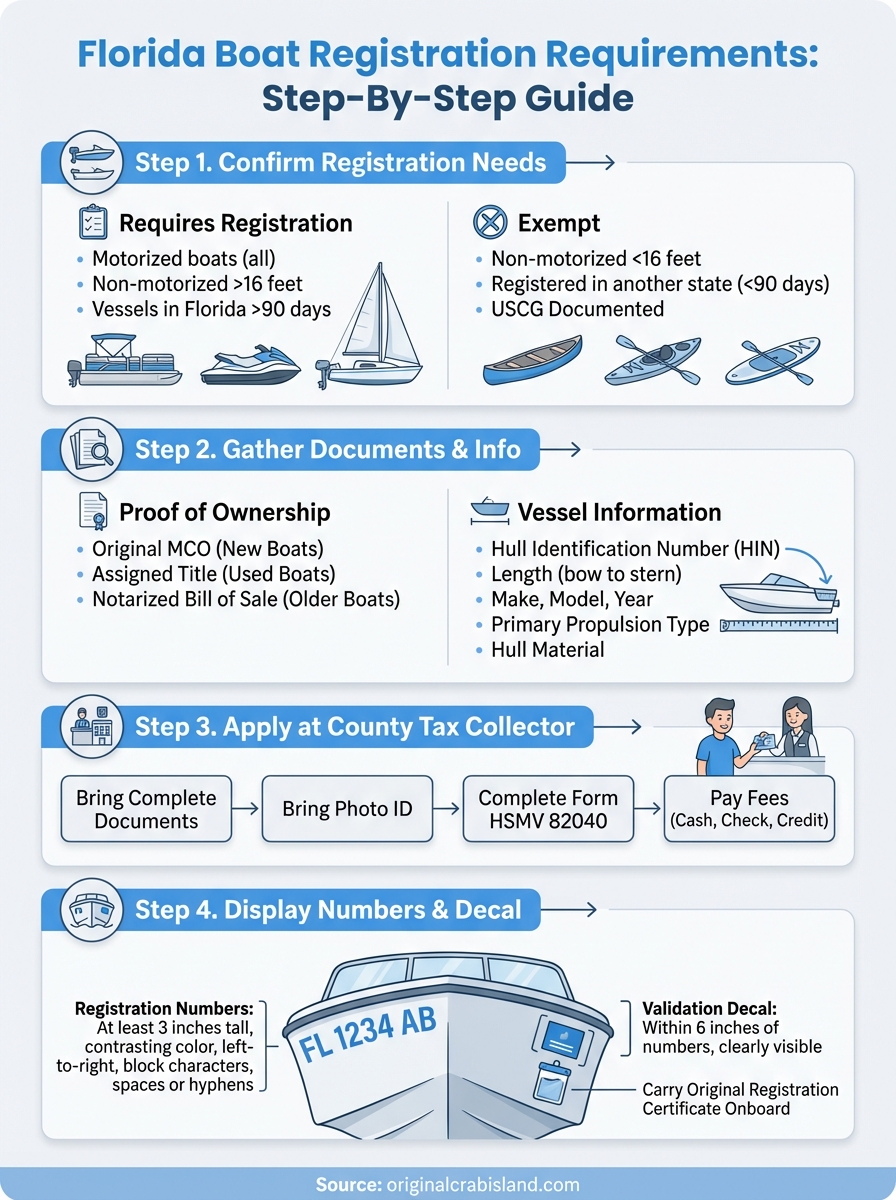
You must register any motorized watercraft operated on Florida public waters, including rivers, lakes, and coastal areas. This applies to boats with inboard engines, outboard motors, or electric trolling motors. Non-motorized vessels longer than 16 feet also need registration if you use them on Florida waters. The florida boat registration requirements apply equally to residents and non-residents who keep their boats in the state for more than 90 consecutive days.
If your boat has any type of motor, even a small electric trolling motor, Florida requires registration.
Registration includes these common vessel types:
- Pontoon boats and deck boats
- Fishing boats with outboard motors
- Personal watercraft (jet skis, wave runners)
- Sailboats over 16 feet with auxiliary motors
Vessels exempt from registration
Non-motorized canoes, kayaks, and paddleboards under 16 feet don’t require registration in Florida. Other exemptions include boats already registered in another state (for the first 90 days), documented vessels with U.S. Coast Guard numbers, and ships’ lifeboats used only in emergencies.
Step 2. Gather the right paperwork and boat details
Before you visit your county tax collector, assemble all required documents and information about your boat. Missing even one piece of paperwork can delay your registration by weeks. The florida boat registration requirements demand specific proof of ownership, along with detailed vessel specifications that match official records. Preparing everything in advance makes your appointment quick and ensures first-time approval.
Proof of ownership documents
You need to prove you legally own the boat through original documents, not photocopies. Acceptable proof includes the Manufacturer’s Certificate of Origin (MCO) for new boats, a properly assigned title from the previous owner for used boats, or a notarized bill of sale if the boat is over 15 years old and has no existing title. Out-of-state titles must show clear transfer signatures and be accompanied by a completed Florida title application form.
Bring original documents to your appointment. Tax collectors won’t accept photocopies or digital screenshots of ownership papers.
Required vessel information
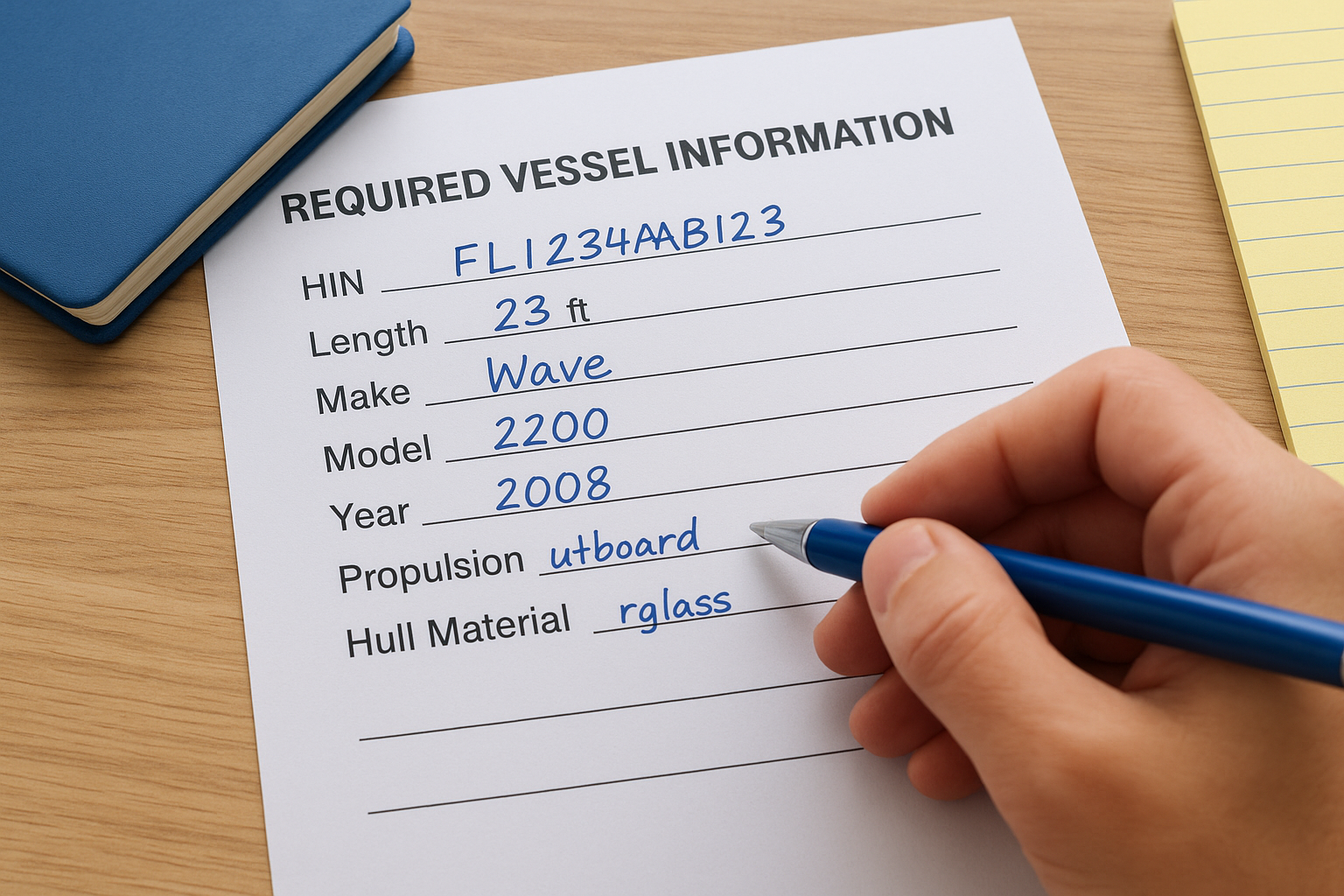
Write down your boat’s hull identification number (HIN) before your visit. This 12-character code appears on the transom’s upper right corner. You also need the exact length measured from bow to stern, the make and model, year of manufacture, primary propulsion type (outboard, inboard, sail), and hull material. Tax collectors verify this information against your ownership documents to complete your registration.
Step 3. Apply through your county tax collector
Once you’ve gathered all documents and vessel information, schedule your visit to the county tax collector’s office where your boat will be primarily used. Most counties accept walk-ins, but calling ahead prevents unnecessary trips if the office has specific appointment requirements. Bring your [driver’s license or state ID](https://originalcrabisland.com/whats-the-minimum-age-license-required-to-drive-a-pontoon-boat-in-destin-florida/) along with all ownership documents and vessel details you compiled in Step 2.
What to bring to your appointment
Pack your complete document folder before leaving home. You need the original proof of ownership (MCO, title, or notarized bill of sale), your government-issued photo ID, and payment for all fees. Tax collectors accept cash, checks, and most major credit cards, though some smaller counties have card processing limitations. If someone else bought the boat for you as a gift, bring a notarized statement explaining the transaction to avoid sales tax questions.
How to complete your application

The tax collector provides Form HSMV 82040, the Application for Certificate of Title and/or Vessel Registration. Fill out all sections completely, including owner information, vessel specifications, and purchase details. Review every line before submitting because errors require resubmission and delay your registration. The clerk verifies your documents match the application, processes your payment, and issues your registration certificate and validation decal immediately.
Most counties complete in-person registrations within 15 minutes if your paperwork is complete and accurate.
Step 4. Display your numbers, decals, and documents
After your county tax collector issues your registration, you need to properly display your registration numbers and decal on your boat before launching. The florida boat registration requirements don’t end with paperwork approval. Florida law specifies exact placement rules for numbers and decals, and you must carry specific documents onboard every time you operate your vessel. Incorrect display can result in citations even if your registration is current.
How to display registration numbers
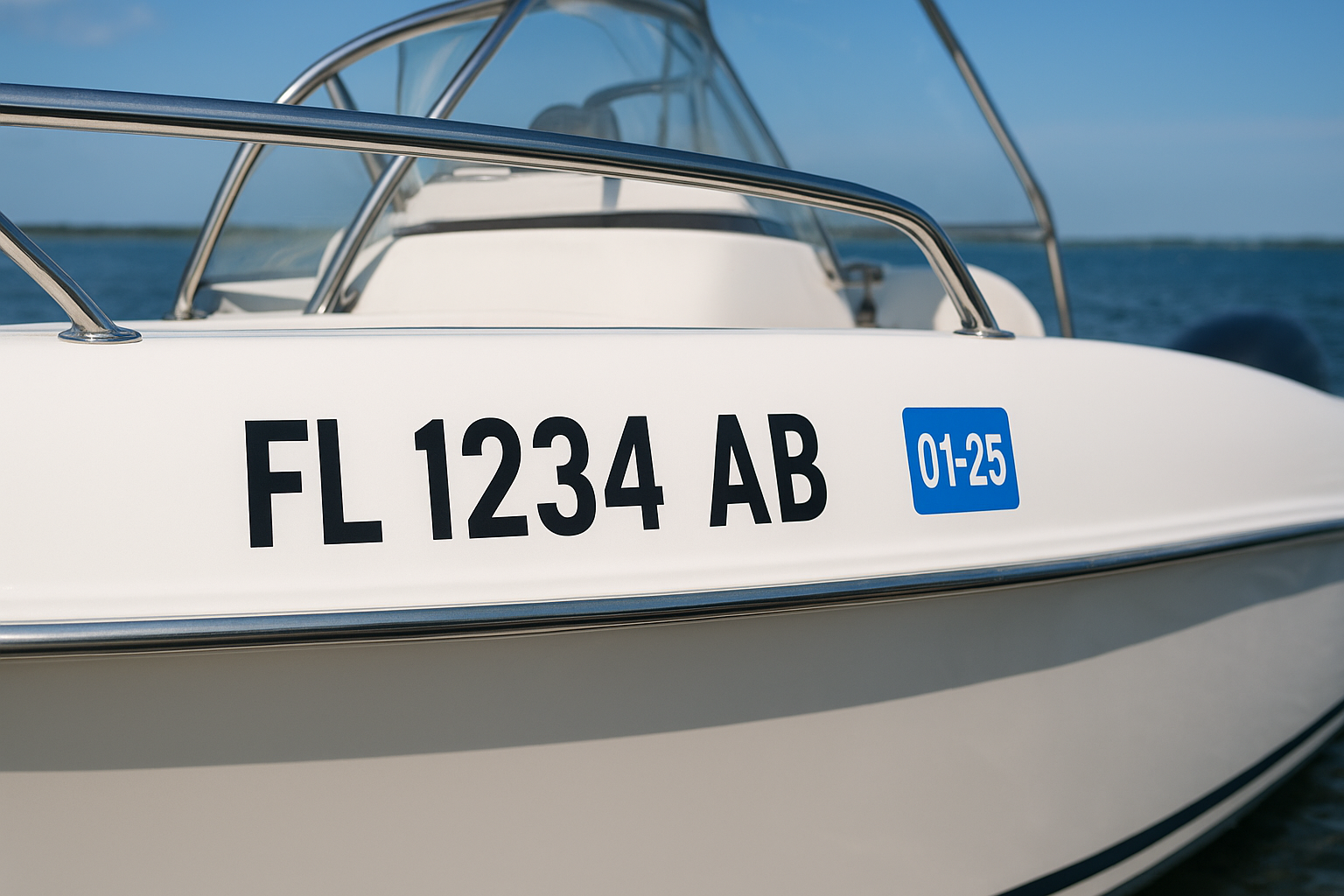
Paint or affix your assigned registration number on both sides of the bow (front) of your boat. Numbers must be at least three inches tall, read from left to right, and use block characters in a color that contrasts sharply with your hull. If your boat is white, use black numbers. Dark-hulled boats need white or light-colored numbers. Leave spaces or hyphens between the letter prefix, number sequence, and suffix exactly as shown on your registration certificate (example: FL 1234 AB).
Where to place your validation decal
Attach your validation decal within six inches of your registration number on each side of the bow. The decal shows your registration expiration date and must remain clearly visible and legible at all times. Replace damaged or faded decals immediately by requesting duplicates from your county tax collector.
Your registration numbers and decals must stay visible and legible. Faded or peeling displays count as violations during safety checks.
Documents to carry onboard
Keep your original registration certificate on the boat whenever you operate it. Store it in a waterproof container or bag to prevent damage from spray and moisture. Law enforcement officers can request to see this certificate during routine safety inspections or traffic stops on the water.
Before you head out on the water
You now have a complete understanding of the florida boat registration requirements, from gathering ownership documents to displaying your registration numbers correctly. The entire process takes minimal time when you arrive prepared with proper paperwork and accurate vessel information. Most boat owners complete their registration in a single visit to their county tax collector’s office and leave with everything needed to operate legally.
Florida’s waters offer incredible opportunities for exploration, fishing, and relaxation once your registration is complete. While you’re getting your own boat registered and ready for launch, consider experiencing what makes Destin special aboard one of our professionally maintained vessels. Rent a pontoon boat at Crab Island and discover why thousands of visitors return year after year to enjoy the emerald waters, shallow sandbars, and unmatched atmosphere that defines this destination. You’ll understand exactly why so many people decide to buy their own boats after experiencing everything this area offers.
Popular Crab Island Pages
- Crab Island Pontoon Rentals
- Crab Island Fishing Charters
- Crab Island Boat and Yacht Rentals
- Crab Island Parasailing
- Crab Island Jet Ski Rentals
- Crab Island Helicopter Rides
- Crab Island Snorkeling Tours
- Crab Island Paddleboard Rentals
- Crab Island Kayak Rentals
- Crab Island Bike Rentals
- Crab Island Shark Boat
- Crab Island Pirate Ship
- Crab Island Tiki Rentals
- Crab Island Snorkeling Tours


