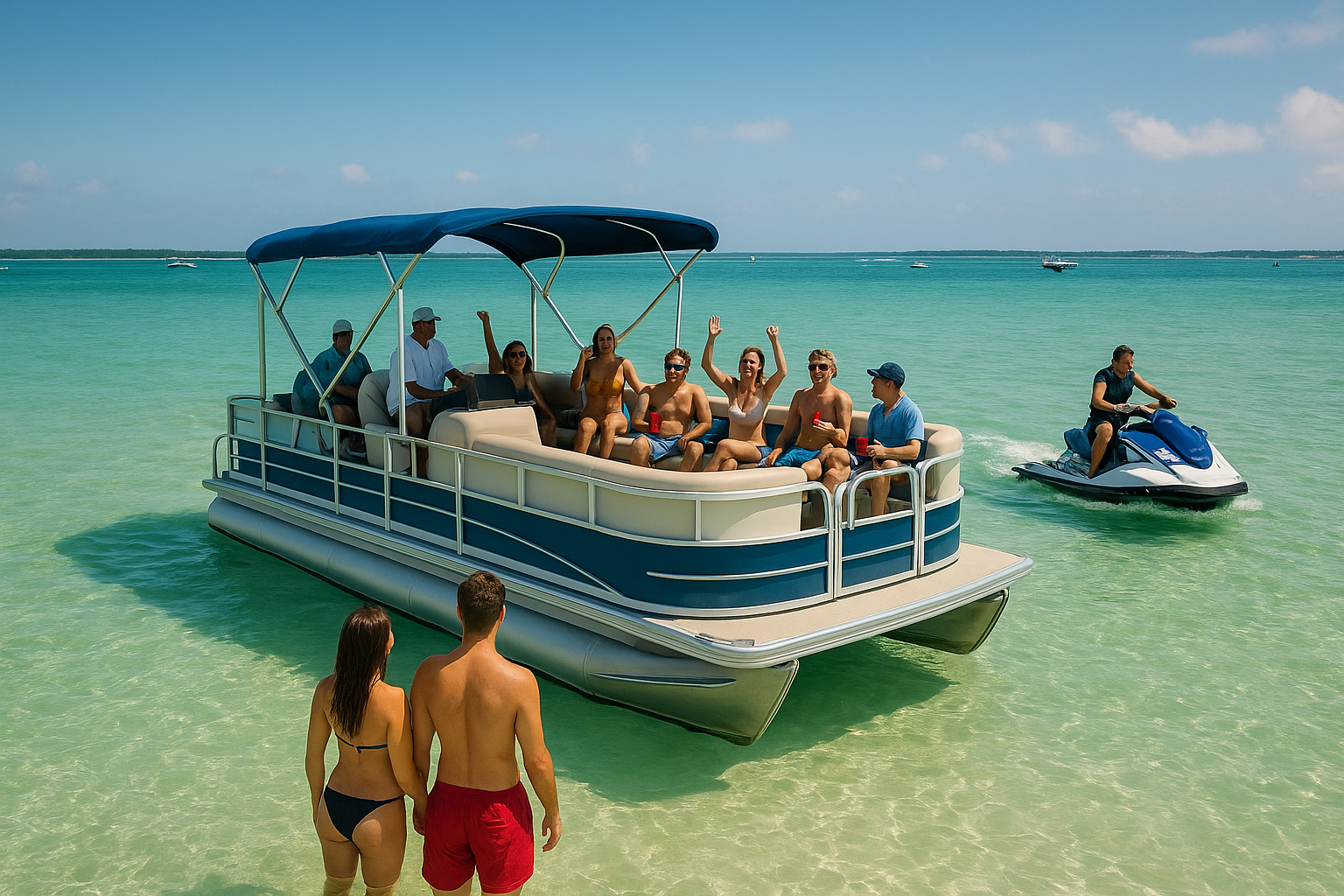
Crab Island looks like paradise, until you’re stuck floating under the Florida sun with no water, no sunscreen, and no cash for the taco boat. Knowing what to bring to Crab Island can make or break your day on this famous Destin sandbar.
We’re Original Crab Island, and we’ve helped thousands of visitors get out to Crab Island by pontoon boat, jet ski, and more. After years of watching people show up unprepared (and sunburned by noon), we put together this list of the five things you absolutely need to pack. Whether you’re heading out with family or planning a group trip with friends, these essentials cover sun protection, food and drinks, payment options for floating vendors, safety gear, and the extras most people forget.
Here’s what to throw in your bag before you leave the dock.
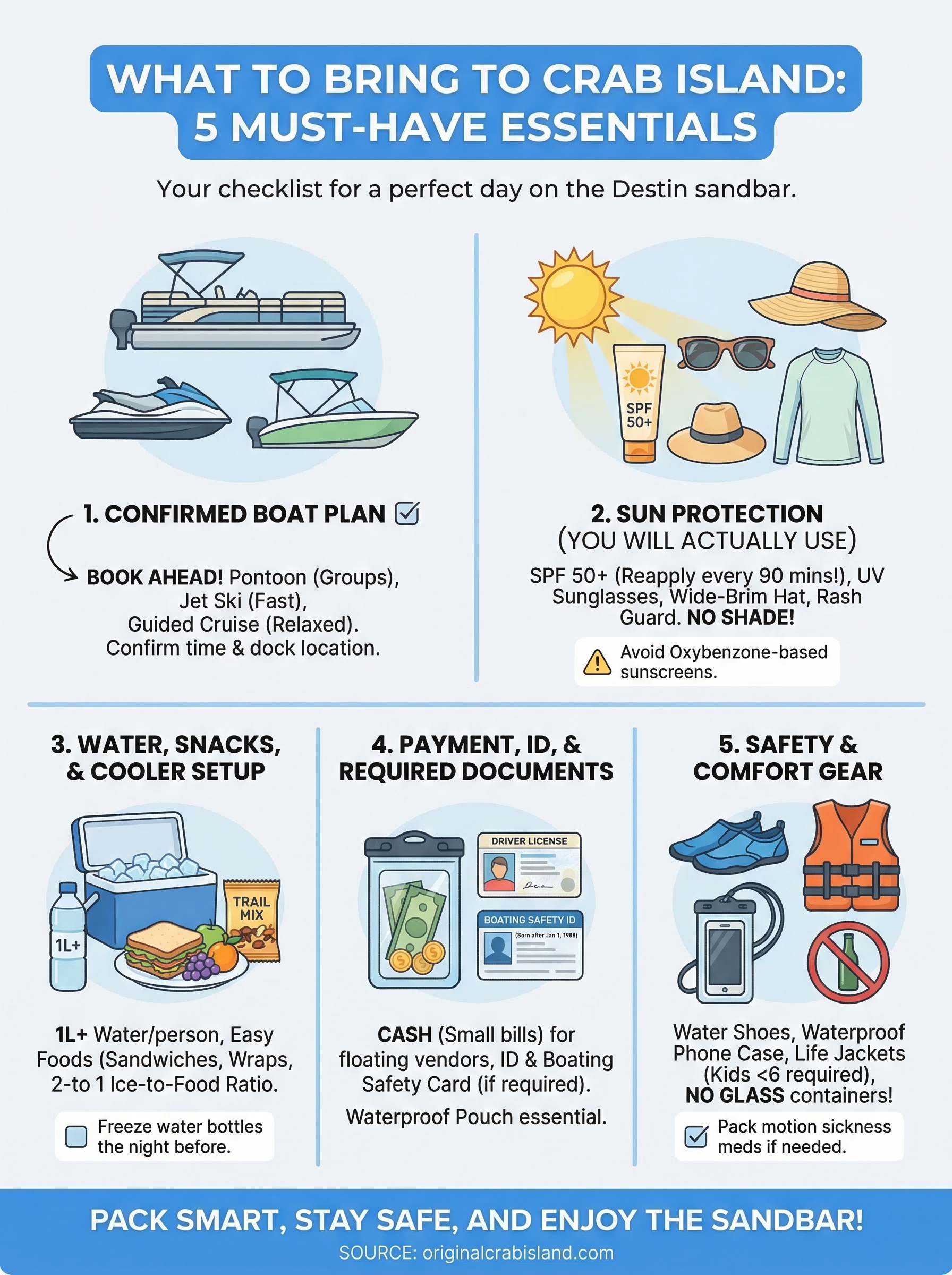
1. A confirmed boat plan to get there
You can’t just walk to Crab Island. It sits in the middle of Destin Harbor, and your only way out is by water. Before you pack a single item on your list of what to bring to Crab Island, you need a solid transportation plan confirmed well in advance.
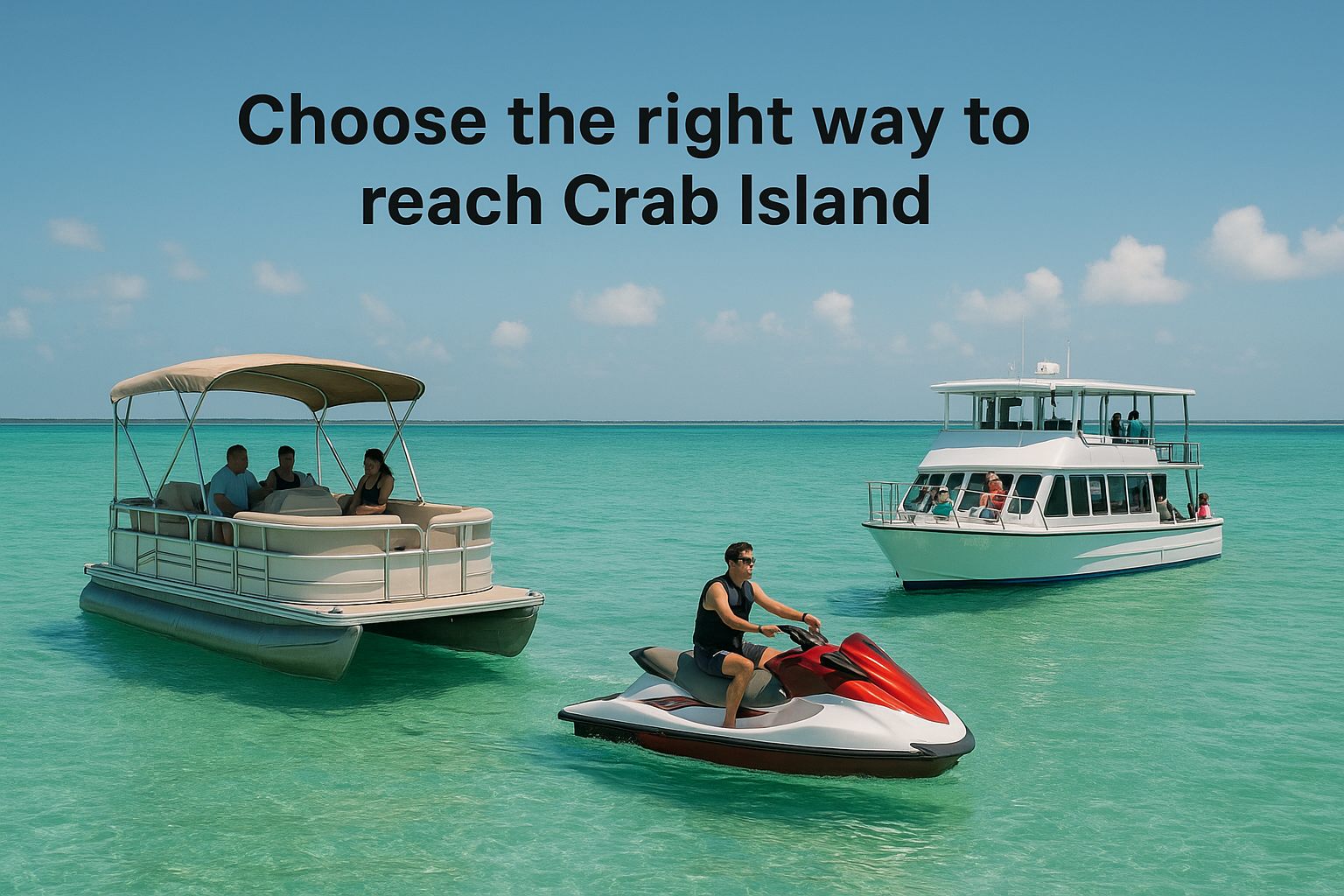
Choose the right way to reach Crab Island
Your main options for getting out to Crab Island include pontoon boats, jet skis, and guided cruises. Each works for a different type of trip:
Pontoon boat: Best for groups, families, and anyone bringing a cooler and gear
Jet ski: Fast and fun, but limits what you can carry
Guided cruise: Good option if you want someone else to handle navigation and anchoring
What to confirm before you leave the dock
Once you pick your watercraft, confirm your departure time and exact dock location the day before your trip. You should also check weather conditions the morning of your visit, since Gulf Coast thunderstorms can roll in fast during afternoon hours and end your day early.
Save your rental company’s phone number before you leave your accommodation so you can handle last-minute changes without scrambling on the day.
Your rental window matters too. Most anchored days at the sandbar run three to four hours, so factor in travel time from the dock when you book your slot.
How Original Crab Island can simplify the day
Original Crab Island handles the logistics so you can focus on the water. You can book a pontoon, jet ski, or guided trip directly through the site, with straightforward pricing and available time slots. The team also points you toward the best spots to anchor and helps you make the most of your time on the sandbar.
2. Sun protection you will actually use
When you think about what to bring to Crab Island, sun protection is the item most people underpack. The sandbar sits completely in the open with zero shade, and the water reflects UV rays back up at you from below. Sun exposure here hits harder than a regular beach day, so proper protection needs to be near the top of your list.
What to pack for full sun on the water
Start with a broad-spectrum SPF 50 sunscreen and apply it at least 20 minutes before you get on the water. You also want to pack:
UV-blocking sunglasses rated for 100% UVA/UVB
A wide-brim hat that won’t blow off in the wind
A rash guard or lightweight long-sleeve shirt for extended time on the sandbar
How to reapply and avoid common mistakes
Most people apply sunscreen once in the morning and consider it handled. You need to reapply every 90 minutes, especially after going in the water. Pack more bottles than you expect to use since one small tube won’t last a full group through the afternoon.
Set a phone timer to remind you to reapply so the fun doesn’t distract you from staying protected.
What to skip to protect the boat and your skin
Skip oxybenzone-based sunscreens since they can stain boat surfaces and harm the local marine environment. Mineral sunscreens with zinc oxide protect you just as well and are a cleaner choice for everyone on the water.
3. Water, snacks, and a cooler setup
Food and drinks are the one category where people consistently underestimate how much they need. The floating vendors out at Crab Island are fun, but their prices reflect the location. Packing your own supplies keeps your group fed and hydrated without burning through your vacation budget before lunch.
What to pack to stay hydrated all day
Bring at least one liter of water per person for a half-day trip, and double that if you have kids or plan to stay through the afternoon. The heat and sun exposure on the sandbar deplete you faster than you expect.
Freeze half your water bottles the night before so they double as ice and stay cold for hours without taking up cooler space.
Easy food ideas that work on a boat
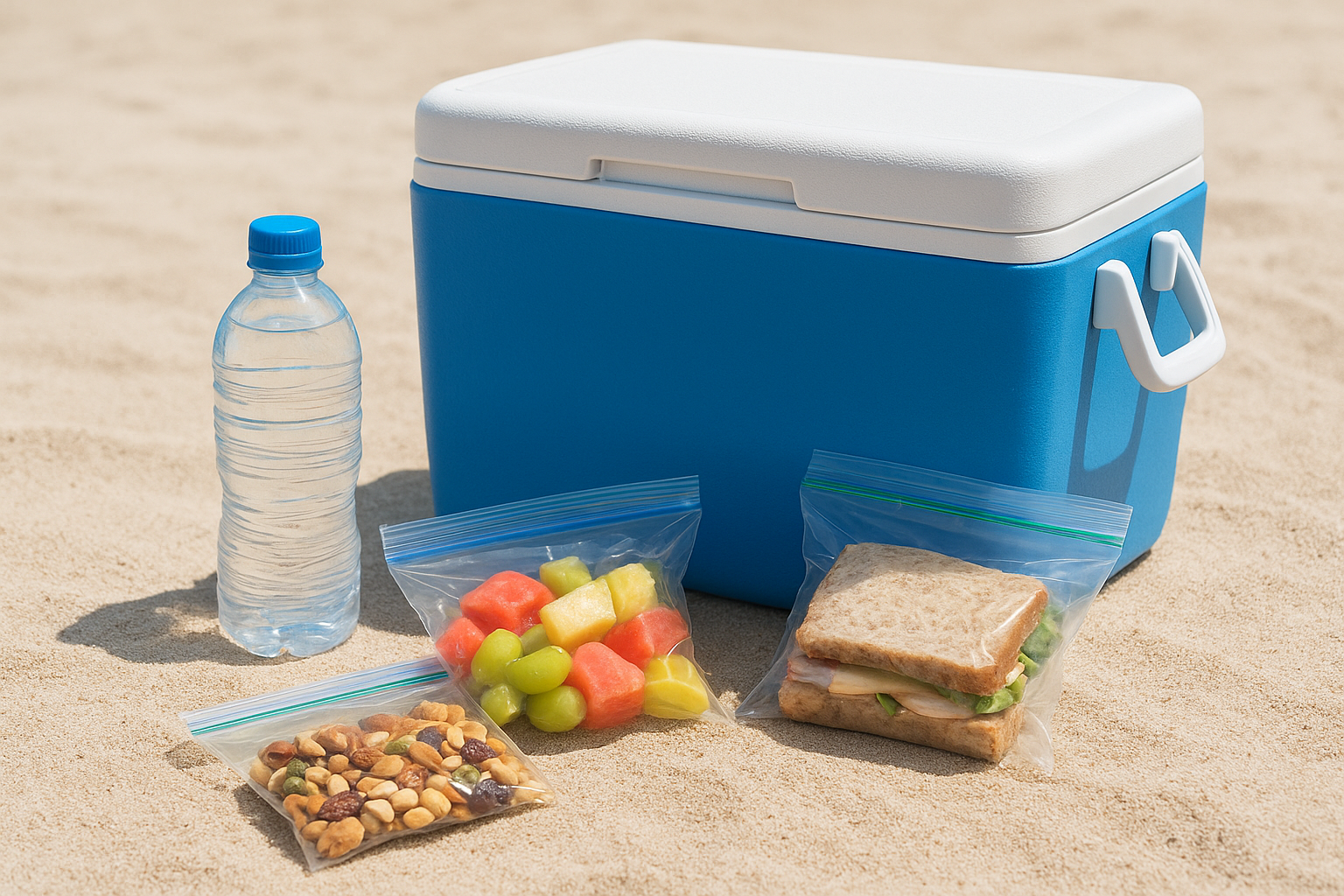
When thinking about what to bring to Crab Island, stick to foods that travel well and don’t require refrigeration for long. Sandwiches, wraps, fruit, and trail mix hold up well in a cooler and are easy to eat while anchored.
Ice, storage, and keeping things sand free
Pack your cooler with a 2-to-1 ice-to-food ratio to maintain safe temperatures throughout the day. Use ziplock bags for snacks and individual items to keep sand out and make cleanup fast when you’re back at the dock.
4. Payment, ID, and required documents
Packing the right payment options and documents is one of the most overlooked parts of planning what to bring to Crab Island. Running out of cash at the sandbar or missing required paperwork can derail an otherwise perfect day.
What to bring for floating vendors
The floating vendors at Crab Island accept cash most reliably, and some may take cards depending on their setup. Bring small bills in a waterproof pouch since transactions range from a few dollars for drinks to $15 or more for food items.
Keep your cash in a ziplock bag or a waterproof wallet so it stays dry when you move between the boat and the water.
What to carry on you vs leave on the boat
Carry your ID and a small amount of cash on your person in a waterproof lanyard or case. Leave larger sums and non-essential valuables secured on the boat to lower the risk of losing them in the water.
Florida boating rules and permits to double check
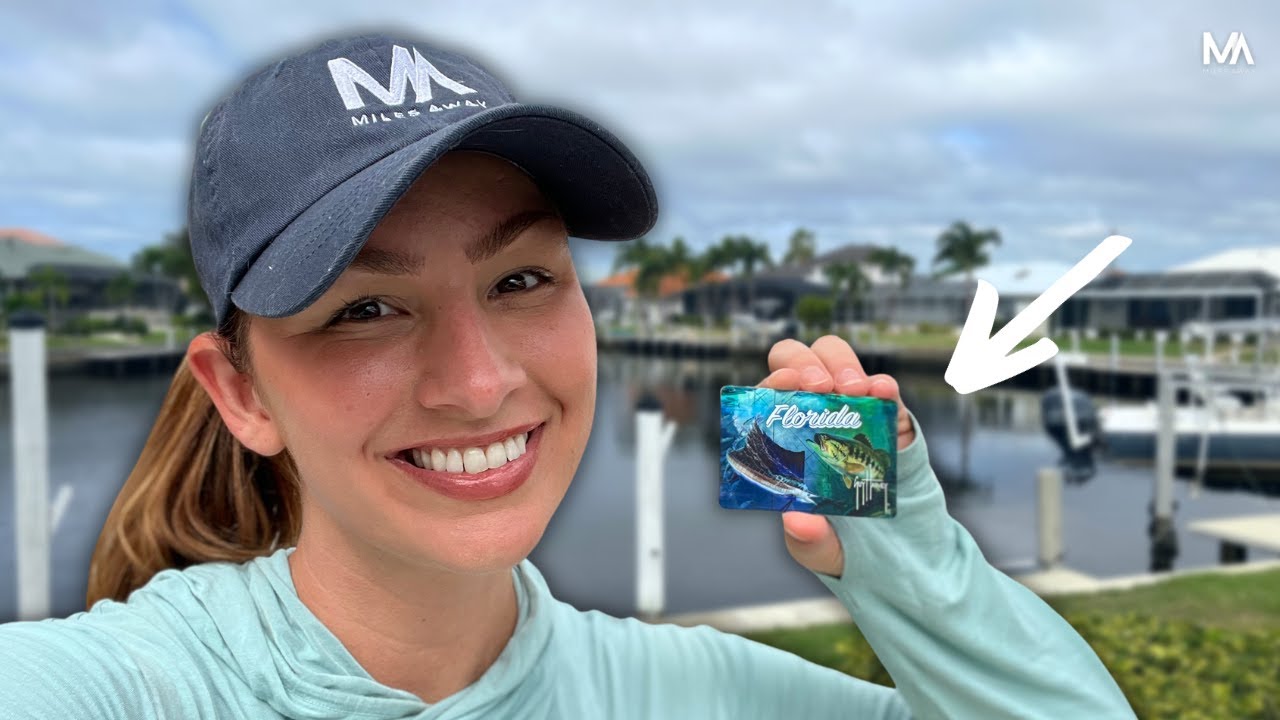
If you rent a boat in Florida, your rental company typically handles the required documentation. However, anyone born after January 1, 1988 must carry a state-issued boating safety ID card while operating a vessel, per Florida law. Confirm all required paperwork with your rental provider before you leave the dock.
5. Safety and comfort gear for a sandbar day
The sandbar is shallow and mostly calm, but a few smart gear choices separate a comfortable day from a frustrating one. Rounding out your list of what to bring to Crab Island, these safety and comfort items take up little space and solve problems before they happen.
What to pack for feet, phones, and valuables
Water shoes protect your feet from sharp shells and uneven sand on the sandbar floor. Pair them with a waterproof phone case and a floating wrist strap to keep your devices safe when you move between the boat and the water.
A dry bag secured to the boat keeps your keys, wallet, and phone dry and in one place all day.
What to bring for kids and first timers
Pack Coast Guard-approved life jackets for children, since Florida law requires them for kids under 6 on moving vessels. First-timers should also bring motion sickness medication if they’re prone to seasickness, even on relatively calm water.
What not to bring to avoid trouble on the water
Leave glass containers at home since they’re prohibited on the water and create a real hazard on the sandbar. Oversized inflatables are also a poor choice because wind and current can carry them away from your group faster than you expect.
Quick recap and next steps
Now you know exactly what to bring to Crab Island for a full day on the sandbar. Cover your five essentials: a confirmed boat plan, solid sun protection, enough food and water for your group, cash and required documents, and the safety gear that keeps everyone comfortable from launch to return.
Most trips that go sideways come down to one skipped item on this list. Pack your cooler the night before, apply sunscreen before you leave your accommodation, and confirm your rental details the day prior. Small prep steps make a measurable difference when you’re out on the water with no quick way back to shore.
Ready to lock in your transportation? Original Crab Island makes it easy to get your group out to the sandbar on a pontoon, jet ski, or guided cruise. Book your Crab Island adventure today and check one major task off your trip planning list.
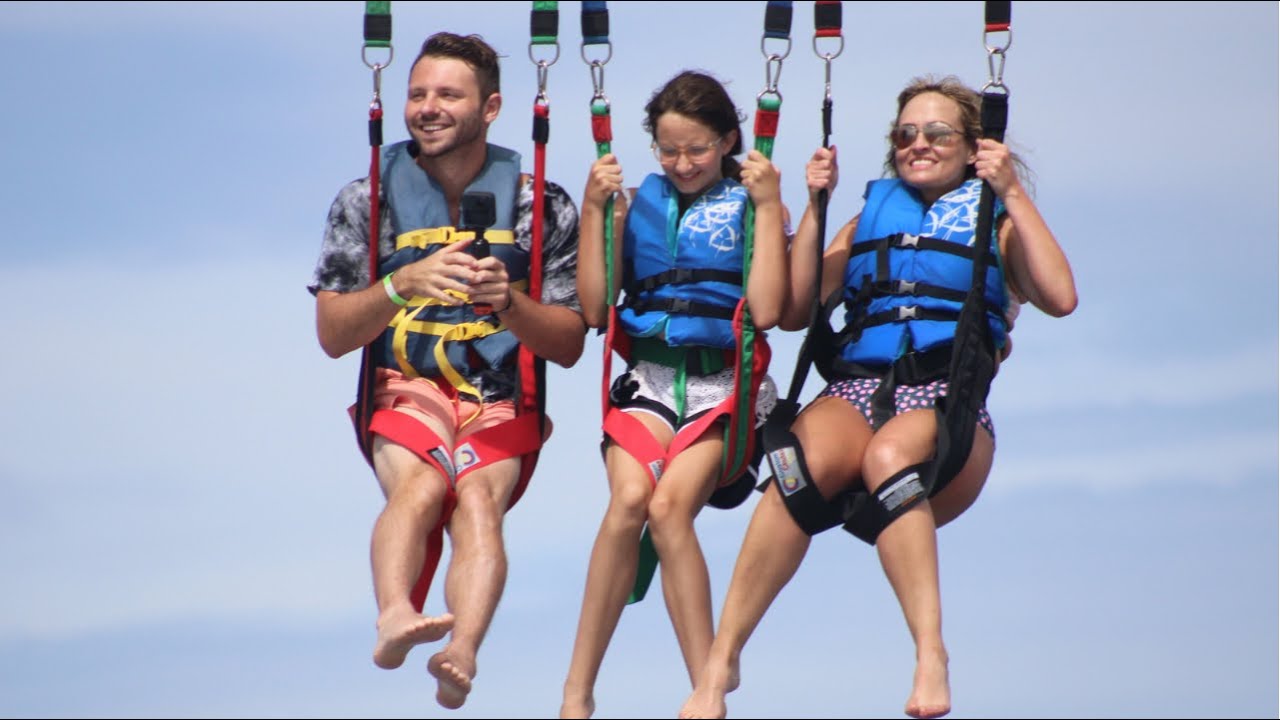
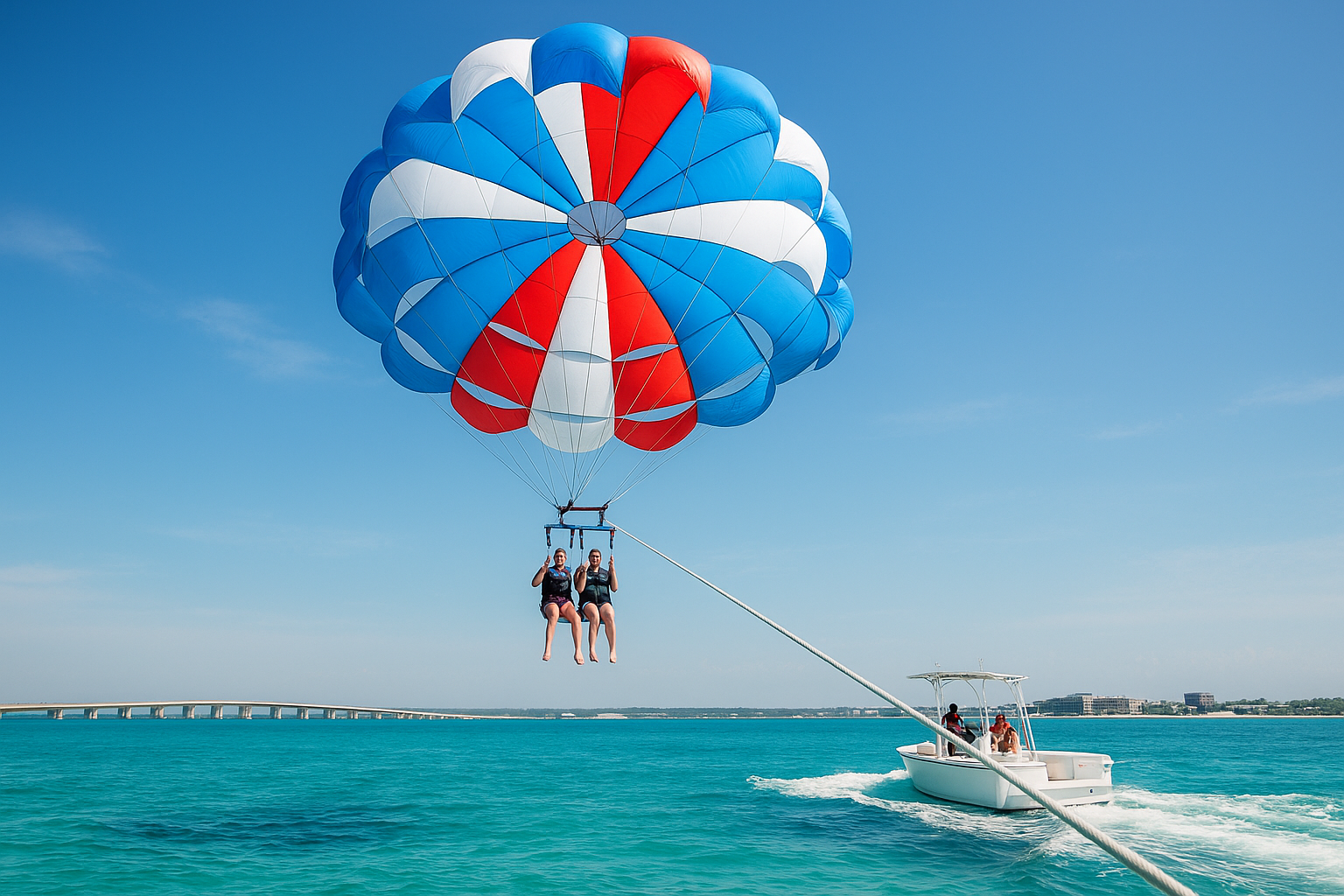
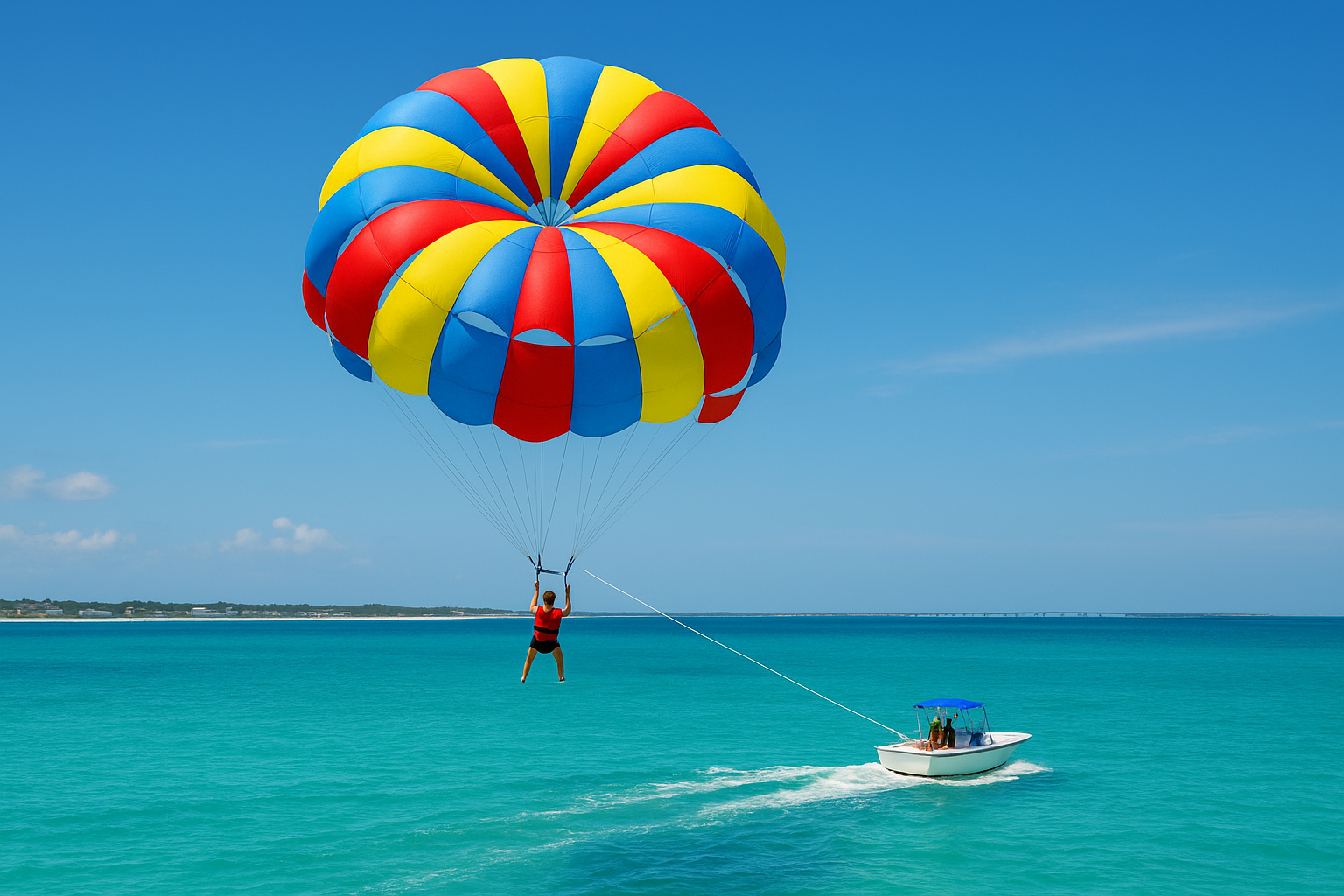
If you’re searching for destin parasailing near me, you’re about to have one of the best experiences the Emerald Coast has to offer. Floating 500+ feet above the Gulf of Mexico gives you a bird’s-eye view of Destin’s turquoise waters, white sand beaches, and, if you’re lucky, dolphins swimming below you. It’s the kind of thing that sticks with you long after your vacation ends.
But not every parasailing operator in Destin delivers the same experience. Prices range anywhere from $50 to over $100 per person, and factors like flight time, rider capacity, and boat quality vary quite a bit between companies. Picking the wrong one can mean overpaying for a short ride or dealing with outdated gear.
We put this list together based on what actually matters: pricing transparency, safety record, customer reviews, and overall value. As a team at Original Crab Island that helps visitors book parasailing and other water activities across Destin every day, we know which operators consistently deliver. Here are the five best options worth your time and money right now.
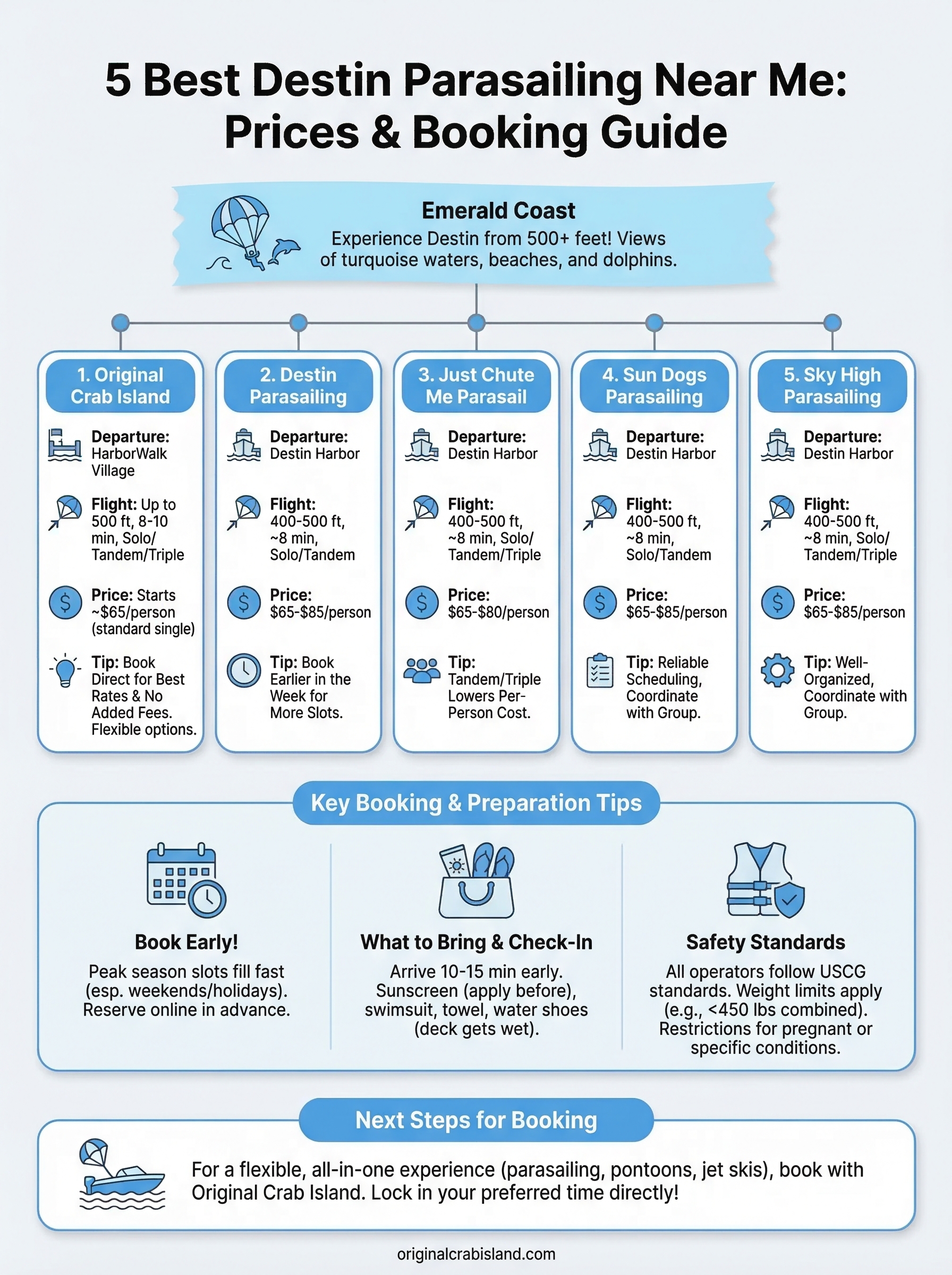
1. Original Crab Island
Original Crab Island operates out of Destin’s HarborWalk Village, putting you right at the heart of the action. If you’ve been searching for destin parasailing near me, this is one of the most convenient and well-reviewed options on the Emerald Coast.
Where it departs and what you can expect to see
Your ride departs from HarborWalk Village, where the marina provides a clean, organized check-in experience. Once airborne, you’ll see Destin’s turquoise Gulf waters stretching to the horizon, the Destin bridge, and often pods of dolphins swimming far below.
Flight height, ride time, and group options
Flights reach up to 500 feet, giving you a genuinely expansive view of the coastline. Rides run approximately 8 to 10 minutes in the air, and you can fly solo, tandem, or in a group of three, making it a flexible choice for families, couples, and friend groups alike.
Price range and what’s typically included
Prices start around $65 per person for a standard single flight, with tandem and triple options bringing the per-person cost down slightly. Your booking covers the full flight, all harness equipment, and a knowledgeable crew who walks you through every step before liftoff.
Booking directly through Original Crab Island typically gives you access to the best available rates without added third-party fees.
Booking, check-in, and what to bring
You can reserve your spot online through the Original Crab Island website, which is the fastest way to lock in a preferred time slot before they fill up. Plan to arrive 15 minutes before your departure for check-in, and bring sunscreen, a swimsuit, and a towel since the boat ride itself is part of the fun.
Safety standards and common restrictions
The crew operates under U.S. Coast Guard standards for all parasailing trips. Weight limits apply, with most flights capping combined rider weight at under 400 lbs. Pregnant riders and anyone with certain cardiovascular or joint conditions are generally not cleared to fly.
2. Destin Parasailing
Destin Parasailing is one of the most well-known names that comes up when visitors search for destin parasailing near me. They’ve been operating in the area long enough to build a strong track record for consistent, well-run rides.
Where it departs and what you can expect to see
Departures run from Destin Harbor, making it easy to reach from most vacation rentals along the Emerald Coast. Once airborne, you’ll catch clear views of the Gulf’s turquoise water, the Destin bridge, and dolphins if conditions are right.
Flight height, ride time, and group options
Flights reach 400 to 500 feet, with about 8 minutes of air time per ride. Solo and tandem options are available, which works well for couples or pairs within a larger group.
Price range and what’s typically included
Standard rides typically run $65 to $85 per person, covering the flight, harness gear, and crew support. Tandem bookings bring your per-person cost down a bit.
Booking earlier in the week gives you more slot options since weekends fill up fast.
Booking, check-in, and what to bring
Reserve online and plan to arrive 10 to 15 minutes before departure. Bring the following:
Sunscreen (apply before you board)
A swimsuit and a towel
Water shoes since the deck gets wet
Safety standards and common restrictions
The operation follows U.S. Coast Guard guidelines, with combined rider weight caps typically around 450 lbs. Pregnant riders and those with heart or joint conditions are generally not permitted to fly.
3. Just Chute Me Parasail
Just Chute Me Parasail is another strong option when you’re narrowing down destin parasailing near me choices. They’ve built a solid reputation for friendly, well-trained crews and consistent rides that hold up well in customer reviews.
Where it departs and what you can expect to see
Trips depart from Destin Harbor, which keeps logistics simple whether you’re staying downtown or along the beachside corridor. From the air, you’ll take in Destin’s turquoise Gulf water, the coastline stretching in both directions, and the Destin bridge laid out below you.
Flight height, ride time, and group options
Flights reach 400 to 500 feet, with approximately 8 minutes of air time per ride. Solo, tandem, and triple rider options are available, making it a flexible fit for couples, families, or mixed-size groups.
Price range and what’s typically included
Expect to pay $65 to $80 per person for a standard flight, with your booking covering all harness equipment and full crew support from the dock to landing.
Flying tandem or triple cuts the per-person cost, so it’s worth coordinating with others in your group before booking solo.
Booking, check-in, and what to bring
Reserve online and arrive 10 to 15 minutes before departure. Bring the following:
Sunscreen applied before you board
A swimsuit and a towel
Water shoes since the deck gets wet
Safety standards and common restrictions
Just Chute Me operates under U.S. Coast Guard standards, with combined rider weight limits around 450 lbs. Pregnant riders and those with cardiovascular conditions are generally not cleared to fly.
4. Sun Dogs Parasailing
Sun Dogs Parasailing rounds out the stronger picks when you’re comparing destin parasailing near me options. Reviewers consistently point to their reliable scheduling and smooth operation as standout qualities.
Where it departs and what you can expect to see
Sun Dogs departs from Destin Harbor, keeping access straightforward from most areas along the coast. Once you’re up, you get clear views of the Gulf’s turquoise water, the shoreline, and the Destin bridge below.
Flight height, ride time, and group options
Flights climb to around 400 to 500 feet, with roughly 8 minutes of air time per ride. Solo and tandem options are available, covering most group configurations.
Price range and what’s typically included
Rides typically run $65 to $85 per person, with harness gear and full crew support included in your booking.
Tandem bookings lower your per-person cost, so coordinate with your group before reserving individual spots.
Booking, check-in, and what to bring
Reserve your slot online and arrive 10 to 15 minutes early for check-in. Bring sunscreen, a swimsuit, and water shoes since the deck gets wet during the ride.
Safety standards and common restrictions
Sun Dogs follows U.S. Coast Guard standards, with combined rider weight limits around 450 lbs. Pregnant riders and those with cardiovascular conditions are generally not permitted to fly.
5. Sky High Parasailing
Sky High Parasailing is a solid pick when you’re weighing destin parasailing near me options. They’ve earned a steady reputation for well-organized trips and attentive crews along the Emerald Coast.
Where it departs and what you can expect to see
Trips launch from Destin Harbor, keeping logistics straightforward for most visitors. From the air, you’ll take in turquoise Gulf water, the Destin bridge, and the coastline stretching out in both directions.
Flight height, ride time, and group options
Flights reach 400 to 500 feet, with approximately 8 minutes of air time per ride. Solo, tandem, and triple rider options are available to fit different group sizes.
Price range and what’s typically included
Rides run $65 to $85 per person, with harness equipment and full crew support included in your booking.
Tandem or triple bookings lower the per-person cost, so coordinate with your group before reserving individual slots.
Booking, check-in, and what to bring
Reserve online and arrive 10 to 15 minutes early for check-in. Plan to bring the following:
Sunscreen applied before boarding
A swimsuit and a towel
Water shoes since the deck gets wet
Safety standards and common restrictions
Sky High follows U.S. Coast Guard standards, with combined rider weight limits around 450 lbs. Pregnant riders and those with cardiovascular conditions are generally not permitted to fly.
Next steps for booking
Every operator on this destin parasailing near me list delivers a solid experience, but your best move is to book early. Peak season slots in Destin fill up fast, especially on weekends and holidays, so waiting until the day before often means limited availability or less desirable time windows.
If you want the most flexible and well-rounded water activity experience, Original Crab Island gives you parasailing alongside options like pontoon rentals, jet ski rentals, and dolphin cruises, all in one place. That means less time coordinating across multiple operators and more time actually enjoying the water. You also get direct booking access, which cuts out third-party fees and keeps your costs lower.
Dolphins are one of the biggest draws for visitors to Destin’s waters, and knowing the best time to see dolphins in Destin can be the difference between a quick glimpse and a front-row show. Bottlenose dolphins live in these Gulf waters year-round, but their activity patterns shift with the seasons, tides, and time of day.
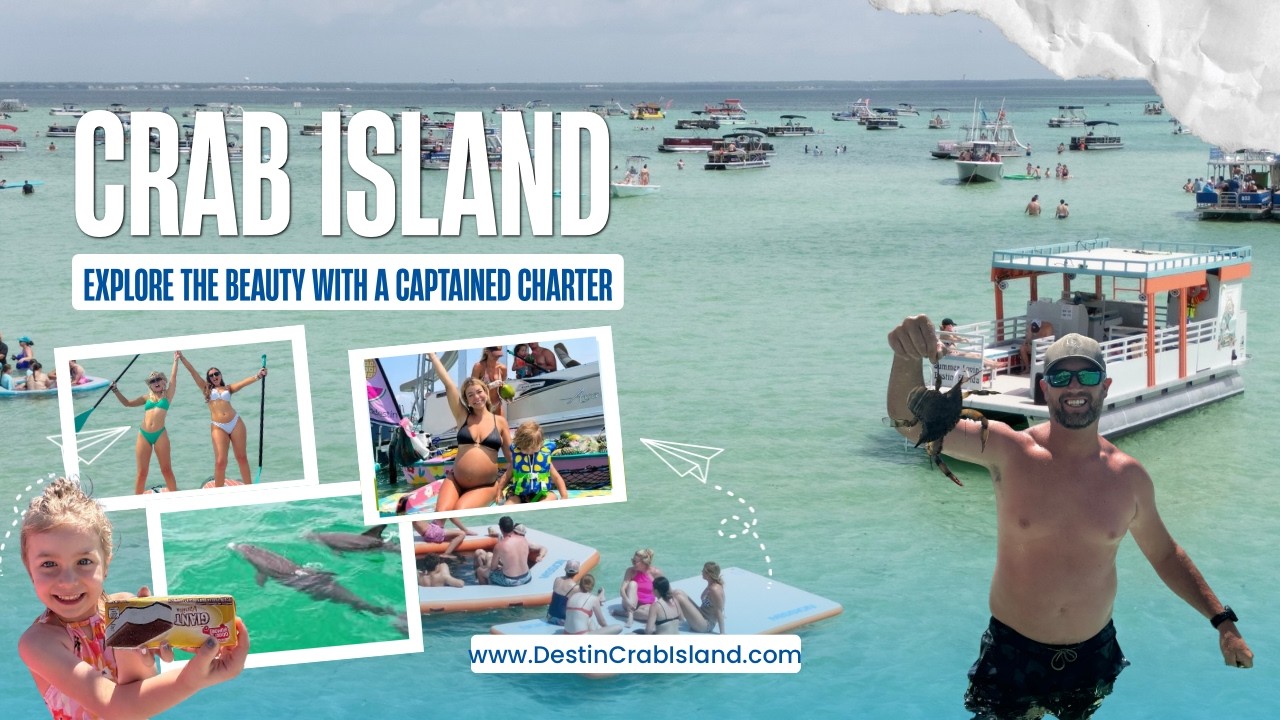
Whether you’re scanning the horizon from shore or heading out on one of our dolphin cruises at Original Crab Island, a little timing knowledge goes a long way. We spend our days on these waters running pontoon tours, sunset cruises, and charters, so we’ve picked up a thing or two about where dolphins gather and when they’re most active around the Destin Harbor and Crab Island sandbars.
This guide breaks down the best seasons, tidal conditions, and hours to plan your dolphin-watching trip. We’ll cover what actually affects dolphin behavior in the Emerald Coast and how to set yourself up for the best possible sighting.
What affects dolphin activity in Destin
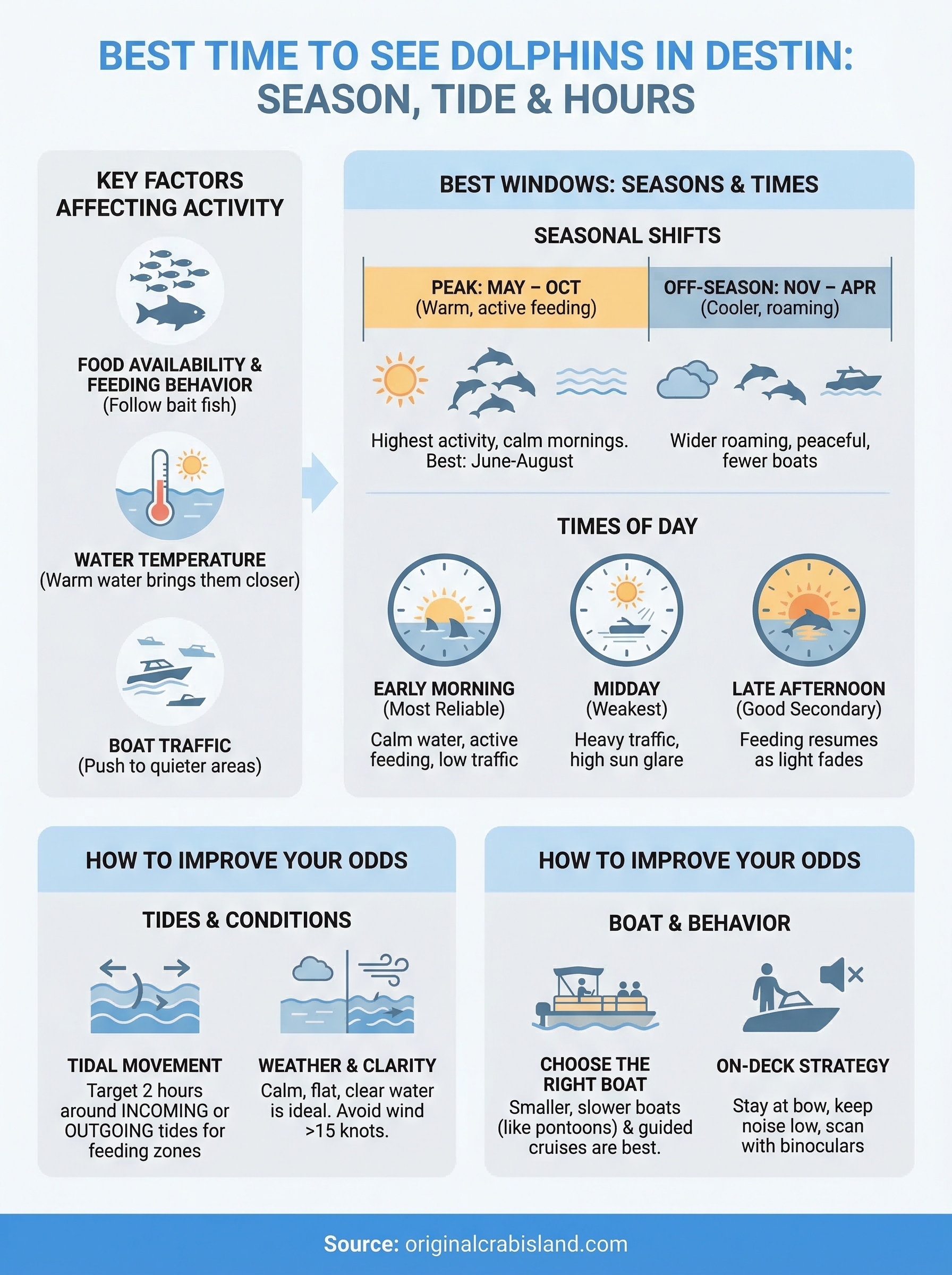
Bottlenose dolphins don’t follow a strict schedule, but their movements aren’t random either. Three main factors drive when and where you’ll find them: food availability, water temperature, and boat traffic around Crab Island and the harbor. Understanding these factors helps you pick the best time to see dolphins in Destin and put yourself in the right place at the right time.
Food availability and feeding behavior
Dolphins in Destin follow bait fish. Mullet, menhaden, and other schooling fish are the primary targets, and when those schools move, dolphins move with them. You’ll often spot dolphins near the East Pass or along the edges of Destin Harbor, where currents push bait against structure. These are reliable feeding zones that attract dolphins consistently throughout the day.
Active feeding sessions are your best bet for extended sightings because dolphins stay concentrated in one area rather than cruising through. Groups will often work together to herd bait fish into tight balls near the surface, which gives you a longer viewing window than a simple passing encounter.
When dolphins feed cooperatively near the surface, they typically stay focused in one spot for 15 to 30 minutes, making those moments far more rewarding than a quick bow-wave sighting.
Water temperature and boat traffic
Water temperature directly controls where bait fish gather, which controls where dolphins hunt. Destin’s Gulf waters stay warm enough year-round to support dolphins, but peak fish activity from late spring through early fall pulls more dolphins close to shore and into the shallower inshore waters around the sandbar.
Heavy recreational boat traffic in the middle of a summer afternoon can push dolphins toward quieter areas away from the main channels. Early morning runs and late afternoon cruises tend to catch dolphins when they are most active and the waters are calmer, giving you a cleaner and more natural encounter on the water.
Best months to see dolphins in Destin
Dolphins stay in Destin’s waters all twelve months, but your chances of frequent sightings peak during the warmer half of the year. Seasonal shifts in water temperature and bait fish populations create clear windows when dolphin activity runs highest close to shore.
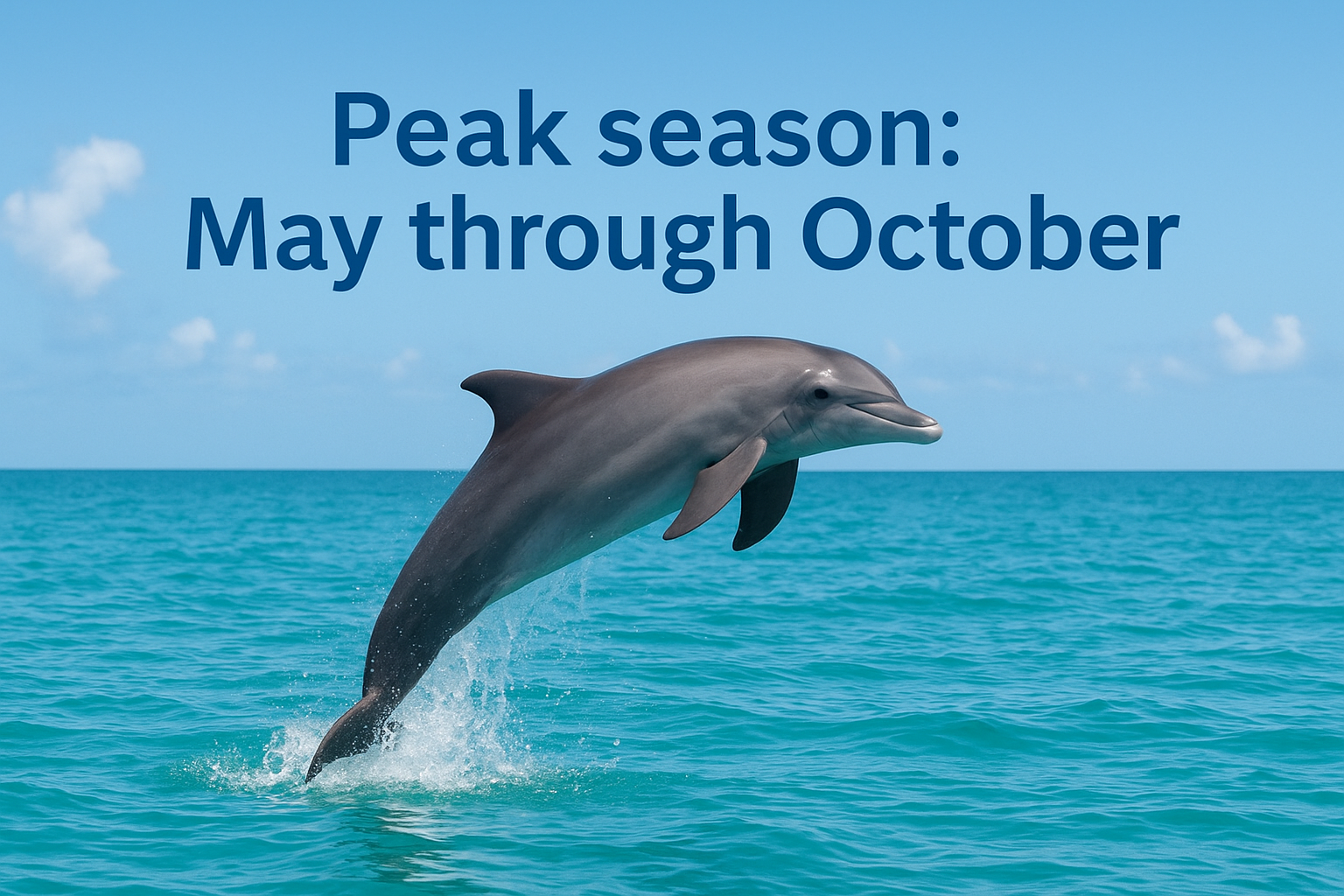
Peak season: May through October
May through October delivers the best time to see dolphins in Destin because warm Gulf temperatures push large schools of bait fish into the shallow inshore areas around the harbor and Crab Island. Dolphins follow that food source directly into your viewing range, and sightings during this window are often longer and more active.
June through August consistently produces the most dolphin encounters per trip, with multiple pods sometimes visible from a single outing on the water.
Calmer Gulf conditions on most summer mornings also make it easier to spot fins and surface activity from a pontoon or charter boat before afternoon winds pick up.
Off-season: November through April
Cooler water temperatures push bait fish offshore between November and April, so dolphins tend to roam wider areas rather than concentrating near the sandbar. Smaller crowds on the water during this period create quieter conditions that sometimes bring pods closer to slower-moving boats.
Winter dolphin sightings are still possible and even more peaceful, making the off-season a genuine option if your schedule only allows a visit outside the summer rush.
Best times of day for dolphin sightings
Time of day shapes your encounter just as much as the season does. If you want to find the best time to see dolphins in Destin, focus on the bookend hours of the day rather than the midday stretch when boat traffic peaks and surface glare makes spotting fins harder.
Early morning: the most reliable window
The two hours after sunrise consistently deliver the highest number of dolphin encounters on Destin’s waters. Bait fish are active near the surface in cooler morning water, which pulls dolphins into shallower inshore areas around the harbor and East Pass. Boat traffic is also minimal at this hour, so pods behave more naturally and spend more time near the surface rather than diving deep to avoid noise.
Early morning runs between 7 and 9 a.m. give you calm water, good light for spotting fins, and dolphins in active feeding mode.
Late afternoon and the pre-sunset window
The last two hours before sunset offer a strong secondary window. Water activity slows down after the midday rush, and feeding sessions often pick back up as afternoon light fades. Dolphins appear regularly near Crab Island and along the harbor edges during this period, and a sunset cruise lines up perfectly with this natural activity spike.
Midday from 11 a.m. to 2 p.m. is your weakest window due to heavy recreational traffic and high sun glare reducing visibility on the water.
How tides, weather, and water clarity matter
Tides, wind, and water visibility all shape where dolphins appear and how long they stay near your boat. These conditions work alongside season and time of day, so locking in the best time to see dolphins in Destin also means checking the marine forecast before you leave the dock.
Tidal movement and feeding zones
Incoming tides push bait fish from deeper Gulf waters toward the shallows near East Pass and the harbor entrance, concentrating dolphin feeding activity in tight, predictable zones. Dolphins move with that pressure and often stay near the surface to pick off fish being swept toward shore, giving you a longer and more visible encounter.
Outgoing tides reverse the process and pull bait schools back along the current edge. Dolphins track that movement closely, and the two hours surrounding any tidal shift, either direction, consistently produce the most active surface behavior you’ll see on the water.
Weather and water clarity
Calm, flat water after a clear night gives you far better visibility for spotting dorsal fins at distance than choppy post-storm conditions. Wind above 15 knots creates surface chop that scatters your sightlines and pushes dolphins deeper, making encounters shorter and harder to follow from a moving boat.
Clear, green-tinted Gulf water lets you track dolphins moving just below the waterline, which turns a brief fin sighting into a full, extended encounter.
Rain runoff and rough surf cloud the water quickly, so a stretch of calm, dry days before your trip dramatically improves what you’ll be able to see.
How to improve your odds on a cruise or rental
The vessel you pick and how you behave on the water both shape your results. Choosing a guided dolphin cruise over an independent rental gives you access to a captain who tracks dolphin patterns daily and knows which areas are producing sightings on any given morning. That local knowledge is the single biggest advantage you can give yourself when trying to nail the best time to see dolphins in Destin.
Go with a smaller, slower boat
Smaller boats like pontoons sit lower on the water and create less engine noise than large charter vessels, which makes dolphins more likely to approach and ride your bow wave. Slower speeds also give you more time to scan the water and follow a pod once you spot fins rather than passing through too quickly to track their movement.
Asking your captain to cut the engine when dolphins approach lets them linger near the boat for minutes rather than seconds.
Stay toward the bow and keep noise low
Positioning yourself at the front of the boat puts you closest to any dolphins riding the pressure wave your hull creates. Keeping noise low on deck, including music and loud conversation, reduces disturbance and encourages pods to stay near the surface longer rather than diving and moving off. Binoculars also help you spot fins at a distance before the boat closes in and gives you a head start on the best viewing spot.
A quick plan for your dolphin day
Put the pieces together and your approach becomes straightforward. Book a morning trip between May and October and aim to leave the dock by 7 a.m. when feeding activity peaks and boat traffic stays light. Check the tide chart before you go and target the two hours around an incoming tide for the highest concentration of dolphins near the harbor entrance and East Pass.
Pick a pontoon or smaller vessel, stay at the bow, and keep the deck quiet when pods approach. Flat, calm water after a stretch of clear days gives you the best visibility for tracking fins below the surface.
Timing the best time to see dolphins in Destin well makes every other part of the trip fall into place. When you’re ready to book, reserve a pontoon or dolphin cruise with Original Crab Island and put your plan into action on the water. For more options, explore our Services page.
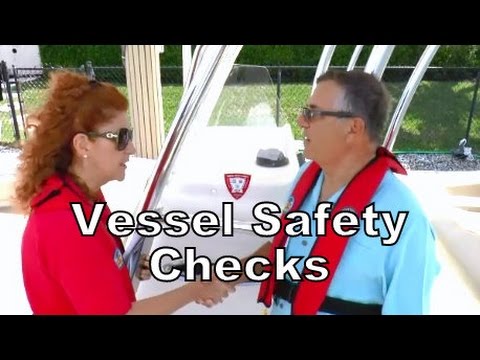
Whether you own a center console, a pontoon, or a weekend sailboat, a USCG Auxiliary vessel safety check is one of the smartest things you can do before hitting the water. It’s a free inspection conducted by trained U.S. Coast Guard Auxiliary volunteers who walk through your boat’s safety equipment, documentation, and overall readiness, no penalties, no fees, no reports filed if you don’t pass.
At Original Crab Island, we put boats on the water in Destin every single day. Our pontoon rentals, jet skis, and charter vessels all meet strict safety and equipment standards because we know firsthand how quickly conditions on the Gulf and around Crab Island can change. That same level of preparation applies to private boat owners, and a vessel safety check is the easiest way to confirm you’re covered.
This article breaks down exactly what the inspection covers, what items are on the official checklist, and how to schedule your free check. We’ll also walk through common reasons boats fail and how to fix those issues before your next trip out of Destin Harbor or any other waterway in the U.S.
What a USCG Auxiliary vessel safety check is
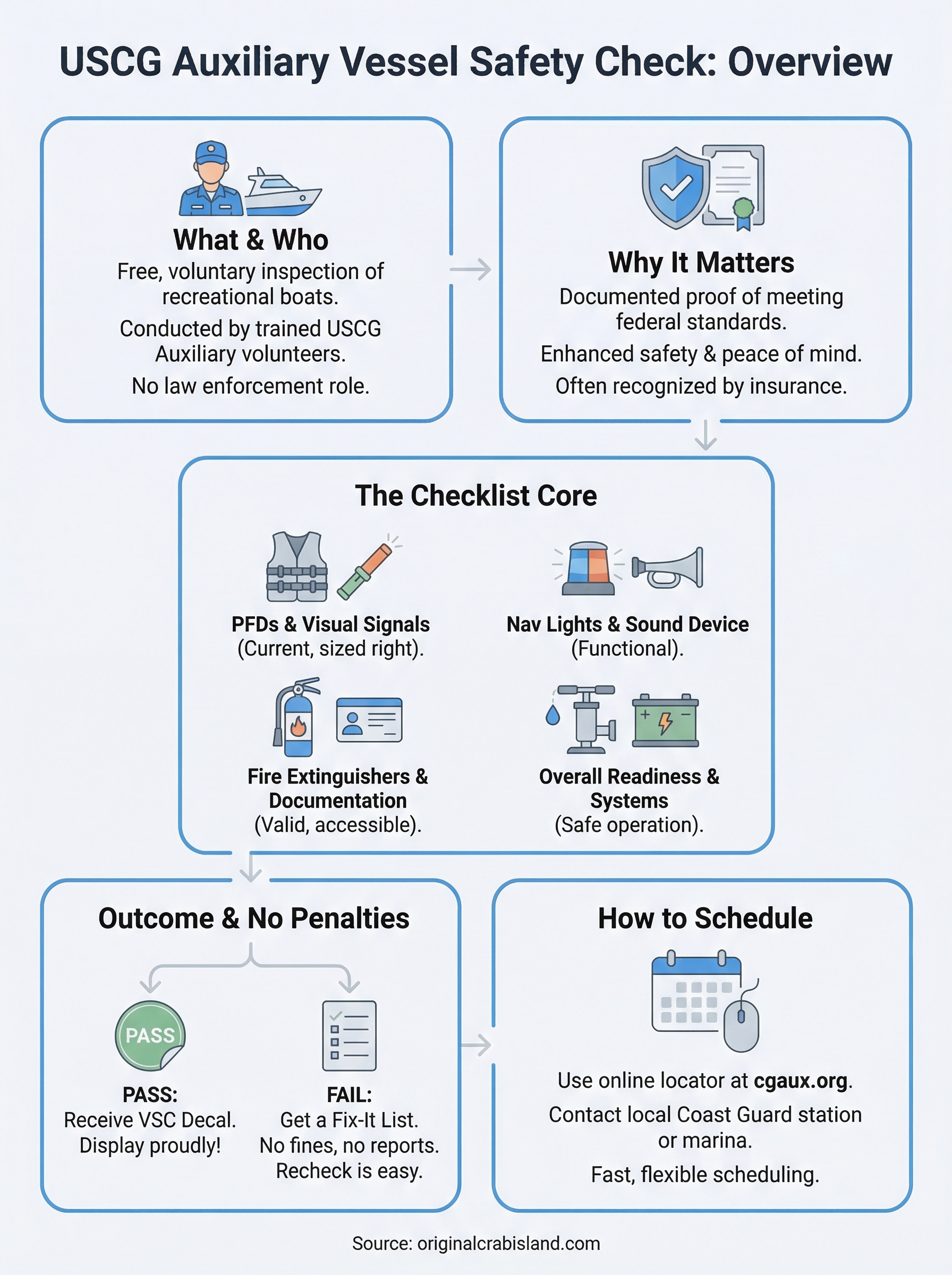
A USCG Auxiliary vessel safety check is a free, voluntary inspection offered to recreational boat owners across the United States. Trained volunteers from the U.S. Coast Guard Auxiliary board your vessel, review your safety gear, confirm you have proper documentation, and verify that your boat meets current federal and state requirements. The entire process typically takes between 30 and 60 minutes, depending on the size and type of your vessel.
Who conducts the inspection
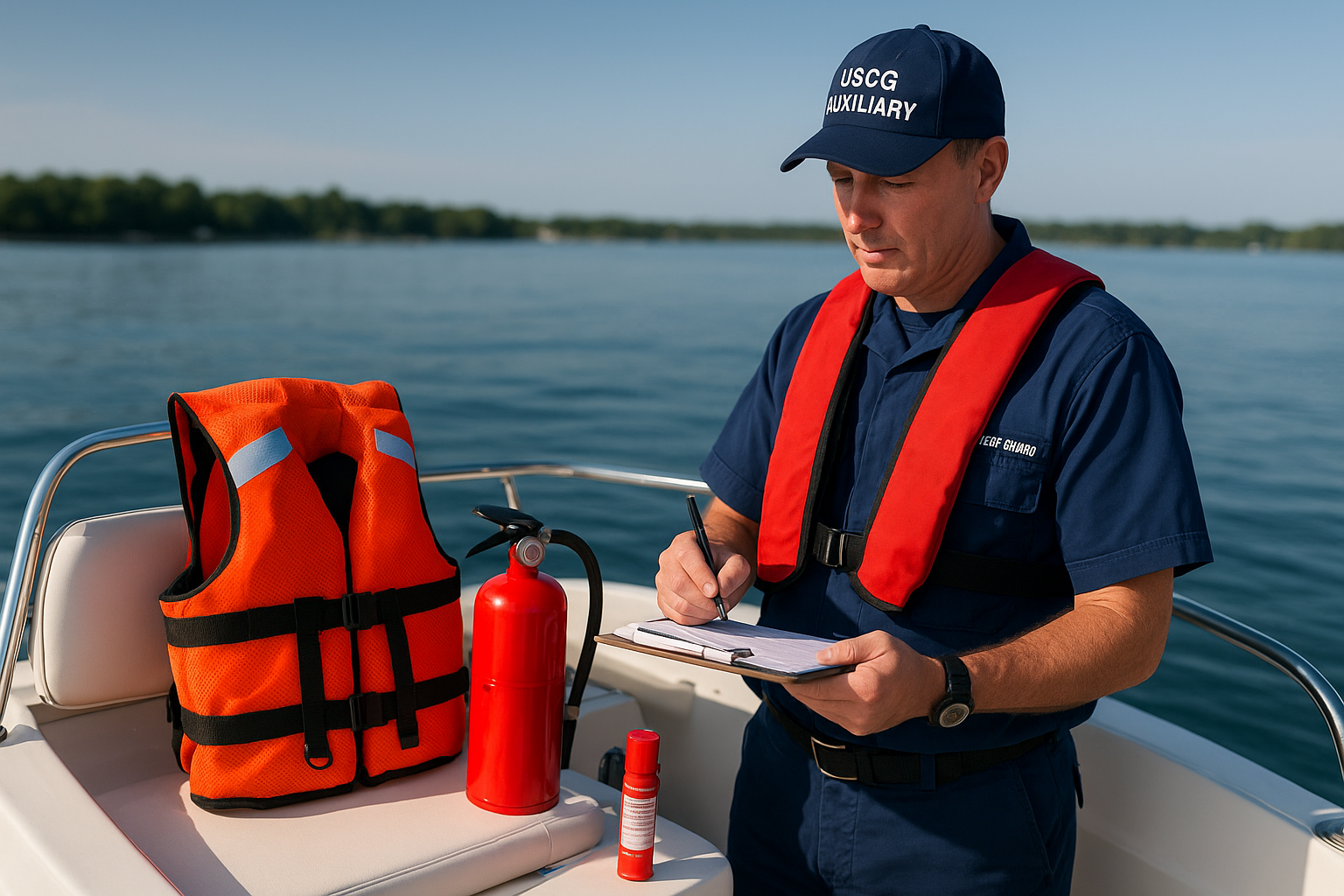
The U.S. Coast Guard Auxiliary is the uniformed civilian component of the U.S. Coast Guard. Volunteers complete formal training courses before they are authorized to conduct safety checks. They wear official uniforms, carry credentials, and follow a standardized inspection procedure on every boat they review. These are not casual volunteers making informal recommendations. Each examiner has passed a verified qualification process before they step aboard any vessel.
The Auxiliary has conducted millions of free vessel safety checks across the country, making it one of the most widely used boating safety programs in the United States.
What happens if your boat does not pass
If your vessel does not meet the required standards, no report is filed with law enforcement or any regulatory agency. You simply do not receive the VSC decal for that inspection, and the examiner provides you with a clear list of what needs to be corrected before you reapply. There are no fines, no penalties, and no consequences tied to falling short. That structure makes the inspection a genuinely low-pressure way to identify gaps in your safety setup before you are out on open water where those gaps can become serious problems.
Why a vessel safety check matters
Beyond the obvious safety benefits, a USCG Auxiliary vessel safety check gives you documented proof that your boat met federal standards at the time of inspection. If an incident occurs on the water, that VSC decal signals that you took reasonable steps to outfit your vessel properly. Insurance companies and marina operators both recognize that distinction.
A boating accident caused by missing or defective safety equipment can result in federal fines that far exceed the cost of any gear you would have needed to buy.
The real cost of skipping it
Most boaters who skip the inspection simply assume their equipment is fine. That assumption is where serious problems start. Life jackets expire, flares have shelf lives, and fire extinguisher pressure gauges drop without warning. A single missed item can leave you out of compliance with U.S. Coast Guard regulations even if everything else on your boat is perfect.
What you gain from passing
Passing means you receive a dated decal that you display on your vessel. It shows Coast Guard officers, fellow boaters, and passengers that your boat cleared a standardized review. That credibility matters, especially when you’re running passengers or heading into open Gulf water where conditions shift fast.
What the examiner checks on your boat
During a USCG Auxiliary vessel safety check, the examiner works through a standardized federal checklist that covers the core safety equipment every recreational vessel is required to carry. The specific requirements vary by vessel type, size, and the waters you travel, but the core categories remain consistent across all inspections.
Personal flotation devices and visual distress signals
The examiner first confirms you have properly sized life jackets for every person on board and that your visual distress signals are current and unexpired. Outdated flares are one of the most common reasons boats fail the check.
Flares older than 42 months from their manufacture date no longer meet USCG requirements, even if they still appear functional.
Key items reviewed in this category:
One Type I, II, III, or V PFD per person on board
One throwable Type IV device for vessels 16 feet and longer
Non-expired visual distress signals for boats used on coastal waters
Navigation lights, fire extinguishers, and sound devices
Your navigation lights must display the correct colors for your vessel class and operate without flicker or failure. The examiner also checks your fire extinguisher for proper gauge pressure and confirms you carry an approved sound-producing device such as a horn or whistle.
Required items in this category:
Port (red), starboard (green), and stern (white) lights fully operational
B-1 or larger fire extinguisher with a valid service date
Horn or whistle that meets federal sound output standards
How to schedule a free vessel safety check
Scheduling a USCG Auxiliary vessel safety check takes only a few minutes. The U.S. Coast Guard Auxiliary maintains a free online locator where you enter your zip code to find a qualified examiner near you. Most examiners respond within a day or two and will coordinate a time that works around your schedule.
The entire process is handled directly between you and the volunteer examiner, with no fees, forms, or agency reports involved.
Finding a local examiner
Your fastest route is the USCG Auxiliary’s official locator at cgaux.org. Beyond that, there are a few other reliable ways to connect with an examiner:
Contact your local Coast Guard station and ask for Auxiliary contacts
Ask at a local marina or boat ramp where Auxiliary members often operate
Reach out to a nearby boating or sailing club
What to expect when you contact an examiner
Once you reach an examiner, they will ask about your vessel type and length so they arrive with the correct checklist. From there, you agree on a date and a meeting location that fits your plans.
Your examiner will also confirm what documentation to have ready, such as your boat registration and any prior VSC decals, so the inspection moves forward without delays.
How to prepare and pass the check
Preparing for a uscg auxiliary vessel safety check does not require expensive upgrades or long hours. Most boats fail over small, fixable items that owners overlooked, and a focused review before the examiner arrives is usually enough to close those gaps.
Running through the checklist yourself 48 hours before your inspection gives you time to replace any expired or missing items without scrambling.
Do a self-inspection first
Before your examiner arrives, pull out every piece of safety equipment and check each item against the federal checklist at cgaux.org. Focus specifically on expiration dates, physical condition, and accessibility so nothing is buried under gear during the review.
Key items to lay out first:
Life jackets for every person on board
Visual distress signals with valid manufacture dates
Fire extinguisher with a charged gauge
Navigation lights in working order
Fix the common failure points
Expired flares, low fire extinguishers, and broken navigation lights are the most common reasons boats do not receive the VSC decal. Replace anything past its service date, recharge your extinguisher if the gauge reads low, and test every light the night before your inspection. Catching these problems yourself takes far less time than scheduling a second visit.
Next steps before you head to the water
A completed uscg auxiliary vessel safety check puts you in a strong position before you ever leave the dock. Schedule your inspection, run through the self-check, replace any expired gear, and confirm your documentation is organized and accessible on the day the examiner arrives.
Once you pass, your VSC decal is your confirmation that your vessel met federal standards. Keep every piece of safety equipment in the same accessible location after your inspection so it stays ready for every trip that follows.
If you’re heading to Destin and want to skip the work of outfitting and maintaining your own boat, our team handles all of that for you. Every vessel we put on the water is inspected, equipped, and ready to go so you can focus entirely on the experience. Book your next Destin water adventure and spend more time enjoying the Emerald Coast instead of checking gear lists.
Destin’s emerald waters and the famous Crab Island sandbar make this stretch of the Florida coast one of the best spots for a day on the water with friends. Whether you’re celebrating a bachelor or bachelorette party, hosting a corporate outing, or just rallying the crew for a good time, finding the right party boat rental Destin Florida has to offer can make or break the experience. The options range from double-decker pontoons to tiki boats, and prices vary just as much as the vessels themselves.
At Original Crab Island, we help visitors book water activities across Destin every day, from pontoon rentals and jet skis to sunset cruises and fishing charters. We know what’s available out there because we operate right in the middle of it. That hands-on experience is exactly what shaped this list.
Below, you’ll find five solid party boat rental options for 2026, broken down by boat type, pricing, group size, and whether you can captain the boat yourself or need to hire one. Let’s get into it.
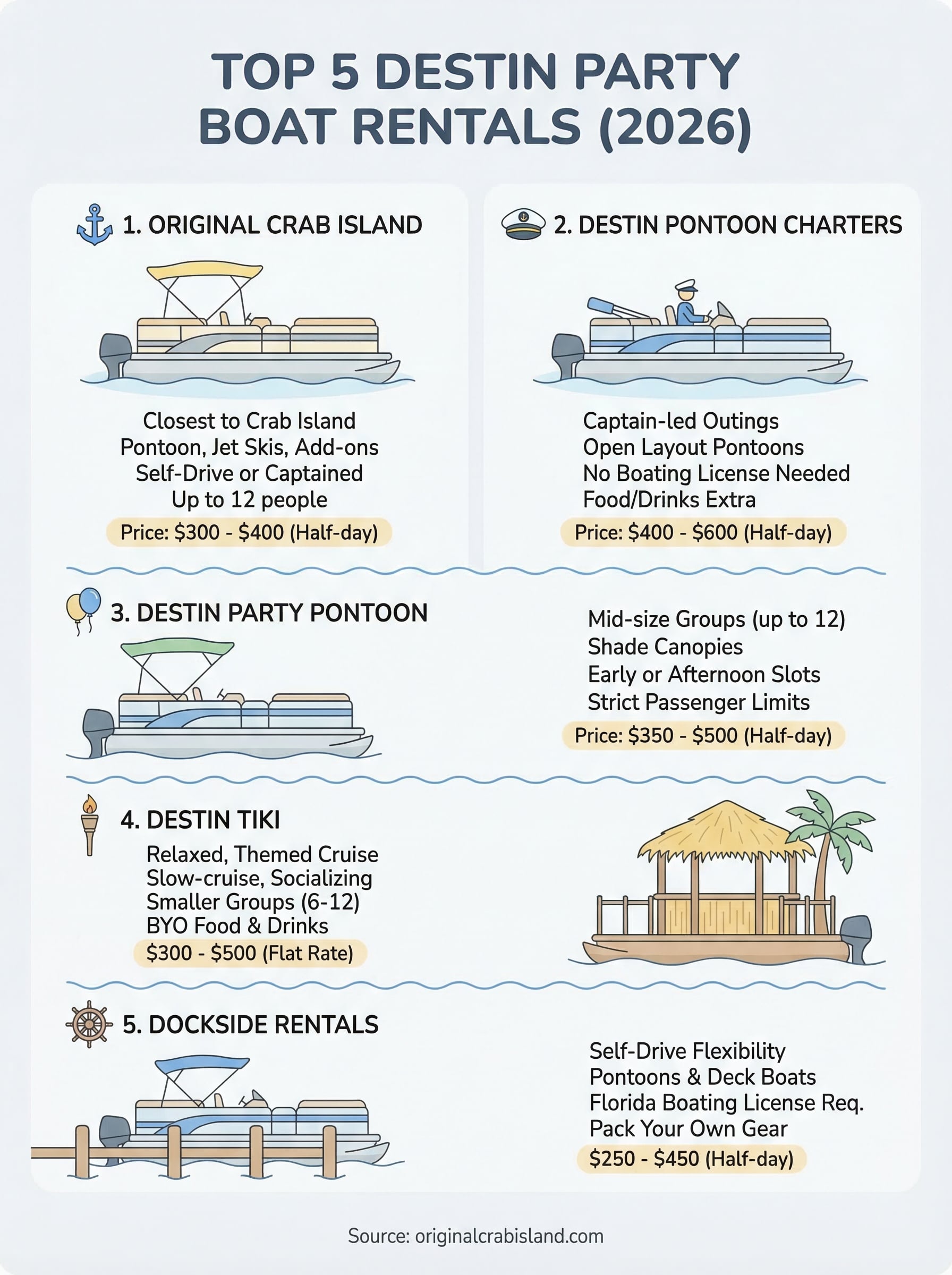
1. Original Crab Island
Original Crab Island operates directly within the Destin water activity scene, making it the closest option to the sandbar itself. If you want a party boat rental Destin Florida experience without juggling multiple vendors, this is where to start.
Why this is a top pick for Crab Island parties
This operation specializes in group water activities, so the staff already knows what a party crew needs before you ask. You get direct access to pontoon rentals, jet skis, and add-on experiences that most other operators don’t offer under one booking.
Boat options and group size fit
The primary vessel is a pontoon boat, comfortable for groups of up to 12 people. Larger groups can pair a pontoon with jet ski rentals to keep everyone on the water at the same time.
Captain or self-drive options
You can book a captained charter for a fully guided experience, or take the helm yourself if you hold a valid boating license. Self-drive gives your group more control over timing and how long you anchor at Crab Island.
What you get with the rental
Your booking includes the boat, life jackets, and standard safety gear. Fuel is typically covered, and staff will walk you through the vessel before departure so no one is guessing when you hit open water.
Confirm the full list of what’s included before you pay, since items like coolers or extra anchoring equipment may cost extra.
What a typical party day looks like
Most groups leave the marina and reach Crab Island within 15 minutes, then anchor up and spend the day swimming and socializing. You can layer in jet ski time or parasailing alongside the boat rental for a fuller itinerary.
Price range and what changes the cost
Pontoon rentals typically start around $300 to $400 for a half-day. Duration, group size, and add-on activities are the main factors that move the total up.
What to confirm before you book
Book peak summer weekends well in advance since availability goes fast. Also confirm the cancellation and weather policy before you finalize the reservation.
2. Destin Pontoon Charters
Destin Pontoon Charters runs captain-led outings with guided group experiences built into every booking.
What makes this option different
This operator includes local navigation expertise so your group gets on-water guidance from departure to return, rather than figuring things out on your own.
Best boat style for your vibe
Their open pontoon layout gives everyone room to move and socialize, making it a solid fit for group celebrations or relaxed days on the water.
Captain-led experience and safety basics
Every trip includes a licensed captain, removing any need for your group to hold a boating certification before you can get on the water.
This setup is ideal if no one in your group feels confident navigating Destin’s crowded summer waterways.
What’s typically included and what costs extra
Fuel and the captain come with the base price, but food, drinks, and water toys are typically out-of-pocket expenses you need to plan for.
Trip flow from marina to Crab Island
Your captain manages navigation and anchoring, so your group stays focused on the party rather than the boat throughout the trip.
Price range and common add-ons
Half-day captained charters run roughly $400 to $600, with extended hours and additional activities pushing the total higher.
Who this is best for
This option suits first-time boaters or groups seeking a party boat rental Destin Florida experience without taking on any navigation responsibility.
3. Destin Party Pontoon
Destin Party Pontoon focuses on group pontoon rentals with a simple booking process, making it a solid pick for visitors who want a party boat rental Destin Florida experience without sorting through too many options.
Best use cases for this rental
This option suits mid-size groupsheading to Crab Island or cruising the intracoastal waterway. Groups planning birthday outings or casual celebrations tend to get the most value here.
Boat layout, capacity, and comfort
Their pontoons seat up to 12 passengers with open deck space for everyone to spread out. Shade canopies are standard on most boats, which matters on a full summer day.
Included gear and optional upgrades
Rentals include life jackets and basic safety gear. Coolers and water floats are sometimes available as upgrades, so ask when you book.
Confirm which upgrades are in stock before your rental date since availability varies by season.
How to plan timing around tides and crowds
Early departures give you calmer water and fewer boats at Crab Island. Afternoon slots work if your group wants a livelier atmosphere at the sandbar.
Price range by duration
Expect to pay $350 to $500 for a half-day, with full-day options running higher depending on the season.
Rules that can impact your group
Alcohol policies vary, so read the rental agreement before you finalize anything. Most operators also enforce strict passenger limits for safety compliance.
4. Destin Tiki
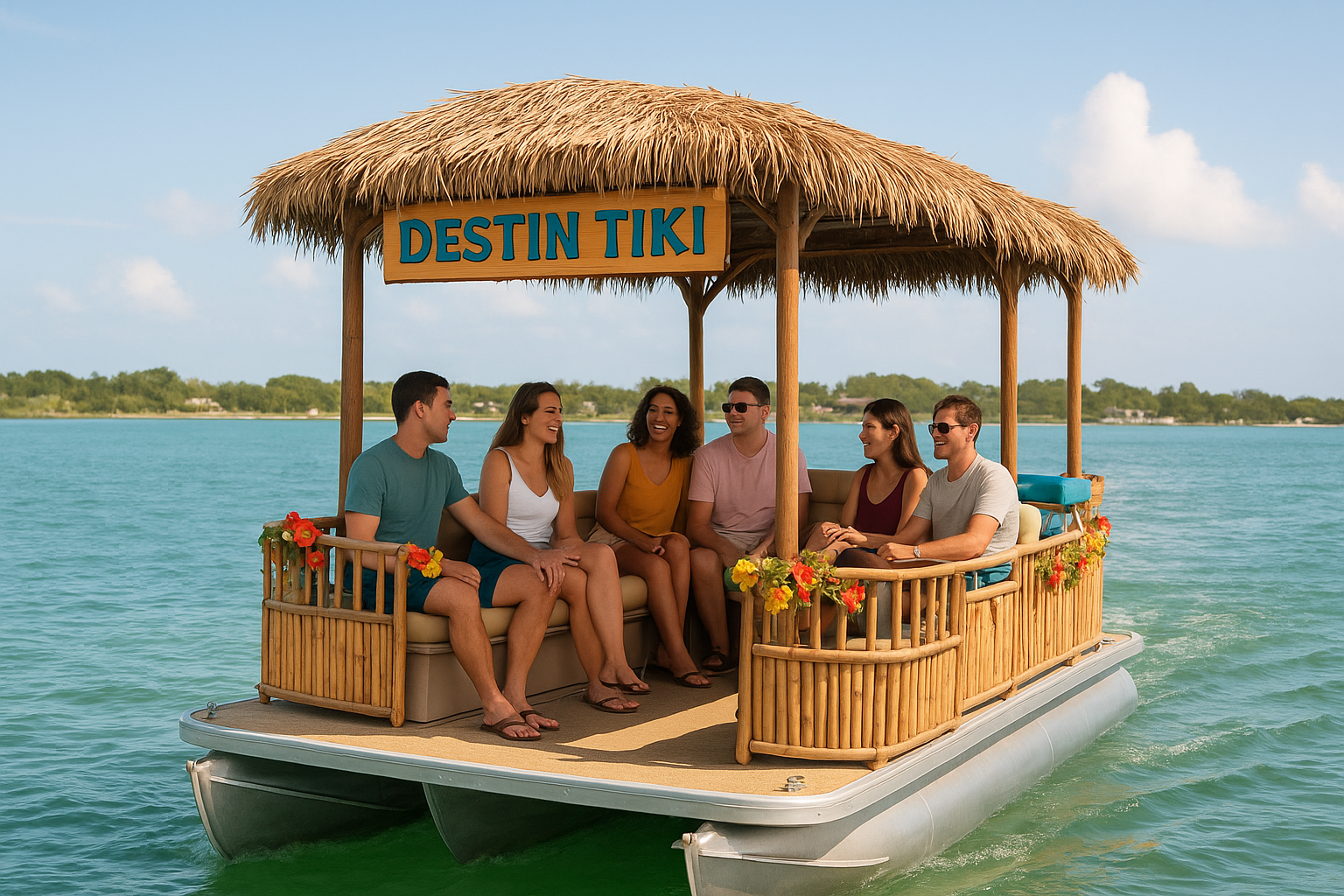
Destin Tiki brings a themed boat experience that sets it apart from standard pontoon rentals, giving groups a relaxed alternative for spending time on the water.
What a tiki boat experience feels like
A tiki boat is a slow-cruise vessel styled with tropical decor, built for socializing rather than speed. Your group drifts through the waterway while everyone stays comfortable on deck without worrying about navigation.
Group size limits and who it works for
Most tiki boats cap at around 6 to 12 passengers, making them a better fit for smaller, tight-knit groups rather than large party crews needing more deck space.
Cruise routes and Crab Island time
Routes typically include waterway cruising and a stop near Crab Island, though actual anchor time depends on your booking length and the operator’s schedule.
Confirm in advance how long the boat spends at Crab Island versus open cruising, since this split varies significantly between operators.
What you can bring on board
Most operators allow coolers and outside food and drinks, which helps your group manage costs compared to other party boat rental Destin Florida options that restrict outside items.
Price range and how they structure trips
Tiki boat trips typically run $300 to $500, structured as flat-rate packages priced by duration rather than group size.
Good-to-know limitations before booking
The relaxed pace means tiki boats are not built for watersports, so skip this option if your group wants jet ski access or active water activities alongside the cruise.
5. Dockside boat rentals in Destin
Dockside rentals give your group full schedule flexibility and let you pick up a self-drive vessel on your own terms without paying for a captain.
Boat choices that work best for parties
Most dockside operators stock pontoons and deck boats that seat between 6 and 12 passengers, covering the majority of group sizes heading to Crab Island for the day.
Self-drive requirements and renter checklist
You need a valid Florida boating license to operate a rental vessel. Bring a government-issued ID and confirm your certification before arriving at the dock.
Missing this step gets your rental cancelled on the spot, so check Florida’s boating requirements well before your trip date.
What you need to bring for a smooth day
Pack sunscreen, coolers, and enough food since most dockside rentals do not supply extras. Arriving prepared keeps your group comfortable for the full day on the water.
How to build a simple itinerary to Crab Island
Depart early, anchor at Crab Island for two to three hours, then cruise the intracoastal before your return window closes for the day.
Price range and common fees
Rentals typically run $250 to $450 for a half-day. Watch for fuel deposits and late-return fees that can push your total higher than expected.
When this option beats a captained charter
If someone in your group holds a boating license and wants control over the schedule, a self-drive dockside rental offers more freedom than a captained party boat rental Destin Florida at a lower base price.
Picking the right boat for your group
The best party boat rental Destin Florida pick comes down to two things: group size and how much control you want over the day. Larger crews with someone who holds a boating license do well with a self-drive pontoon, while first-timers benefit from a captained charter that handles navigation and anchoring from start to finish.
Your budget and activity mix also shape the decision. If your group wants jet skis or watersports alongside the boat, stick with operators that allow add-ons. If a relaxed themed cruise fits better, a tiki boat covers that without extra logistics.
Renting a yacht in Destin without worrying about navigation, docking, or reading nautical charts, that’s the whole appeal of a Destin yacht rental with captain. You get the luxury of being on the water, a professional handles everything else, and your only job is to enjoy the ride. Whether you’re heading out to Crab Island, cruising along the Emerald Coast at sunset, or hosting a celebration on deck, a captained yacht takes the experience up several notches.
But not every charter company operates the same way. Some include fuel in the price, others don’t. Some captains know every sandbar and dolphin hotspot between the harbor and the Gulf, while others are just getting started. Picking the right service matters, it’s the difference between a smooth, memorable day and one spent wondering what you’re actually paying for. That’s exactly why we put this list together: to help you spend less time researching and more time planning the fun part.
At Original Crab Island, we’ve spent years helping visitors get the most out of Destin’s waters through pontoon rentals, jet ski adventures, fishing charters, and more. We know what makes a great day on the water, and we know which operators deliver. Below, you’ll find five of the best captained yacht rental options in Destin for 2026, each vetted for quality, reliability, and the kind of experience that’s actually worth your vacation budget.
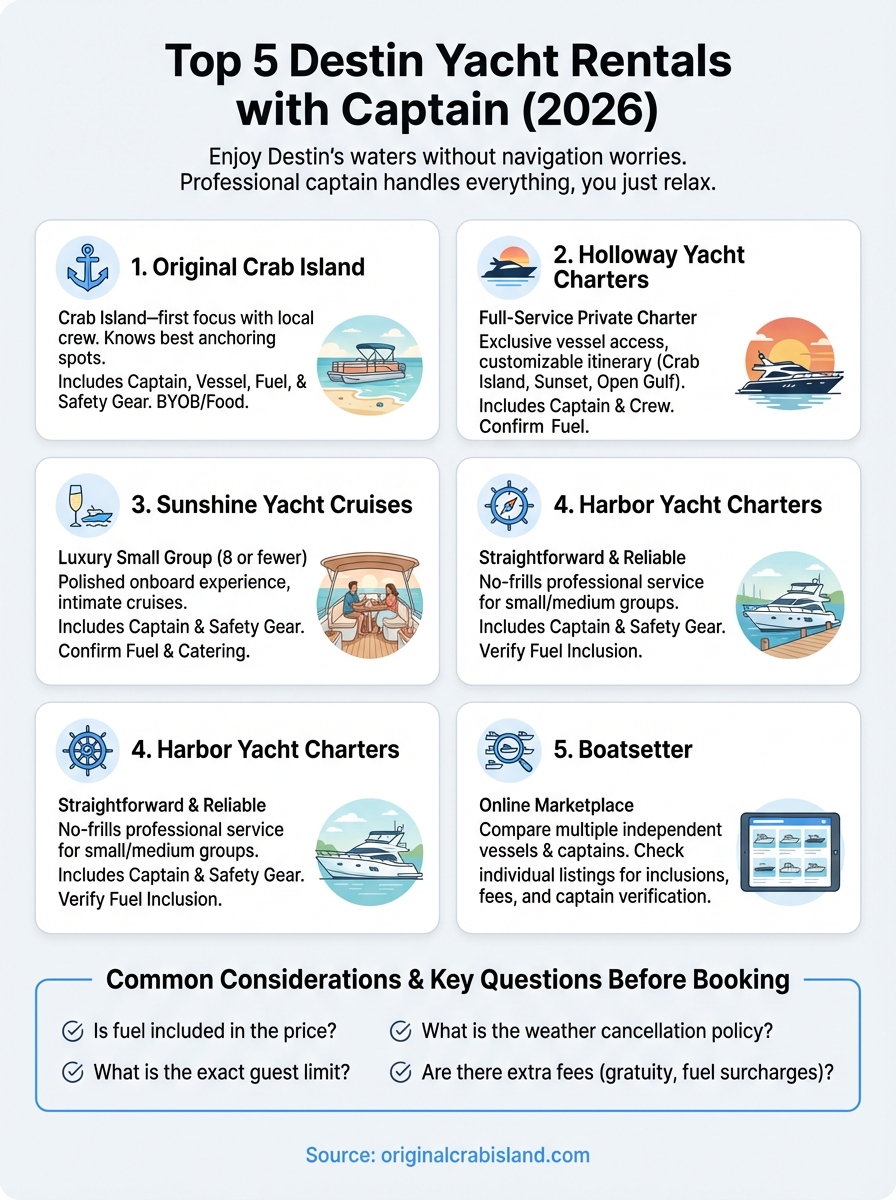
1. Original Crab Island
Original Crab Island is a Destin-based rental and charter service built around getting visitors out on the water with a local crew that knows these specific waterways. If you want a Destin yacht rental with captain that makes Crab Island the centerpiece of your day, this is the place to start your search.
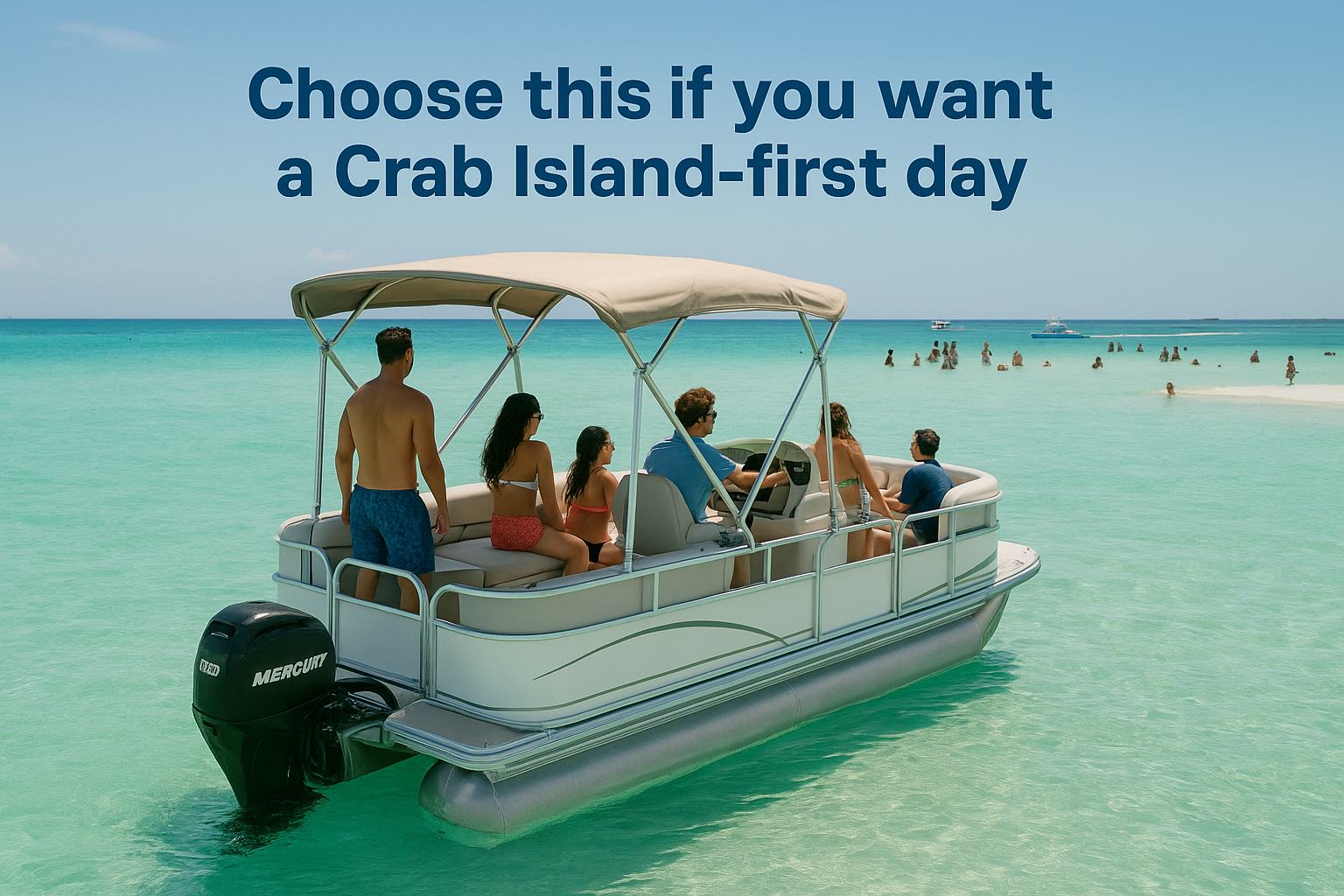
Choose this if you want a Crab Island-first day
Book here when your priority is anchoring at Crab Island and making the most of the sandbar experience. The crew spends every season navigating these waters, so they know the best spots to anchor, swim, and socialize without the guesswork.
Choosing a captain who works Crab Island daily means you spend more time enjoying the water and less time drifting around trying to find a good spot.
Know the yacht and crew options you can book
Original Crab Island operates pontoon boats and larger watercraft, each paired with a licensed captain. Every crew member brings hands-on local experience and handles all navigation, docking, and safety briefings for your group.
Plan your route, timing, and pickup location
Departures leave from Destin Harbor, and you set your pickup window when you book. Consider an early morning start for calmer water and better anchorage before crowds fill the sandbar.
Understand what the charter includes
Your booking covers the captain, vessel, and fuel for the planned route. Safety gear and standard onboard equipment are included with every charter.
Set expectations for food, drinks, and add-ons
You bring your own food and beverages. Coolers and ice are welcome aboard, and the crew can tell you exactly what to pack for a full day out.
Estimate total cost and common extra fees
Rates depend on vessel size and trip length. Confirm whether extended hours or extra stops carry additional costs before you finalize the booking.
Ask these questions before you book
Is fuel included in the quoted price?
What is the maximum guest count for your chosen vessel?
Can you add a dolphin-watching or sunset segment to the route?
2. Holloway Yacht Charters
Holloway Yacht Charters runs private captained charters out of Destin, making it a strong pick when you want dedicated service and a crew that manages every detail of your destin yacht rental with captain from departure to docking.
Choose this if you want a full-service private charter
Book with Holloway when exclusive vessel access is non-negotiable for your group. Every trip is privately yours, with no shared decks or unfamiliar guests cutting into your experience.
A fully private charter means the captain builds the day around your group, not a fixed public schedule.
Know the yacht sizes and guest limits
Holloway offers multiple vessel sizes to fit different group counts. Confirm the maximum passenger cap for your chosen boat before finalizing your headcount.
Pick a cruise style and itinerary
Choose from a Crab Island stop, sunset cruise, or open Gulf run. The captain adjusts the route around your priorities on departure day.
Understand what the charter includes
Your booking covers the licensed captain and full crew. Ask upfront whether fuel and safety equipment are included in the base rate.
Plan for food, drinks, and special requests
Most packages allow BYOB and outside catering. Confirm cooler space and any onboard restrictions before your trip date.
Estimate total cost and common extra fees
Pricing scales with yacht size and trip duration. Watch for fuel surcharges or gratuity added after the initial quote.
Ask these questions before you book
Is the captain licensed and insured?
What is the weather cancellation policy?
Can you change the route once underway?
3. Sunshine Yacht Cruises
Sunshine Yacht Cruises focuses on smaller, more intimate charters along Destin’s Emerald Coast. If you want a refined take on a Destin yacht rental with captain without booking a massive vessel for a large crowd, this operator fits that gap well.
Choose this if you want a luxury yacht feel for a small group
Book here when your group is eight people or fewer and you want a polished onboard experience without paying for space you won’t use.
Smaller vessels often deliver a more personal trip, since the captain spends more time with your group rather than managing a packed deck.
Know the fleet, layouts, and onboard amenities
Sunshine runs well-appointed smaller yachts with comfortable seating and shaded deck areas. Confirm cabin access and restroom availability before your booking is finalized.
Plan a sunset, day cruise, or Crab Island stop
Their itineraries cover afternoon Crab Island visits, full-day coastal runs, and sunset departures. Pick the window that matches your group’s schedule and priorities.
Understand what the charter includes
Your rate typically covers the captain and standard safety equipment. Verify whether fuel costs are bundled or billed separately.
Coordinate catering, alcohol rules, and celebrations
Ask directly about outside food and alcohol policies. Many celebration packages allow you to bring your own catering with advance notice.
Estimate total cost and common extra fees
Rates reflect trip length and vessel selection. Budget for potential gratuity and docking fees on top of the base price.
Ask these questions before you book
What is the minimum booking duration?
Does the captain allow route adjustments mid-trip?
Are decorations or celebration setups permitted onboard?
4. Harbor Yacht Charters
Harbor Yacht Charters operates captained private charters out of Destin Harbor, making it a reliable choice when you want a no-frills destin yacht rental with captain that delivers a clean, professional day on the water without a lot of extras to sort through.
Choose this if you want a straightforward captained yacht day
Book with Harbor when your group values reliability and simplicity over elaborate package upgrades. The focus here is on getting you out on the water with a licensed captain who handles the logistics while you enjoy the ride.
A straightforward charter works especially well for first-time groups who want a great experience without managing complex package decisions.
Know the yacht options and passenger cap
Harbor offers a focused fleet of mid-size yachts suited for small to medium groups. Confirm the exact guest limit for your vessel before inviting your full headcount.
Plan your departure window and must-see stops
Ask the captain about morning versus afternoon departures and which windows offer calmer water. Build in stops at Crab Island or local coastal landmarks based on your group’s priorities.
Understand what the charter includes
Your booking covers the captain and onboard safety equipment. Verify whether fuel is bundled into the base rate before you confirm.
Confirm add-ons, policies, and onboard rules
Ask directly about outside food, beverages, and any prohibited items. Clarify the policy on music, decorations, and guest behavior before departure day.
Estimate total cost and common extra fees
Rates scale with trip duration and yacht selection. Watch for gratuity and fuel surcharges that may appear outside the initial quote.
Ask these questions before you book
Is the captain fully licensed and insured?
What is the weather cancellation and rescheduling policy?
Can you extend the trip if the group wants more time on the water?
5. Boatsetter
Boatsetter is an online marketplace where independent boat owners and licensed captains list their vessels for private charter. If you want to browse multiple options for a destin yacht rental with captain in one place rather than calling individual operators, this platform gives you that flexibility.
Choose this if you want to compare multiple yachts fast
Use Boatsetter when comparing prices, vessel styles, and captain reviews matters more than booking through a single dedicated charter company. The platform lets you filter results quickly and read verified reviews before committing.
A marketplace comparison works best when your group has specific requirements that one operator might not fully meet on their own.
Understand how captained bookings work on a marketplace
Each listing specifies whether a licensed captain is included or available as an add-on. You book directly through the platform, and the individual owner or captain manages the trip from there.
Filter for the right size, style, and pickup area
Filter by guest count, vessel type, and departure location to narrow results to Destin-area yachts with captains.
Understand what the charter includes and who provides it
Inclusions vary by listing, so read each charter description carefully rather than assuming a standard package applies across the board.
Watch for fees, deposits, and insurance details
Boatsetter charges a platform service fee on top of the listed rate. Confirm the deposit amount and refund policy before you pay.
Estimate total cost and common extra fees
Budget for the service fee, fuel costs, and captain gratuity alongside the base rate.
Ask these questions before you book
Is the captain’s license verified through the platform?
What is the cancellation window for a full refund?
Does the listing price include fuel?
Next Steps
You now have five solid options for a Destin yacht rental with captain that cover everything from a Crab Island-focused day to marketplace comparisons. Each operator on this list handles the navigation so your group can focus entirely on enjoying the water. The right choice depends on your group size, budget, and what you actually want to do once you’re out there.
Start by narrowing your list to two or three operators that match your priorities, then call each one directly to confirm pricing, availability, and what’s included. Getting specific answers before you book saves you from surprises on the day of your trip. Ask about fuel, guest limits, and cancellation policies every time.
Whether you’re casting a line off the Destin shore or heading into the Gulf for a deep-sea adventure, you’ll need a valid FWC Florida fishing license before you wet a hook. The Florida Fish and Wildlife Conservation Commission (FWC) requires one for nearly every angler in the state, and skipping it can mean fines starting at $50, not exactly the vacation souvenir you’re after.
At Original Crab Island, we help visitors make the most of Destin’s waters every day through fishing charters, pontoon rentals, and guided trips. One of the most common questions we hear is about licensing, who needs one, how much it costs, and where to actually buy it. So we put together this straightforward guide to answer all of that.
Below, you’ll find a step-by-step walkthrough of how to buy or renew your Florida fishing license online through the official FWC portal, along with details on pricing, exemptions, and a few tips that’ll save you time. Getting licensed takes about five minutes, and then you’re free to focus on what actually matters: catching fish.
What you need before you buy or renew
Before you log into the FWC portal, gather a few key details so the process goes smoothly. The whole purchase takes about five minutes, but only if you’re not hunting around for information mid-checkout. Having everything ready upfront means no paused sessions or incomplete orders.
Your personal details
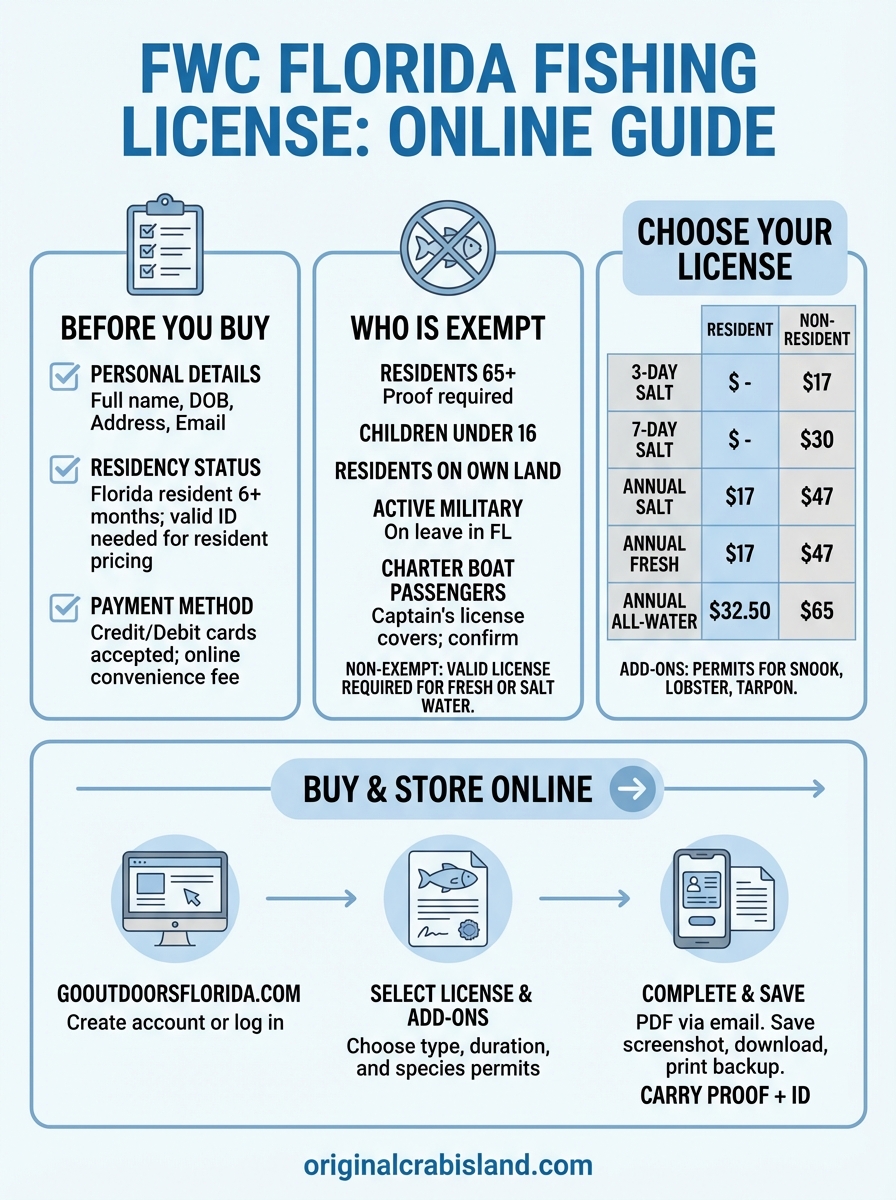
The portal will ask for your full legal name, date of birth, and home address. If you’re a Florida resident, you’ll also need your Florida driver’s license number or state ID number to verify residency and unlock resident pricing. Non-residents don’t need a Florida ID, but you will need a valid government-issued ID to reference. Keep your email address handy too, since your license confirmation and digital copy go straight to your inbox.
Make sure the name you enter matches your government-issued ID exactly, since FWC officers may check both during an inspection.
Your residency status and payment method
Your residency status determines which license category and price tier you qualify for. Florida residents pay significantly less than non-residents, so it’s worth confirming your status before you start. You qualify as a Florida resident if you’ve lived in the state for at least six consecutive months before applying.
For payment, the GoOutdoorsFlorida portal accepts major credit and debit cards, including Visa, Mastercard, Discover, and American Express. There’s a small convenience fee for online transactions, typically around $2 to $3. If you want to avoid that fee, you can purchase your FWC Florida fishing license in person at a licensed agent like a local tackle shop or county tax collector’s office, though online is faster for most visitors.
Step 1. Check if you need a Florida fishing license
Not everyone who drops a line in Florida needs a license. Before you pull up the FWC portal, spend one minute confirming your situation so you don’t pay for something you don’t actually need.
Who is exempt
Several groups are fully exempt from holding an FWC Florida fishing license, and the list covers more people than most visitors expect. Check the exemptions below before you buy:
Florida residents age 65 and older with proof of residency
Children under 16 years old, regardless of residency
Florida residents fishing from their own land or a family member’s land
Active-duty military personnel stationed in Florida, on leave with valid orders
Anglers fishing on a licensed charter boat or for-hire vessel (the captain’s license covers passengers)
If you’re booking a guided fishing charter in Destin, confirm with the operator that their vessel license covers you before assuming you’re exempt.
Who does need one
If you don’t fall into one of those categories, you need a valid license before you fish in Florida’s fresh or salt water. This applies to residents and non-residents alike, so out-of-state visitors planning to fish independently should complete this process before they hit the water.
Step 2. Pick the right license and add-ons
Florida offers several license options, and picking the right one upfront saves you from overpaying or buying something that doesn’t cover your trip. The FWC Florida fishing license structure is split by residency, water type, and duration, so take a moment to match the right option to your plans before you reach the checkout screen.
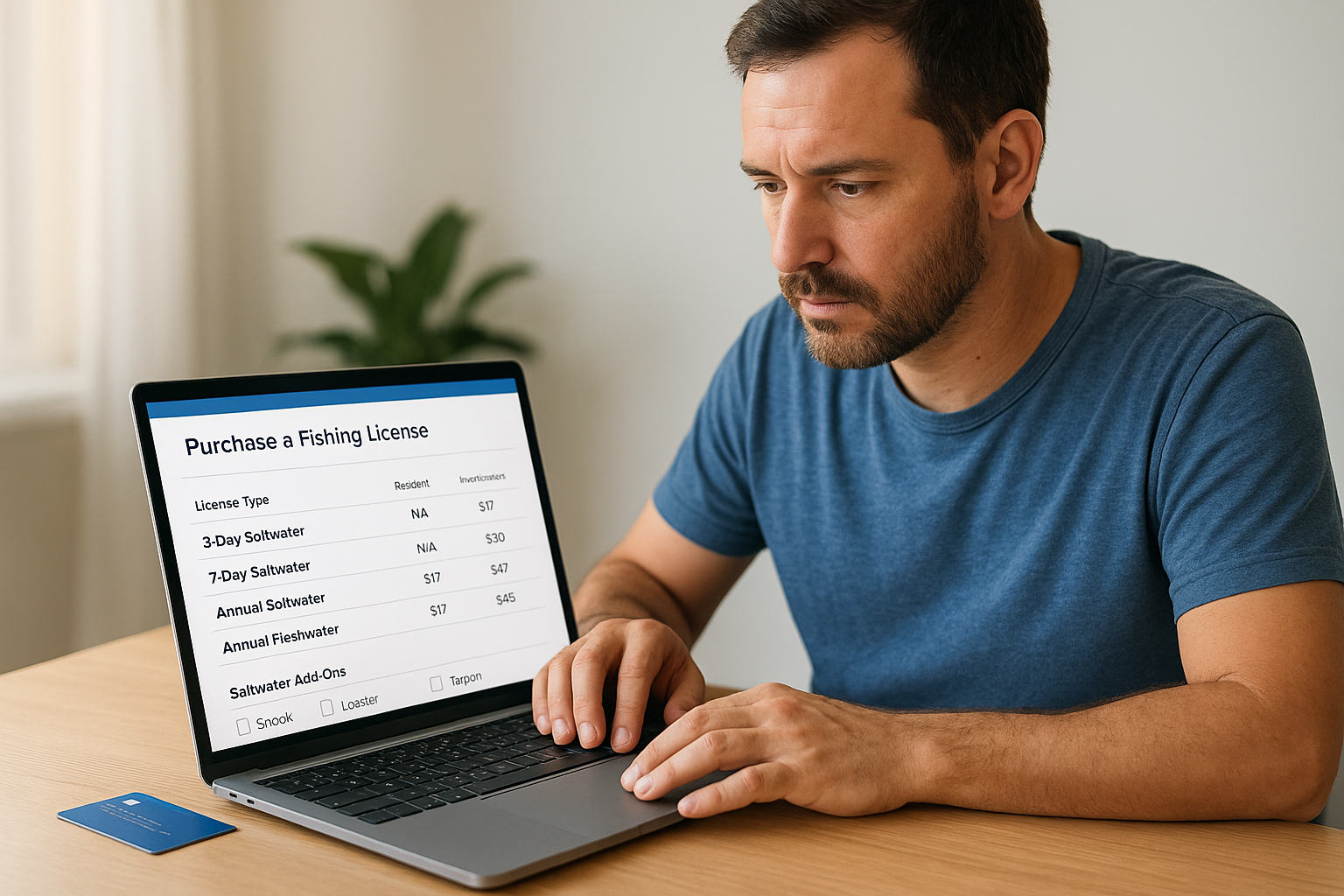
License types and prices
Your two main variables are residency status and how long you plan to fish. Here’s a breakdown of the most common options:
License Type
Resident
Non-Resident
3-Day Saltwater
N/A
$17
7-Day Saltwater
N/A
$30
Annual Saltwater
$17
$47
Annual Freshwater
$17
$47
Annual All-Water
$32.50
$65
If you’re visiting Destin for a week or less, the 7-day non-resident saltwater license is almost always the best value.
Saltwater add-ons
Some species require additional permits on top of your base license. If you plan to target snook, lobster, or tarpon, purchase the matching add-on separately during checkout. The portal displays all available add-ons after you select your base license, so scroll through that list before you confirm your order.
Step 3. Buy or renew on GoOutdoorsFlorida
With your details ready and your license type selected, head to GoOutdoorsFlorida.com, which is the official FWC portal for purchasing and renewing your Florida fishing license. The site handles both first-time buyers and renewals through the same login flow, so the process is identical regardless of where you are in the cycle.
Create or log in to your account
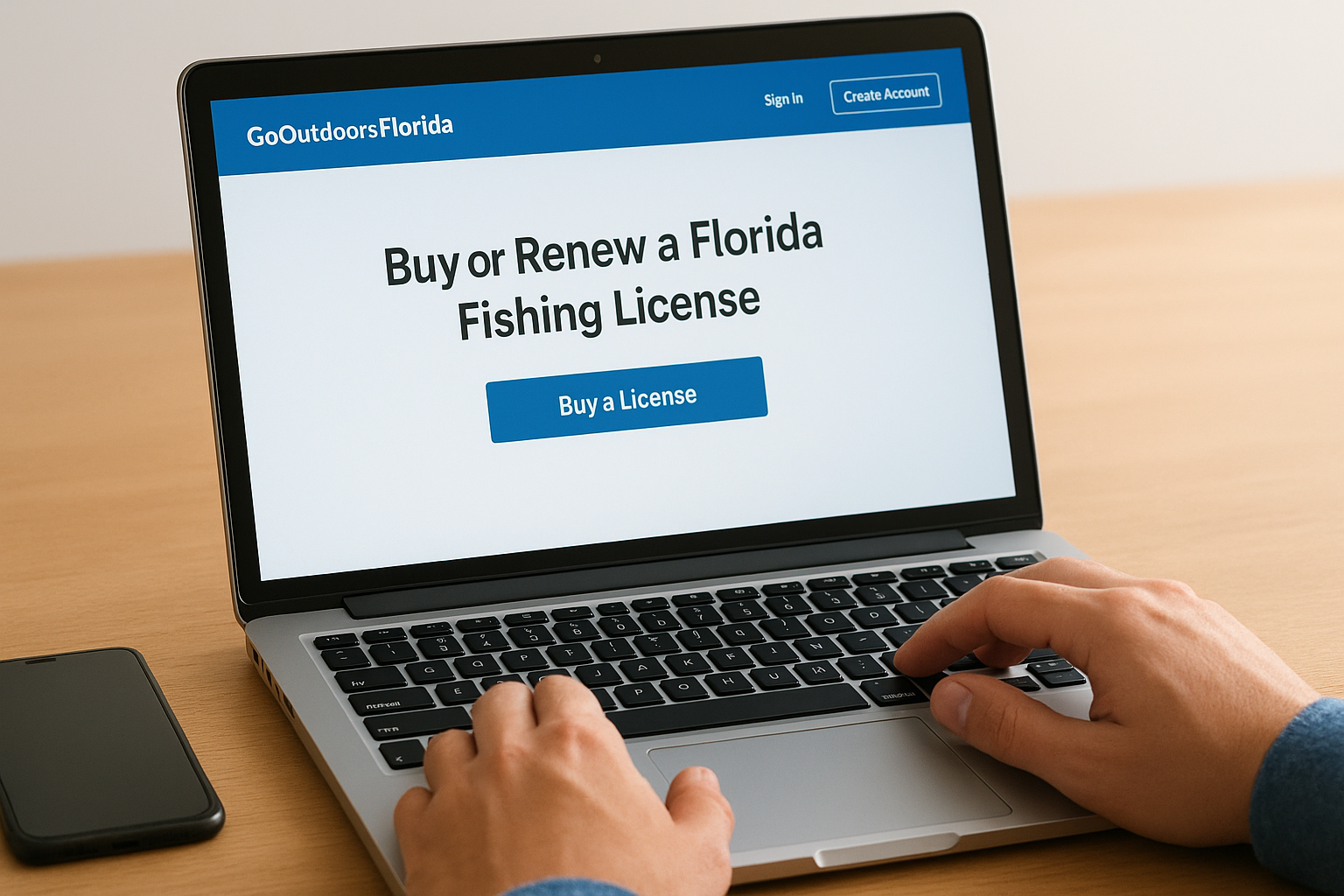
Visit GoOutdoorsFlorida.com and click "Sign In" at the top right. If this is your first purchase, select "Create Account" and fill in the required fields:
Full legal name
Email address
Date of birth
Home address
Returning customers simply log in with their existing credentials and skip straight to the purchase screen.
Complete your purchase
Once you’re logged in, select "Buy a License" from the main menu, choose your license type and duration, add any species-specific permits, then proceed to checkout. Enter your payment details and confirm your order. Your FWC Florida fishing license arrives in your inbox as a PDF within minutes. Save it to your phone or print it before you head to the water.
Screenshot your confirmation page right after purchase as a backup in case the confirmation email is delayed.
Step 4. Store your license and stay compliant
Buying your FWC Florida fishing license is only half the job. Florida law requires you to carry proof of your license while fishing, and FWC officers can ask to see it at any time on the water. Being prepared before you launch saves you from scrambling at the worst moment.
Save a digital and printed copy
Your license PDF arrives by email, so download it to your phone immediately and keep it in a dedicated folder you can access without a signal. Cell service on the water is not always reliable, so print a backup copy and store it in a waterproof bag in your tackle box or dry bag. Here’s a quick checklist to cover both options:
Screenshot the confirmation page right after purchase
Download the PDF to your phone’s Photos app or Files app for offline access
Print one copy and seal it in a small zip-lock bag
Offline access matters more than most anglers realize; screenshot the license before you leave the dock.
Know what officers check
FWC officers verify your name, license number, and expiration date during inspections. Make sure the information on your license matches your government-issued ID exactly to avoid any complications on the water. Run through these points before every trip:
Confirm your license has not expired
Verify any species add-ons match what you plan to target
Keep your ID alongside your license at all times
You’re ready to fish
With your FWC Florida fishing license purchased, saved to your phone, and backed up in print, you’ve cleared the one administrative hurdle standing between you and the water. The whole process takes under five minutes, and now your only focus is the fishing itself rather than last-minute paperwork.
Destin puts some of the best saltwater fishing on the Gulf Coast right at your doorstep, from snapper and grouper to amberjack and king mackerel running out in the Gulf. If you’d rather skip the planning and get straight to the action, a guided charter handles the gear, the bait, and the navigation for you.
Ready to get on the water? Original Crab Island’s fishing charters take you into the Gulf with experienced captains who know exactly where the fish are running. Show up with your valid license, and let the crew handle the gear, the navigation, and the rest of the day.
Destin sits right on the edge of some of the most productive fishing waters in the Gulf of Mexico, and that reputation extends well beyond deep-sea trips. If you’re searching for inshore fishing charters Destin has to offer, you’re looking at a style of fishing that’s perfect for younger anglers and families who want action without the long boat ride. Calm, shallow waters along the harbor, bay, and coastal flats mean less seasickness, shorter trips, and more fish on the line.
At Original Crab Island, we help families get out on the water every day, from pontoon rentals at Crab Island to guided fishing trips across the Emerald Coast. We know which operations deliver a great experience for kids and which ones cut corners. That firsthand knowledge is exactly what shaped this list.
Below, you’ll find five inshore fishing charters in Destin that consistently earn praise from families. We looked at captain experience, kid-friendliness, gear quality, and overall value to help you pick the right trip without second-guessing your choice.
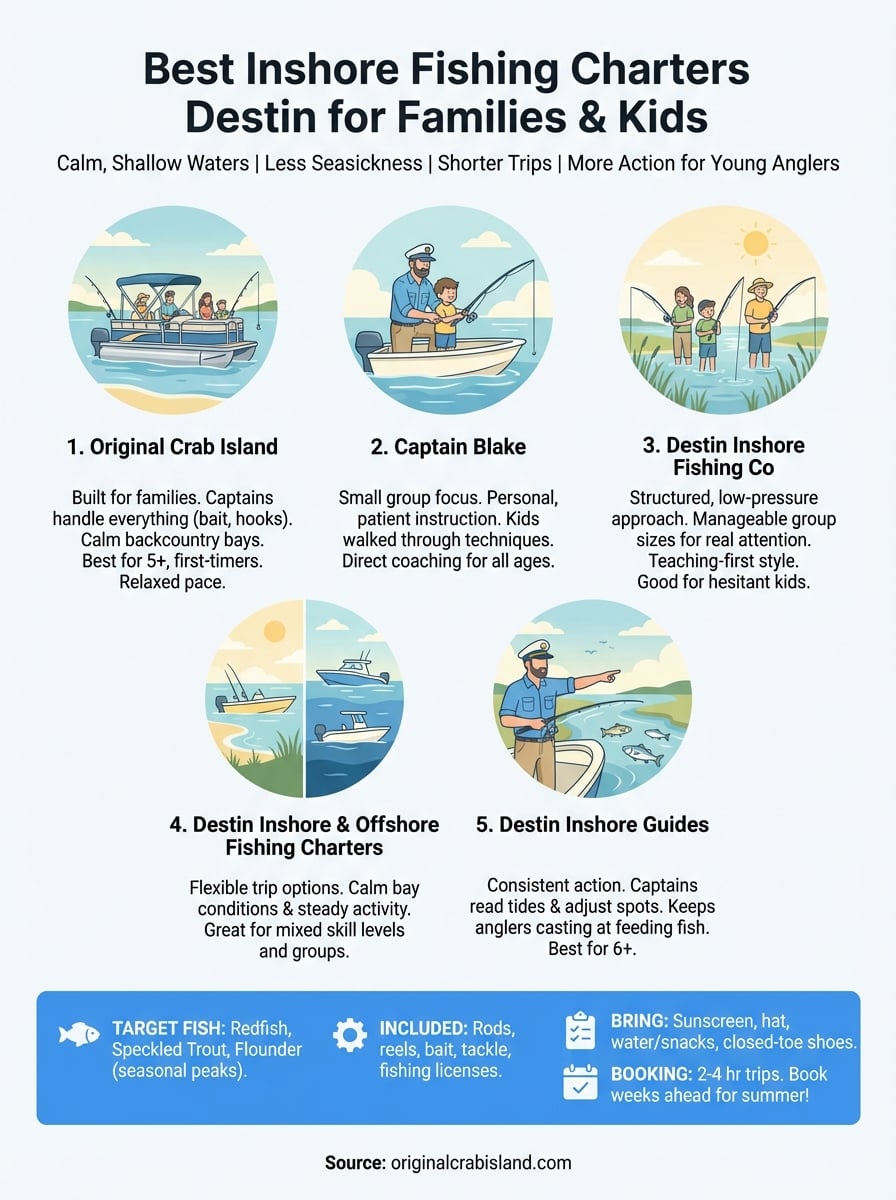
1. Original Crab Island
Original Crab Island runs guided inshore fishing charters out of Destin that are built specifically around family-friendly experiences. Captains handle everything from bait setup to fish identification, so you’re not stuck managing a rod while trying to keep track of your kids at the same time.
How the family inshore trips work
Your captain launches from Destin Harbor and heads into the backcountry bays, grass beds, and shallow flats of the Choctawhatchee Bay system. These protected waters keep the boat steady and the ride smooth, which means younger kids stay comfortable and engaged instead of fighting seasickness.
Who this charter is best for
This charter works well for families with kids ages 5 and up, first-time anglers, and groups who want a relaxed pace rather than a high-pressure fishing experience. You don’t need any prior fishing knowledge to walk away with fish.
If you’ve never taken kids fishing before, an inshore charter is the right starting point before committing to longer offshore trips.
Target fish and seasonal expectations
Redfish, speckled trout, and flounder are the primary targets throughout the year. Spring and fall deliver the most consistent bite, while summer trips still produce well in the early morning hours before water temperatures peak.
What’s included and what to bring
Your trip includes rods, reels, tackle, bait, and fishing licenses for all passengers. Bring sunscreen, polarized sunglasses, a hat, and snacks or drinks for the kids. Water shoes or closed-toe footwear are recommended for boarding and moving around the boat safely.
Pricing, trip length, and booking tips
Trips run two to four hours, with pricing that scales by group size and trip length. Book at least a few days ahead during peak summer months. You can reserve your charter online at originalcrabisland.com to lock in your preferred date before slots fill up.
2. Captain Blake
Captain Blake runs one of the most family-recommended inshore fishing charters Destin regulars return to year after year. His focus on small group sizes and personal instruction sets him apart from larger operations where younger anglers can get overlooked.
How the family inshore trips work
Captain Blake works the shallow flats and tidal creeks of Choctawhatchee Bay, where calm water keeps the ride comfortable from start to finish. He takes time to walk kids through each technique, so the experience stays educational and engaging rather than just standing around waiting for a bite.
Who this charter is best for
This charter works well for families with kids of any age and small groups who want direct, patient coaching from a guide who enjoys teaching. First-timers will feel comfortable and well-supported throughout the entire trip.
Smaller group capacity means every angler on board gets more rod time and more one-on-one attention from the captain.
Target fish and seasonal expectations
Redfish and speckled trout are the primary targets, with flounder becoming more active during fall when water temperatures cool across the bay flats.
What’s included and what to bring
Captain Blake supplies all the rods, reels, bait, and tackle your group needs. Bring the following for comfort on the water:
Sunscreen and a wide-brim hat
Water and snacks for the kids
Closed-toe shoes for boarding
Pricing, trip length, and booking tips
Two-hour and four-hour trips are available depending on your schedule. Summer slots fill fast, so book at least a week out if your trip lands in June or July.
3. Destin Inshore Fishing Co
Destin Inshore Fishing Co runs family-oriented inshore fishing charters Destin visitors book for its structured, low-pressure approach on the water. Captains keep group sizes manageable, which means your kids get real attention rather than being shuffled to the side while adults handle the gear.
How the family inshore trips work
Your captain targets the shallow grass flats and protected bays surrounding Destin, where smooth water and consistent fish activity make for an ideal family outing. The trip moves at a comfortable pace so younger anglers stay interested without getting worn out.
Who this charter is best for
This charter works well for families with first-time anglers who want a patient guide walking them through each step. Groups who prefer learning over just catching fish tend to appreciate this operation’s teaching-first style.
If your kids are nervous about handling bait or casting for the first time, a guide who takes the time to explain each step makes a real difference.
Target fish and seasonal expectations
Redfish and speckled trout are the primary focus year-round. Flounder activity increases in fall as bay water temperatures drop.
What’s included and what to bring
Rods, reels, live bait, and fishing licenses are all provided. Pack the following:
Sunscreen and a wide-brim hat
Water and snacks for kids
Closed-toe shoes for the boat
Pricing, trip length, and booking tips
Trips run two to four hours, with rates that fit a family vacation budget. Book at least one week out during summer to avoid missing your preferred date.
4. Destin Inshore and Offshore Fishing Charters
Destin Inshore and Offshore Fishing Charters gives families flexible trip options, with inshore excursions targeting the protected bay system that makes shallow-water fishing so accessible for kids and first-time anglers.
How the family inshore trips work
Your captain works the shallow flats and tidal zones of Choctawhatchee Bay, where calm conditions and steady fish activity keep younger anglers engaged from the first cast to the last.
Who this charter is best for
This charter works well for mixed groups where some members want a relaxed inshore experience while others consider venturing farther out on a separate trip. Groups with varying skill levels will appreciate the straightforward, low-pressure approach on the water.
Access to both inshore and offshore options through the same operator simplifies planning for families with different fishing goals.
Target fish and seasonal expectations
Redfish and speckled trout are the main targets year-round. Flounder activity increases in fall when cooler water temperatures draw them onto the bay flats in higher numbers.
What’s included and what to bring
Your booking covers rods, reels, bait, and fishing licenses for all passengers. Bring sunscreen, hats, water, and closed-toe shoes for boarding and moving around the boat.
Pricing, trip length, and booking tips
Two-hour and four-hour trips are available to fit different schedules. These inshore fishing charters Destin visitors book fill fast in summer, so reserve your date at least a week in advance.
5. Destin Inshore Guides
Destin Inshore Guides is one of the family-friendly inshore fishing charters Destin visitors count on for consistent action in the shallows. Captains focus on reading tides and adjusting spots to keep younger anglers casting at actively feeding fish throughout the trip.
How the family inshore trips work
Your captain works the shallow flats and tidal channels of Choctawhatchee Bay, repositioning as needed to find feeding fish. Calm water and short runs keep younger kids comfortable from the first cast to the last.
Who this charter is best for
This charter suits families with kids ages 6 and up who want steady action and patient instruction on the water. Groups who value a guide that reads conditions and moves accordingly will get more out of this trip than from a static, single-spot approach.
A captain who adjusts to tides and shifting conditions gives younger anglers more opportunities to actually catch fish.
Target fish and seasonal expectations
Redfish and speckled trout are the main targets year-round. Flounder numbers increase in fall when cooler bay temperatures pull them onto the flats in higher concentrations.
What’s included and what to bring
Your booking includes rods, reels, bait, tackle, and fishing licenses. Bring sunscreen, a hat, and closed-toe shoes for moving around the boat safely.
Pricing, trip length, and booking tips
Two-hour and four-hour trips are both available to fit your vacation schedule. Book at least one week ahead in summer to lock in your preferred time slot before openings disappear.
Your next steps for a kid-friendly trip
All five options on this list deliver steady action, patient guidance, and calm protected water that keeps younger anglers engaged from the first cast to the last. The right inshore fishing charters Destin families choose comes down to group size, how much one-on-one instruction your kids need, and which dates fit your travel window.
Check availability for your dates as soon as your trip is confirmed. Summer slots fill weeks in advance, and waiting until you land in Destin usually means limited options rather than the specific trip your group actually wants. Booking early also gives you room to coordinate other water activities around your fishing schedule without scrambling at the last minute.
If you’ve ever searched for a fishing charter in Destin, you’ve probably seen the terms deep sea fishing vs offshore fishing thrown around like they mean two completely different things. Sometimes they do. Sometimes they don’t. It depends on who you ask, and that confusion is exactly why so many anglers end up booking a trip that doesn’t match what they actually wanted.
Here’s the short answer: both terms describe fishing that takes place away from the shoreline, but they differ in distance from shore, water depth, target species, and the gear involved. Deep sea fishing generally refers to trips in waters 100 feet deep or more, while offshore fishing is a broader category that can start much closer to land. The distinction matters because it directly affects what you’ll catch, how long you’ll be out, and how much you’ll spend.
At Original Crab Island, we run fishing charters out of Destin, Florida, one of the most productive fishing destinations in the entire Gulf of Mexico. Our guests ask us about this difference all the time before booking, and we’d rather they understand exactly what they’re signing up for than end up on the wrong trip. This article breaks down the real, practical differences between deep sea and offshore fishing so you can choose the experience that fits your skill level, your budget, and the species you want to target.
Why these terms get used interchangeably
The confusion between deep sea fishing and offshore fishing doesn’t come from anglers being careless with language. It comes from the fact that the fishing industry itself has never settled on a single, binding definition for either term. You won’t find a federal regulation that draws a hard line between the two. No licensing body requires charter companies to label their trips one way or the other. That gap in standardization means everyone from a charter captain in Destin to a YouTube fishing channel fills in their own definition, and the result is that both terms get used to describe trips that can look almost identical on the surface.
The fishing industry has no universal standard
Most industries have a governing body or shared terminology that keeps language consistent. Commercial fishing has regulations, catch limits, and licensing structures, but recreational and charter fishing terminology operates more on tradition and regional habit than on any formal rulebook. When you search for a deep sea fishing vs offshore fishing comparison, you’re essentially asking about two terms that evolved organically from different fishing communities over decades, not two categories that anyone deliberately defined and separated.
The absence of a shared standard is the single biggest reason these terms cause confusion for anyone booking their first charter trip.
Because no authority standardized the language, different regions developed their own usage patterns. A captain in Louisiana might call anything past 30 miles "deep sea." A captain in the Florida Panhandle might use "offshore" and "deep sea" as synonyms without a second thought. You get different answers depending on who you ask, and that inconsistency compounds every time someone writes a charter listing, posts a fishing video, or talks to a friend about their last trip.
How charter marketing blurs the line further
Charter companies write their listings to match what potential customers type into search engines, not to educate anglers on technical distinctions. If "deep sea fishing Destin" gets searched more than "offshore fishing Destin," you’ll see more charters use "deep sea" in their titles, even if the trip only runs 20 miles out into 80 feet of water. The marketing layer on top of the already-fuzzy industry language makes both terms even harder to pin down.
This isn’t deliberate misdirection. Charter operators genuinely understand that their customers use these terms loosely, and they match that language to stay visible. The result is that you’ll find two charters offering what look like identical trips, one calling it "deep sea" and the other calling it "offshore," because both terms appeal to the same search behavior. Until you look at the actual trip details like distance, depth, target species, and duration, you won’t know whether those two listings are actually the same type of trip or meaningfully different.
Why anglers and media reinforce the overlap
Television fishing shows and online fishing content have played a significant role in cementing the interchangeable use of both terms. Shows set in the Gulf of Mexico tend to use "deep sea" because it sounds more dramatic, while written fishing guides often default to "offshore" because it’s more technically accurate as a broad category. Viewers and readers absorb both terms applied to the same footage and the same fish, which trains them to treat the words as synonyms.
Your own social circle probably reinforces this too. When a friend tells you they went deep sea fishing and caught mahi-mahi, they almost certainly went on an offshore trip that may or may not have reached truly deep water. The story gets told with whichever term sounds right in the moment, and that casual usage stacks up over time into widespread confusion. Understanding why the terms overlap puts you in a better position to ask the right questions when you’re actually ready to book.
The practical definitions anglers use
Even without a universal standard, working definitions have emerged from how anglers actually talk about their fishing experiences. These aren’t official categories, but they’re consistent enough across the Gulf Coast that knowing them will help you cut through the noise when comparing charters and reading trip descriptions. When you understand what experienced fishermen mean by each term, the deep sea fishing vs offshore fishing debate becomes much easier to navigate.
What anglers mean by offshore fishing
Offshore fishing is the broader of the two terms, and most experienced anglers use it to describe any trip that takes you past inshore waters, which typically means beyond the three-mile mark where the ocean floor starts to drop away from the continental shelf. On a practical level, offshore fishing can happen in water anywhere from 30 feet deep to several hundred feet deep, depending on the trip. That wide range is exactly why "offshore" works as an umbrella term.
When a captain describes a trip as offshore, they usually mean you’ll be targeting pelagic species, fish that live in the open water column rather than near structure on the bottom. Mahi-mahi, wahoo, and kingfish are common offshore targets in the Gulf of Mexico, and you can reach productive grounds for these fish without venturing into extreme depths. Most offshore trips out of Destin run anywhere from 20 to 60 miles from the coast, and the depth at those distances varies considerably depending on the direction you travel.
What anglers mean by deep sea fishing
Deep sea fishing carries a more specific depth implication than offshore. In practical angler usage, this term typically refers to trips that reach water depths of 100 feet or more, often pushing into the 300-to-1,000-foot range or beyond. The key distinction isn’t just distance from shore but the actual depth of the water you’re fishing in, which changes the species you’ll target, the gear you’ll need, and the techniques your captain will use.
The depth of the water, not the miles from shore, is what separates a deep sea trip from a standard offshore outing.
When someone tells you they went deep sea fishing and pulled up red snapper, grouper, or amberjack, they’re describing bottom fishing in deeper water where these species hold tight to rocky structure and artificial reefs. That type of fishing requires heavier tackle, longer drop times, and trips that generally run farther from the dock than a standard offshore excursion.
Distance and depth benchmarks in the Gulf of Mexico
The Gulf of Mexico has a unique underwater topography that makes the distance-depth relationship less predictable than you might expect. Unlike the Atlantic, where the continental shelf drops off sharply not far from shore, the Gulf shelf extends gradually for a long stretch before plunging into deep water. That geography directly shapes what deep sea fishing vs offshore fishing looks like when you’re departing from a Destin dock.
How the Gulf floor drops off from Destin
Destin sits in a favorable position along the Florida Panhandle, where the continental shelf is relatively narrow compared to areas farther west in the Gulf. Heading south from Destin, you’ll find yourself in 100-foot water within roughly 20 to 30 miles offshore, depending on your exact heading. That’s a faster depth gain than you’d see departing from, say, a Louisiana port, which means deep water is more accessible from Destin than from many other Gulf Coast departure points.
By the time you reach 40 to 50 miles out, depths can climb past 300 feet. Push farther to the 80-to-100-mile range and you’re approaching the shelf edge, where the bottom falls away dramatically into water exceeding 1,000 feet. Your trip’s target depth determines nearly everything else about the experience, from the species you’ll encounter to the amount of time you’ll spend traveling versus actually fishing.
The proximity of deep water to Destin is one of the main reasons the area consistently produces some of the best offshore and deep sea fishing in the entire Gulf of Mexico.
Where the depth benchmarks fall for each trip type
Here’s how the distance and depth ranges typically break down for trips out of Destin:
Trip Type
Approximate Distance
Approximate Depth
Nearshore offshore
10-25 miles
30-80 feet
Standard offshore
25-50 miles
80-200 feet
Deep sea
40-80+ miles
200-600+ feet
Extreme deep sea
80-100+ miles
600-1,000+ feet
Keep in mind these ranges overlap intentionally, because depth varies by heading and seasonal conditions shift where fish hold. A trip running 35 miles due south might land you in 150 feet of water, while the same distance in a slightly different direction could put you in 250 feet. When you’re comparing charters, always ask the captain for both the target mileage and the expected bottom depth, not just one or the other.
Fish you can expect on each type of trip
Species is where the deep sea fishing vs offshore fishing distinction becomes most tangible. The depth and distance of your trip directly determine which fish live in that water column, and understanding those target species upfront helps you pick the right charter instead of hoping you stumble onto the fish you actually want to catch.
What offshore trips put in the box
Offshore trips in the 20-to-50-mile range out of Destin consistently produce pelagic species that spend most of their lives in open water rather than hugging the bottom. Mahi-mahi, also called dolphin fish, are a staple target because they congregate around floating structure like weed lines and debris, which you can find at those distances without pushing into extreme depths. Wahoo and kingfish are two other species that show up reliably on standard offshore trips, and both put up a serious fight on lighter tackle.
Mahi-mahi are one of the most visually striking and sought-after species you’ll encounter on an offshore trip, and their aggressive feeding behavior makes them accessible to anglers at almost any experience level.
Blackfin tuna also enter the picture on offshore trips, particularly when you’re working depths in the 100-to-200-foot range. These fish run in schools and respond well to live bait and trolling setups, which are standard approaches your captain will already have rigged before you leave the dock.
What deep sea trips bring to the surface
Deep sea fishing shifts the target species entirely toward bottom-dwelling fish that hold tight to structure in deeper water. Red snapper and grouper are the two species most anglers come to Destin specifically to catch, and both require depths of at least 100 feet to find consistently. Amberjack and tilefish also fall into this category, with tilefish in particular requiring drops into water well past 400 feet.
These bottom species demand heavier tackle and more patience than their pelagic counterparts because you’re dropping weight to the seafloor and waiting for fish that feed near structure rather than chasing bait through the water column. The payoff is that snapper and grouper are some of the best-eating fish in the Gulf, which is part of why demand for these trips stays high throughout the season.
Seasonal patterns that shift the catch
Season affects both categories significantly, so the species available on your specific travel dates matter as much as the trip type itself. Mahi-mahi peak in late spring through early fall in the Gulf, while red snapper season operates under federal regulations that limit when you can legally keep them, typically running from June through late summer with exact dates set annually by NOAA.
Techniques and tackle differences you’ll actually notice
The gear your captain puts in your hands will look noticeably different depending on whether you’re on an offshore or deep sea trip. Understanding those differences helps you know what to expect before you step onto the boat, and it gives you context for why deep sea fishing vs offshore fishing requires a fundamentally different approach to presentation and retrieval from start to finish.
How offshore fishing rigs work
Offshore trips out of Destin rely heavily on trolling and live bait presentations designed to cover water and intercept fast-moving pelagic species. Your captain will typically run multiple lines spread across the boat’s wake at varying distances, each rigged with lures, ballyhoo, or rigged squid that mimic the baitfish these species chase through the water column. The focus is movement and reaction strikes, not patient bottom work.
Trolling setups cover far more water than any stationary technique, which is why captains use them to locate scattered offshore species like wahoo and mahi-mahi efficiently.
When you’re not trolling, you might pitch live bait around floating structure or work a weed line with a pitch bait setup. Rod weights in the 20-to-50-pound class handle most of what you’ll encounter on a standard offshore trip, and the tackle stays light enough that you’ll feel every run clearly through the rod blank. Offshore gear generally favors speed and responsiveness over raw pulling power.
What changes when you drop into deep sea territory
Deep sea fishing shifts almost entirely to bottom fishing techniques that require heavier terminal tackle and longer drop times. You’ll use weighted rigs that often range from 4 to 32 ounces depending on current strength and depth, designed to reach the seafloor and hold position near the structure where snapper and grouper feed. The rod class jumps significantly, with 50-to-80-pound setups standard for larger grouper and amberjack in deep water.
Your retrieve changes too. Instead of a fluid trolling pass, you’re dropping to the bottom, feeling for contact, and working the bait with short lifts to attract fish holding tight to a reef or rock pile. Electric reels appear on some deeper trips because manually cranking a heavy rig from 400-plus feet is genuinely exhausting, especially after multiple drops across a full day on the water. Your arms will understand the difference between an offshore trip and a true deep sea outing the moment you feel that first heavy sinker hit bottom.
Boat size, trip length, and cost realities
The physical and financial differences between offshore and deep sea trips are just as real as the species differences, and they’ll shape your planning before you ever step onto a dock. When you compare deep sea fishing vs offshore fishing side by side, the boat, the hours, and the price tag tell a clear story about what each trip actually demands from both the captain and the angler.
What kind of boat each trip requires
Offshore trips running 20 to 50 miles from shore typically operate on center console boats or smaller sport fishing vessels in the 25-to-35-foot range. These boats are maneuverable, fuel-efficient at shorter distances, and capable enough to handle standard Gulf conditions. They work well for groups of four to six anglers and get you to productive water without the overhead of running a larger vessel.
Deep sea trips require significantly more boat because the distance, depth, and potential weather exposure at 60-plus miles offshore demand stability and range that smaller hulls simply can’t provide.
Full-sized sport fishing boats and larger offshore vessels in the 40-to-65-foot range are the standard platform for true deep sea outings. These boats carry more fuel, more tackle, and a larger crew, and their size gives you a more stable platform when Gulf conditions build throughout the day.
How long you’ll actually be on the water
Offshore trips typically run 6 to 8 hoursfrom departure to return, with a meaningful portion of that time spent actually fishing once you reach your target grounds. You get on the water early, run to your spot, fish through the productive morning window, and return before afternoon conditions deteriorate.
Deep sea trips stretch considerably longer. A full-day deep sea charter runs 10 to 12 hours, and some extreme trips pushing past 80 miles require an overnight departure or an early 4 a.m. launch just to reach the grounds during fishable daylight. Factor in that travel time increases significantly when your target depth sits farther offshore, and you can see why deep sea trips require a more serious time commitment than a standard offshore half-day.
What you should expect to pay
Offshore trips from Destin generally range from $150 to $300 per person on a shared charter, with private charters running higher depending on boat size and trip length. Deep sea charters cost more across the board because fuel consumption, captain experience, and trip duration all scale up with the distance involved. Private deep sea charters commonly run $1,200 to $2,500 or more for a full day, so understanding what depth and distance you actually want before you book keeps you from overpaying for a trip that doesn’t match your goals.
Who each trip fits best based on your goals
Choosing between deep sea fishing vs offshore fishing comes down to matching the trip to what you actually want out of a day on the water. Your experience level, target species, and tolerance for a long day offshore all point toward one type of trip over the other. Neither option is universally better, but one will fit your specific situation more cleanly than the other.
Offshore trips work best if you’re newer to saltwater fishing
If you haven’t spent much time on the open ocean, an offshore trip in the 20-to-50-mile range is the right starting point. The boat ride is shorter, the conditions you’ll encounter are generally more manageable, and the trolling and live bait techniques used on these trips are approachable for anglers at almost any skill level. You don’t need prior experience to follow a captain’s instructions on a trolling setup, and the visual excitement of watching a mahi-mahi crash a lure makes these trips genuinely fun even when the action slows.
Families with kids, first-timers, and anyone prone to motion sickness will have a far better experience on a shorter offshore run than on a full-day deep sea trip.
Offshore trips also work well when your group cares more about the overall experience than targeting a specific species. If the goal is to be out on the Gulf, catch something, and get back in time for dinner, a standard offshore charter delivers that without the physical and financial commitment of a deep sea outing.
Deep sea trips suit anglers with a specific target in mind
If you came to Destin specifically for red snapper, grouper, or amberjack, you need a deep sea trip. These species don’t show up consistently in shallow water, and no amount of skill compensates for fishing the wrong depth. Anglers who understand bottom fishing techniques and have spent time on longer charter trips will get the most out of a full-day deep sea outing because they know how to read the bite and work the gear without spending the first hour getting oriented.
Deep sea trips also fit anglers who treat the experience as the destination. The extra distance, the heavier tackle, and the longer time on the water are features rather than drawbacks if your goal is a serious fishing day. If you want to say you pulled a large grouper from 300 feet of water in the Gulf of Mexico, a deep sea charter is the only trip that delivers that.
Booking tips for Destin and Crab Island visitors
Destin puts you in an excellent position for both offshore and deep sea fishing, and understanding the deep sea fishing vs offshore fishing distinction before you contact a charter will save you from booking a trip that misses your target species entirely. Most charters list their trips by name rather than by depth or distance, so you need to ask specific questions before you hand over a deposit.
Ask about depth and distance, not just trip name
The name of a trip tells you almost nothing about where the boat will actually go. Before you confirm any charter, ask the captain two direct questions: how many miles offshore does the trip run, and what bottom depth are you targeting? A "deep sea" label on a charter listing means different things to different operators, but a captain who gives you a specific depth number is telling you exactly what type of fishing you’ll get.
Asking for the target depth in feet is the single most reliable way to confirm whether a charter will put you on the species you actually want to catch.
Know what the price includes before you pay
Charter prices in Destin vary widely, and the gap between a shared trip and a private charter can run several hundred dollars. Most charters include tackle, bait, and fish cleaning, but some add fuel surcharges or charge separately for ice and boxes. Confirm these details before you book so you’re not caught off guard at the dock. If you’re traveling with a group, a private charter often makes more financial sense per person than booking multiple spots on a shared trip.
Match your booking dates to species regulations
Federal red snapper regulations set a specific open season that changes annually, so your travel dates directly affect what you’re legally allowed to keep. Check the current season dates with NOAA Fisheries before you lock in your travel, especially if snapper is the primary reason you’re making the trip. Mahi-mahi and wahoo have no closed season in federal Gulf waters, which gives offshore trips more flexibility year-round.
Booking a fishing charter through Original Crab Island means you get local knowledge from captains who fish these waters regularly and understand exactly which depths are producing at any given point in the season. You can reserve your trip directly through our booking page and ask questions before you arrive in Destin.
Final take
The deep sea fishing vs offshore fishing debate has a straightforward answer once you strip away the marketing language: both describe fishing beyond inshore waters, but depth and distance separate them in ways that directly affect your species, your gear, and your day. Offshore trips put you on pelagic fish like mahi-mahi and wahoo in a manageable time frame. Deep sea trips take you farther, drop you deeper, and put you over structure-loving species like snapper and grouper that no shorter run will consistently produce.
Picking the right trip starts with knowing what fish you want and being honest about how long you want to be on the water. Ask your captain about target depth in feet, confirm what the price covers, and check red snapper season dates if that’s your target. When you’re ready to book a charter out of Destin, reserve your fishing trip with Original Crab Island and get on the water with captains who know these grounds.
Picture this: you’re on a boat, the sky is shifting from blue to gold to deep orange, and the water beneath you mirrors every color. That’s the basic idea behind a sunset cruise, a guided boat ride timed so you’re out on the water during the most photogenic hour of the day. But there’s more to it than just pretty skies.
A sunset cruise can include anything from complimentary drinks and light snacks to narrated tours, live music, or wildlife sightings depending on the operator, location, and type of vessel. Some are intimate and quiet; others feel more like a floating party. The experience varies widely, and knowing what to expect before you book makes all the difference.
Here in Destin, Florida, sunset cruises are one of the most popular ways to cap off a day on the water, and at Original Crab Island, we run them regularly along the Emerald Coast. This guide breaks down exactly what a sunset cruise is, what’s typically included, how the timing works, and how it compares to other evening boat experiences like dinner cruises and sunset sails.
Why sunset cruises are so popular
Ask anyone who’s been on one, and they’ll tell you the same thing: a sunset cruise is one of those experiences that just works. It combines relaxed pacing, spectacular visuals, and the natural rhythm of a vacation day into something that feels effortless. There’s a reason they fill up fast at every coastal destination in the country.
The light does the heavy lifting
Photography and tourism research both point to the same window: the hour before and after sunset, often called the "golden hour," produces the most flattering natural light of the day. Colors deepen, reflections sharpen, and everything on the water looks more vivid than it does at noon. You don’t need to be a photographer to notice it.
The combination of warm light, open water, and minimal effort makes a sunset cruise one of the easiest "wow" moments you can plan on a vacation.
On the Emerald Coast, this effect is especially striking. The Gulf’s clear, shallow water picks up the amber and pink tones from the sky in a way that catches people off guard, even if they’ve seen hundreds of sunsets before. It’s a different experience from watching the sun go down from the beach.
It fits a vacation schedule naturally
Most people spend their mornings and afternoons swimming, exploring, or on the water for active activities. By early evening, they want something lower-key but still engaging. A sunset cruise fills that slot perfectly. You’re not committing to a long dinner reservation or a late-night activity. You board, you relax, you watch the sky change, and you’re back on shore before the night gets going.
Families, couples, and groups all gravitate toward sunset cruises for this reason. The format works for almost any combination of ages, energy levels, and interests.
How a sunset cruise works from start to finish
The format is straightforward, which is part of the appeal. You book a specific time slot in advance, show up at the dock about 10 to 15 minutes early, and the boat departs timed around that evening’s sunset window. The whole experience runs on a predictable schedule with no complicated logistics.
Before you board
Most operators ask you to arrive roughly 15 minutes before departure. This gives you time to find your seat, get comfortable, and settle in before the captain heads out. Sunset times shift throughout the year, so the departure time on your booking will reflect the actual sunset for that specific date, not a fixed hour year-round.
Checking the sunset time for your travel dates before you book helps you plan the rest of your evening around the cruise.
On the water
Once you’re out, the cruise typically runs 60 to 90 minutes, covering a route that keeps the horizon in clear view. The captain navigates toward open water or along the coastline, positioning the boat so you get an unobstructed sightline as the sun drops. When the cruise wraps up, you dock back where you started. That’s the full structure of what is a sunset cruise, from departure to return.
What’s included on most sunset cruises
What’s included varies by operator, but most sunset cruises share a core set of offerings you can count on regardless of location. Knowing what a sunset cruise typically includes helps you set clear expectations before you step on board and avoid any last-minute surprises.
Drinks and light refreshments
Complimentary beverages are the most common inclusion, ranging from water and soft drinks to beer and wine depending on the operator’s license and pricing tier. Some cruises add light snacks like chips or fruit alongside drinks, though full meals are generally reserved for dinner cruises rather than sunset-focused departures.
Confirm exactly what drinks are included before you book, especially if your group has specific preferences or dietary needs.
Crew and narration
A licensed captain and at least one crew member are standard on virtually every sunset cruise, handling navigation, safety, and guest needs throughout the trip. Many operators also provide light narration pointing out landmarks, local history, or wildlife along the route, which adds a bit of context to what you’re seeing out on the water.
You might also hear the crew call out dolphin sightings during the cruise, which happen regularly along the Emerald Coast during evening hours. These unscripted moments are a big part of what makes a sunset cruise feel like more than just a boat ride.
Sunset cruise vs sunset sail vs dinner cruise
These three options often get mixed up in search results and booking sites, but they each deliver a different experience at a different price point. Knowing the distinctions before you book saves you from signing up for something that doesn’t match what your group actually wants.
The main differences at a glance
A sunset cruise focuses on the visual experience of the sun setting, typically from a motorized boat with drinks included and a runtime of 60 to 90 minutes. A sunset sail covers the same time window but uses a sailboat, which moves slower and quieter, making it a better fit for guests who want a calm, wind-driven evening. A dinner cruise runs significantly longer, usually two hours or more, and includes a full meal served on board alongside the views, which pushes the price up accordingly.
If your main goal is understanding what is a sunset cruise at its most straightforward, the motorized cruise delivers that without the extended time or added cost of a dinner cruise.
Type
Vessel
Duration
Food Included
Sunset cruise
Motorized boat
60-90 min
Drinks and snacks
Sunset sail
Sailboat
60-90 min
Drinks and snacks
Dinner cruise
Motorized boat
2+ hours
Full meal
How to choose the right sunset cruise in Destin
Destin offers several sunset cruise options, and picking the right one comes down to your group size and what kind of atmosphere you want. If you already understand what is a sunset cruise at its core, the next step is matching the format to your specific situation.
Consider your group size and setup
Smaller couples or pairs tend to prefer quieter, more intimate setups on smaller vessels, while larger groups or families usually do better on a pontoon-style boat with more deck space and seating. Think about how many people are in your party before you commit to a specific boat type.
Booking early in your trip, rather than your last evening, gives you flexibility to reschedule if weather pushes the cruise back. Most operators in Destin hold limited spots per departure, so waiting until your final day can leave you without options.
Reserve your cruise within the first day or two of arriving so your preferred time slot stays available.
Check what’s included before you book
Drink options and snack availability vary between operators, so read the listing details before you pay. Some cruises include alcoholic beverages in the base price; others charge separately. Confirming these details upfront helps you avoid unexpected costs once you’re on board.
Here’s a quick checklist to run through before booking:
Drinks included (alcoholic or non-alcoholic)
Snacks or light refreshments
Maximum group capacity
Refund or rescheduling policy for weather
Quick recap and next steps
A sunset cruise is a guided boat ride timed around the evening’s sunset, typically running 60 to 90 minutes with drinks included and clear views of the open horizon. Now that you know what is a sunset cruise and how it compares to dinner cruises and sunset sails, you have everything you need to pick the right option for your group size, budget, and evening plans.
Destin ranks among the best spots on the Gulf Coast for this kind of experience, and Original Crab Island runs sunset cruises regularly along the Emerald Coast. Spots fill up fast during peak season, so booking early in your trip gives your group the best shot at the time slot you want without scrambling at the last minute.