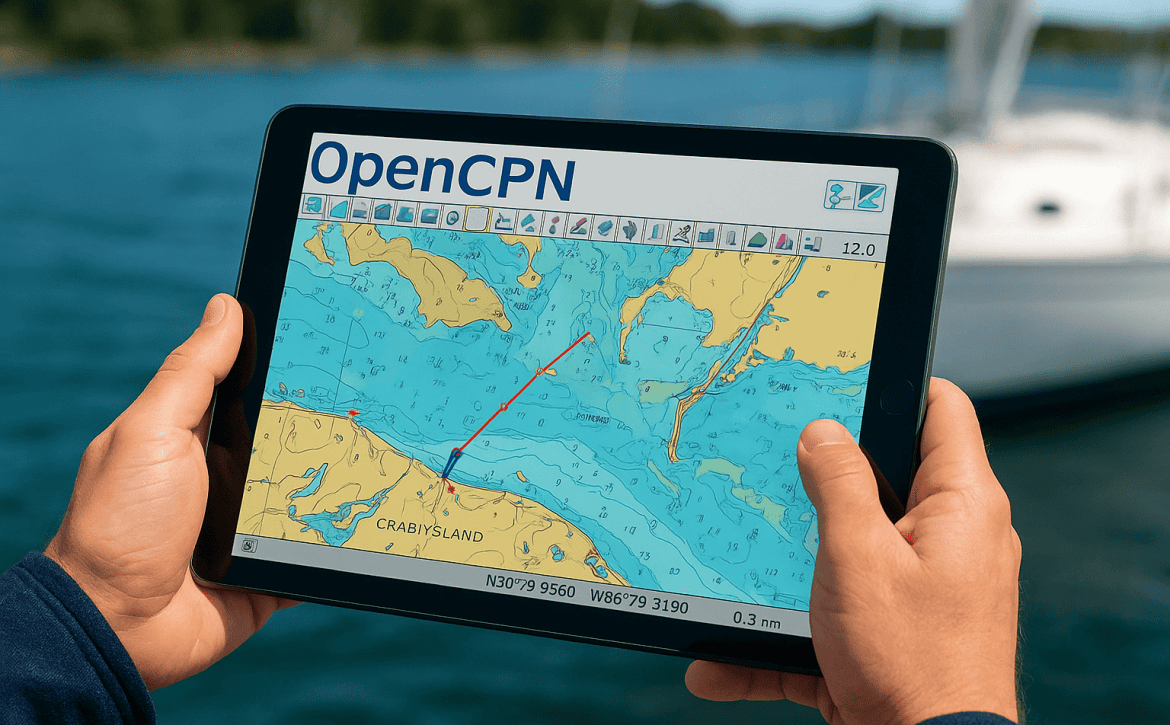
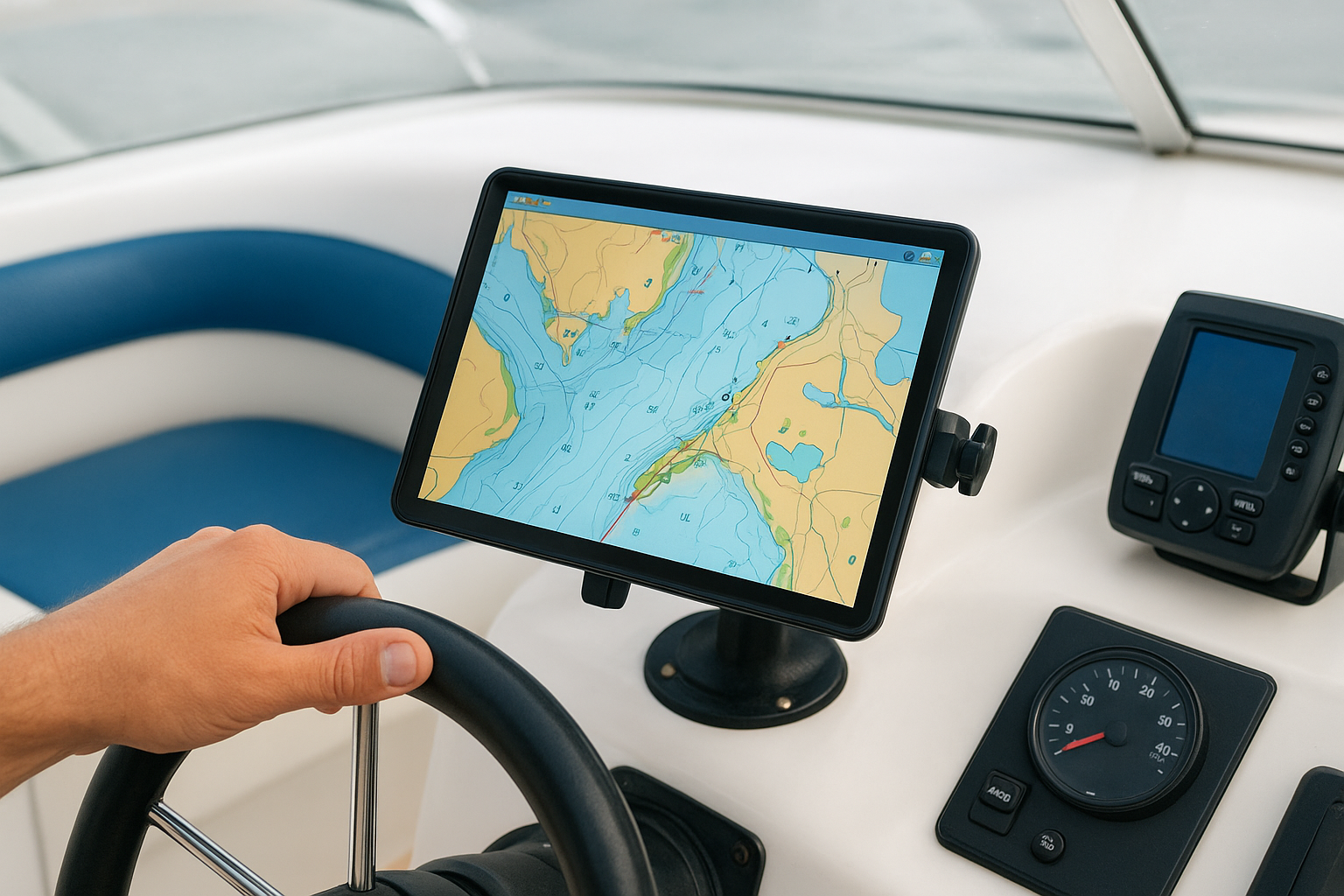
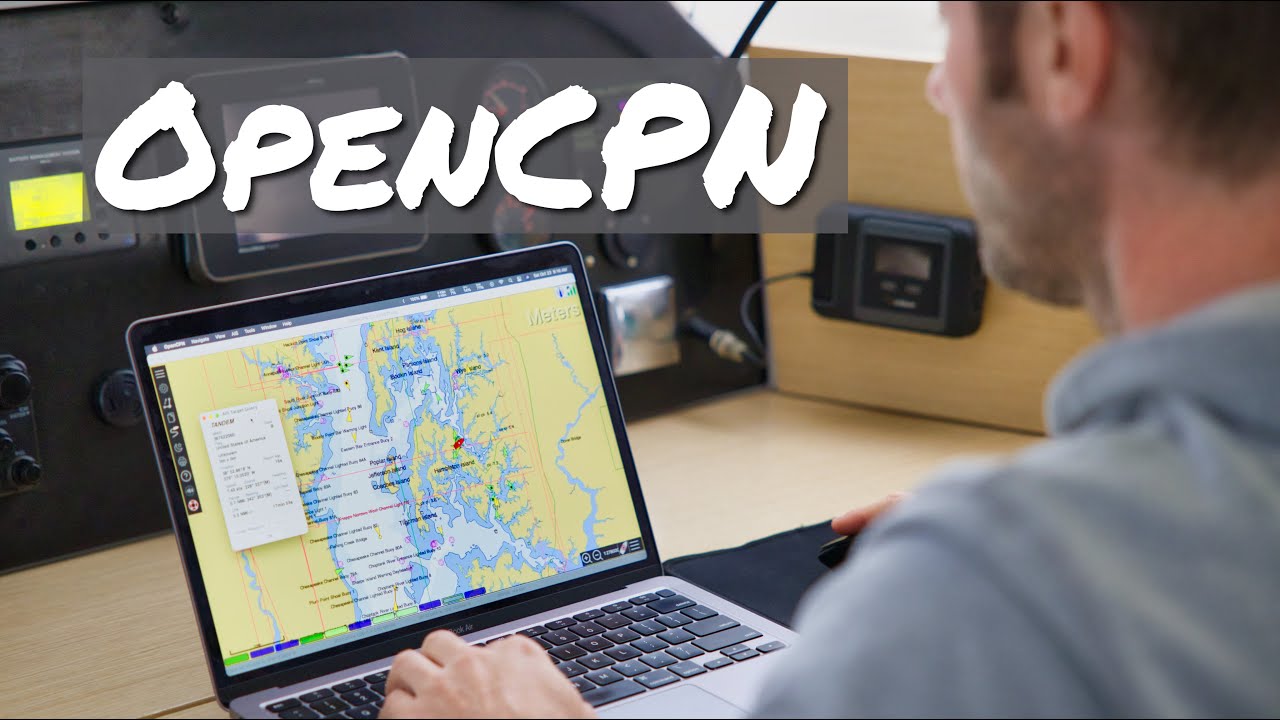
Whether you’re piloting a rental pontoon around Crab Island or navigating offshore waters in the Gulf of Mexico, having reliable chart-plotting tools matters. OpenCPN navigation software is a free, open-source program that turns a laptop, tablet, or even a Raspberry Pi into a fully functional marine chartplotter, no expensive proprietary hardware required.
Here at Original Crab Island, we put people on the water every day across Destin, Florida, from pontoon cruises to deep-sea fishing charters. We know firsthand that understanding navigation tools makes time on the water safer and more enjoyable. OpenCPN is one of those tools that recreational boaters and seasoned captains alike keep coming back to, and for good reason.
This article breaks down what OpenCPN actually does, what features set it apart, and how to download, install, and configure it on your device. If you’ve been curious about the software but weren’t sure where to start, you’re in the right place. We’ll walk through the basics so you can get up and running before your next trip on the water.
What OpenCPN does and who it’s for
OpenCPN stands for Open Chart Plotter Navigator. At its core, it reads digital nautical charts and displays your GPS position on those charts in real time, giving you a live picture of where you are on the water. You can plan routes before you leave the dock, track your movement while underway, and pull in live data from connected instruments like AIS receivers and depth sounders.
The core function: chart plotting
OpenCPN navigation software processes chart files in several formats and renders them on your screen as an interactive map. You can zoom in on channels, sandbars, and anchorages, measure distances, and draw waypoints for your planned route. The software runs on Windows, macOS, Linux, and Android, which means you can use a device you already own rather than buying a dedicated chartplotter unit.
A dedicated marine chartplotter can cost several hundred to several thousand dollars; OpenCPN delivers comparable chart-plotting functionality for free.
Who benefits most from OpenCPN
Recreational boaters make up the largest group of OpenCPN users. If you rent a vessel for a day trip, own a sailboat, or run a small fishing boat on coastal waters, OpenCPN gives you professional-grade situational awareness at no cost. The software scales well, so solo kayakers using a phone mount and offshore passage-makers on blue-water sailboats both find it useful.
Commercial operators and charter captains also use OpenCPN as a secondary or backup navigation system, layering it alongside certified commercial equipment for added redundancy. Beginners appreciate the straightforward interface, while experienced mariners value the plugin system that extends the software’s capabilities far beyond basic chart plotting.
Why boaters use OpenCPN
Boaters keep coming back to OpenCPN navigation software because it solves real problems without adding complexity or cost. The software gives you accurate, real-time positioning on detailed nautical charts, which is exactly what you need whether you’re threading through a shallow inlet or heading miles offshore.
Cost and accessibility
Traditional chartplotters lock you into proprietary hardware and expensive map subscriptions. OpenCPN breaks that model entirely. You download the software for free, install free official chart packages from sources like NOAA, and run it on a device you already own. That combination makes serious navigation tools available to every boater, not just those with deep pockets.
For coastal U.S. waters, NOAA provides free, official electronic nautical charts (ENCs) that work directly inside OpenCPN.
Flexibility across conditions
Your needs on the water change, and OpenCPN adapts with them. You can run it on a Windows laptop at the nav station, an Android tablet mounted in the cockpit, or a dedicated single-board computer below deck. The same chart files and route plans transfer between devices, so your preparation at home carries over seamlessly to whatever setup you use underway.
Key features and chart support
OpenCPN navigation software packs a strong feature set into a lightweight application that runs without an internet connection once you have your charts downloaded. You get real-time GPS tracking, route planning, waypoint management, and instrument integration all in one interface, and the plugin system lets you add capabilities as your needs grow.
Built-in tools that matter underway
The software displays your speed over ground, course, and heading in configurable data panels you can position anywhere on screen. AIS support lets you see nearby vessel traffic plotted directly on your chart, which is especially useful in busy coastal areas. You can also set anchor alarms and proximity alerts that notify you if the boat drifts beyond a defined radius.
AIS integration inside OpenCPN turns your screen into a live traffic display, showing other vessels’ positions, names, and speeds in real time.
Chart formats and free sources
OpenCPN reads S-57 and S-63 vector charts along with raster BSB/KAP files, giving you broad compatibility with chart sources worldwide. For U.S. waters, NOAA publishes free electronic nautical charts you can install directly into the software. Vector charts update more frequently than printed paper charts and render cleanly at any zoom level, so your situational awareness stays accurate.
How to set up OpenCPN step by step
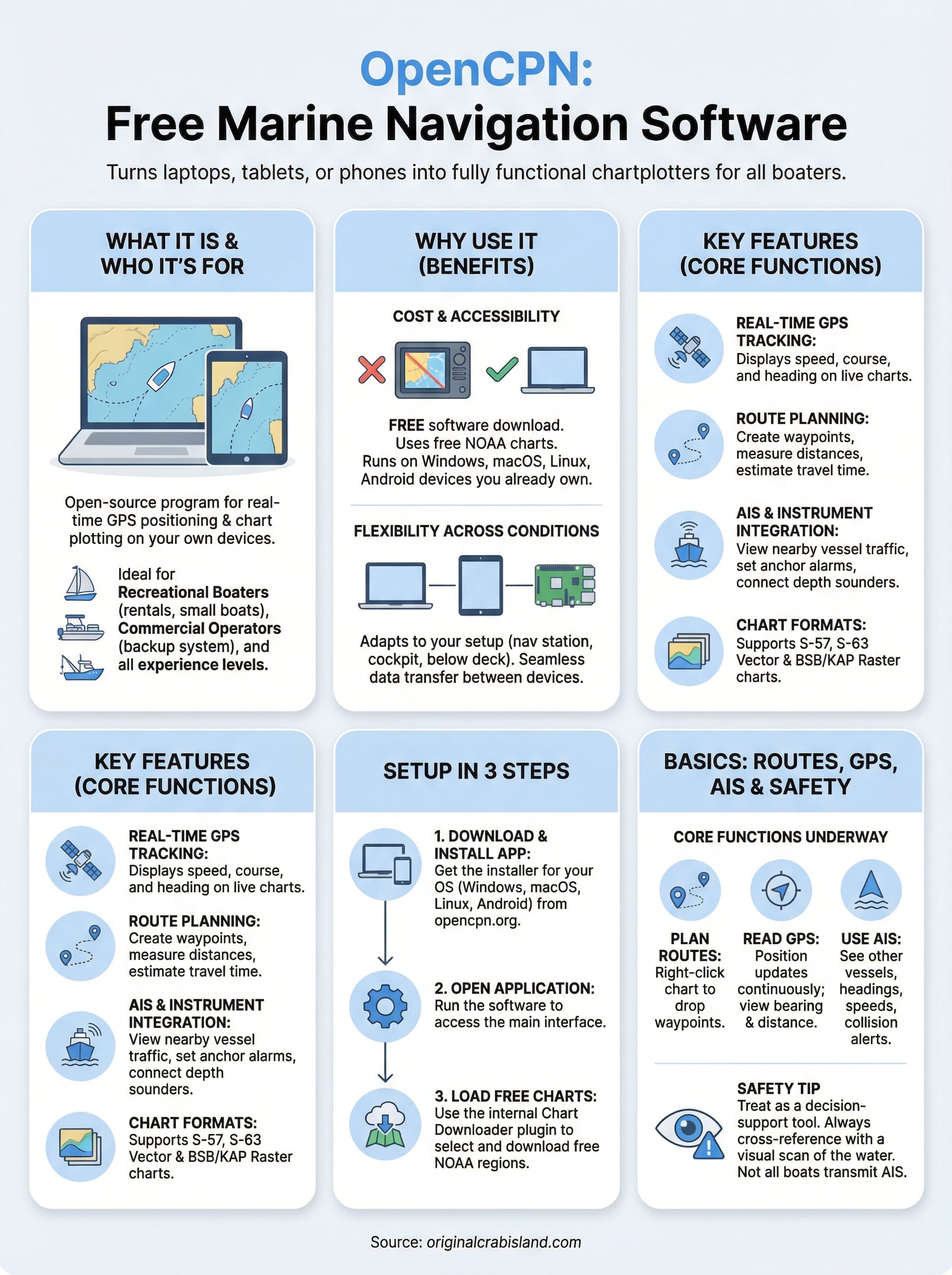
Setting up OpenCPN navigation software takes less than 15 minutes on most devices. The process follows a three-step flow: download the application, install it, then load your charts. Each step is straightforward, and you won’t need any technical background to complete it.
Download and install the application
Head to opencpn.org and grab the installer that matches your operating system. Windows and macOS users get a standard installer package, while Linux users can install through a package manager. Run the installer, accept the defaults, and OpenCPN opens ready to configure. The software supports the following platforms:
Windows 7 and newer
macOS 10.13 and newer
Linux (Debian, Ubuntu, and others)
Android (via Google Play)
Load your charts
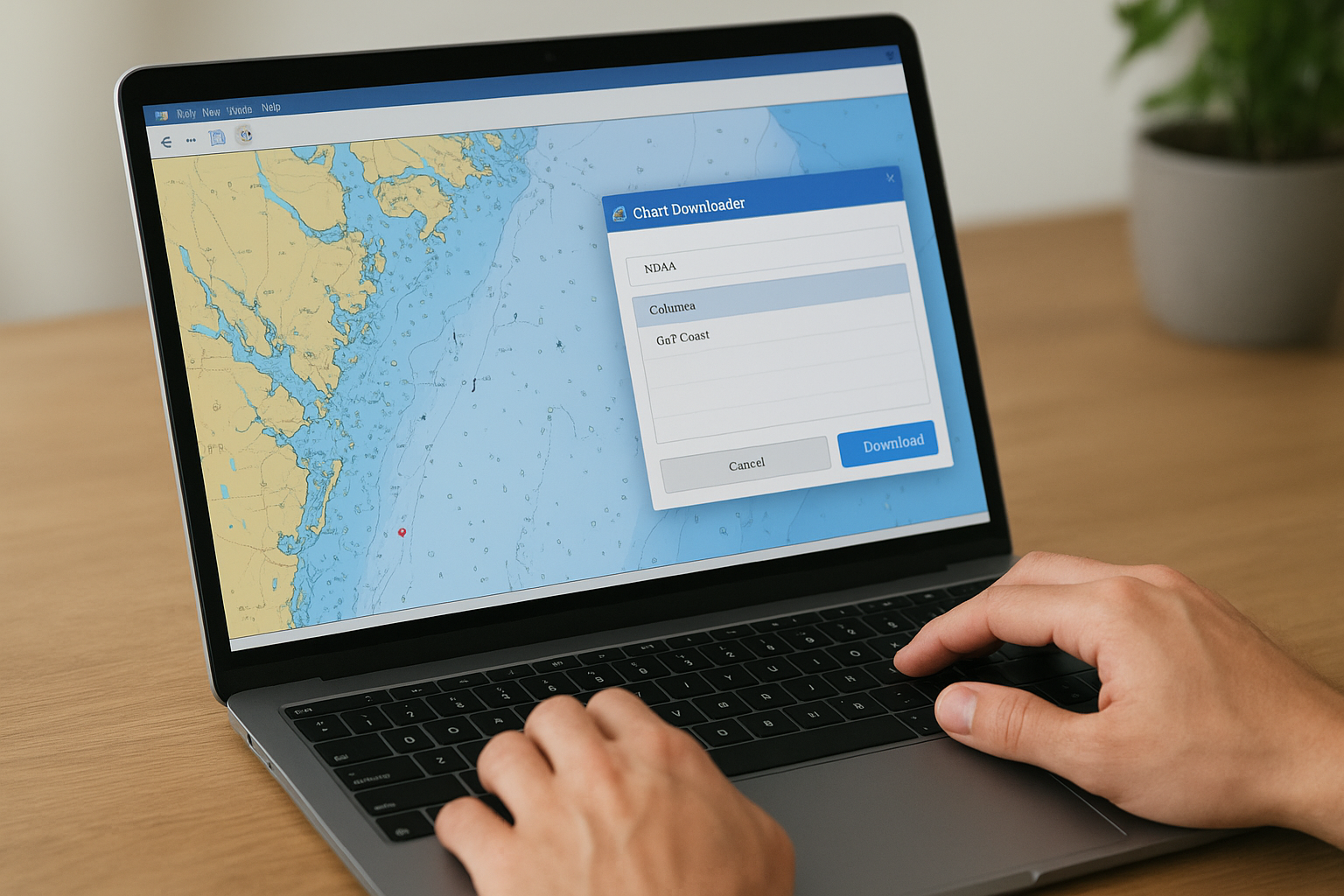
Without charts, OpenCPN navigation software shows you a blank screen. Open the Chart Downloader plugin inside the software by clicking Tools, then Plugins. Select NOAA as your source, choose the region covering your planned boating area, and download. NOAA charts are free and install directly into the software within minutes.
NOAA updates its electronic nautical charts regularly, so re-downloading your region before each season keeps your data accurate.
Once the charts load, coastal outlines, depth contours, and navigation aids fill in across your screen.
Basics: routes, GPS, AIS, and safety tips
Once you have OpenCPN navigation software loaded with charts and a GPS source connected, three functions will drive most of your time in the application: route planning, live positioning, and AIS vessel tracking. Each one builds on the others to give you a full picture of what’s happening around your boat.
Planning routes and reading GPS
Creating a route is as simple as right-clicking your chart and dropping waypoints along your intended path. OpenCPN calculates the total distance and estimated travel time between each point, so you can verify your plan makes sense before you leave the dock. Your GPS feed updates your position continuously once you’re underway, keeping the chart centered on your location. Key tools you’ll use constantly include:
Add, move, or delete waypoints on the fly
Name and save routes for repeat trips
View bearing and distance for each leg
Using AIS and staying safe
AIS displays other vessels’ positions, headings, and speeds directly on your chart, which helps you anticipate crossing traffic before it becomes a problem. You can set collision alarms that trigger when a vessel’s closest point of approach falls within a threshold you define. Always cross-reference your screen with a visual scan, since not every boat transmits AIS, including most small recreational craft.
Treat OpenCPN as a decision-support tool, not a replacement for watching the water around you.
Your next steps on the water
OpenCPN navigation software gives you a capable, free chartplotter that works on hardware you already own. You now know what it does, how to install it, and how to use its core tools for routes, GPS, and AIS tracking. The practical next step is to download the application, pull in your NOAA charts for your target region, and spend 20 minutes clicking around the interface before you ever leave the dock. Familiarity on land translates directly to confidence underway.
Once you feel comfortable with the software, put it to work on real water. If you’re heading to Destin, Florida, load the charts for the Choctawhatchee Bay and the waters around the sandbar before your trip. Pairing solid navigation knowledge with the right vessel makes every outing better. When you’re ready to get out there, book a boat rental or charter on Crab Island and put your new skills to use on the Emerald Coast.
Rent a Pontoon Boat at Crab Island: Rates, Boats, and Booking
Quick answer: To rent a pontoon boat Crab Island bound, Original Crab Island charges $375 for a half day (4 hours) and $575 for a full day (8 hours). Both rates carry up to 13 passengers and include one full tank of fuel, life vests for everyone aboard, Bluetooth speakers, a Bimini top for shade, coolers, and a boarding ladder. You launch from HarborWalk Village in Destin and reach the Crab Island sandbar in roughly 5 to 15 minutes. Drivers need a valid license, and anyone born on or after January 1, 1988 must pass the Florida Boater Safety Test. Call (850) 783-0556 to book.
Key takeaways
Half day runs $375 for 4 hours, full day runs $575 for 8 hours, both up to 13 passengers.
Double-decker pontoons include a slide. Single-deckers do not.
One full tank of fuel comes with every Crab Island pontoon rental.
Dock to sandbar takes 5 to 15 minutes from HarborWalk Village.
Renters born on or after January 1, 1988 need the Florida Boater Safety Test before launch.
Seven pickup locations serve the Emerald Coast, from Fort Walton Beach to Inlet Beach.
People rent a pontoon boat at Crab Island for one reason. Crab Island sits in Choctawhatchee Bay just north of the Destin Bridge. It is not an island at all. It is a submerged sandbar where the water runs ankle to waist deep depending on the tide, and the only way to reach it is by boat. That single fact drives every decision you make about your trip.
Original Crab Island operates out of HarborWalk Village at 385 Harbor Blvd. We run pontoons, jet skis, parasailing, fishing charters, and helicopter tours from one location, so your group books everything through one operator instead of chasing four vendors around the harbor. This page covers what a Crab Island pontoon rental costs, what comes aboard, and what you need before you can take the wheel.
What does it cost to rent a pontoon boat at Crab Island?
Original Crab Island publishes every rate upfront. No call-for-pricing, no fuel surprise at the dock. Two durations cover almost every group that wants to rent a pontoon boat for the sandbar.
Rental
Duration
Capacity
Rate
Half day
4 hours
Up to 13 passengers
$375
Full day
8 hours
Up to 13 passengers
$575
The full day costs $200 more than the half day but doubles your time on the water, which drops your hourly cost from about $94 to about $72. Groups that plan to anchor, swim, eat, and stay through the afternoon get better value from the full day. Groups with an afternoon dinner reservation usually take the half day.
Group size
Half day per person
Full day per person
6 people
$62.50
$95.83
10 people
$37.50
$57.50
13 people
$28.85
$44.23
Per-person math is where a Crab Island pontoon rental beats most other ways to spend a day on the Emerald Coast. Babies and children count toward the 13-passenger limit. A family of four with two toddlers fills six seats, not four.
What comes with your Crab Island pontoon rental?
Every pontoon boat rental at Original Crab Island includes one full tank of fuel. Burn past that tank and you pay for the refill, though most Crab Island trips never come close since the sandbar sits minutes from the dock.
Aboard every boat you get USCG-approved life vests in all sizes, a safety briefing before you leave, Bluetooth speakers, a Bimini top for shade, coolers, a boarding ladder, GPS, and floating mats. Parking at 214 Harbor Blvd runs first-come, with free overflow across the street at 310 Mountain Drive.
The fleet splits into single-deckers and double-deckers. Double-deckers carry a slide off the upper level, which is the feature most families ask about by name. If the slide matters to your group, say so when you book, because double-deckers go first on summer weekends.
Can you drive the boat yourself?
Yes. Most guests who rent a pontoon boat here drive it themselves. Pontoons handle slowly and forgivingly, and the run to the sandbar stays inside protected bay water the whole way.
You need a valid driver’s license and your emailed confirmation number at check-in. If you were born on or after January 1, 1988, Florida law requires you to complete the Boater Safety Test and carry the card. The FWC offers a free version online that takes three to four hours. Do it before you travel, not the morning of.
If nobody in your group wants the responsibility, add a captain when you book. A captain also helps if you want to fish, since somebody has to keep the boat positioned.
Which pickup location fits your group?
You can rent a pontoon boat from seven Emerald Coast markets, and Original Crab Island serves all seven year-round. Destin puts you closest to the sandbar. The rest suit groups already staying east or west along the coast. Pick the launch point nearest your rental house and you spend less of the day driving.
From the Destin dock, 5 to 15 minutes depending on bay traffic. Every pontoon boat rental leaving HarborWalk Village runs the same route, and that proximity is the practical reason to launch here: less cruising, more floating.
Pontoons stay in the bay, the harbor, and Crab Island waters. They may not enter the Gulf. Flat-bottomed hulls handle protected water well and Gulf chop badly, so the restriction protects both you and the boat. Grilling onboard is not permitted either.
When should you book?
Peak season runs May through August. Book your Crab Island pontoon rental at least a week ahead for summer weekends, and earlier for a double-decker or a holiday date.
Check in 30 minutes before departure, or 45 minutes during peak season. Late arrivals lose water time, since the next group has the boat.
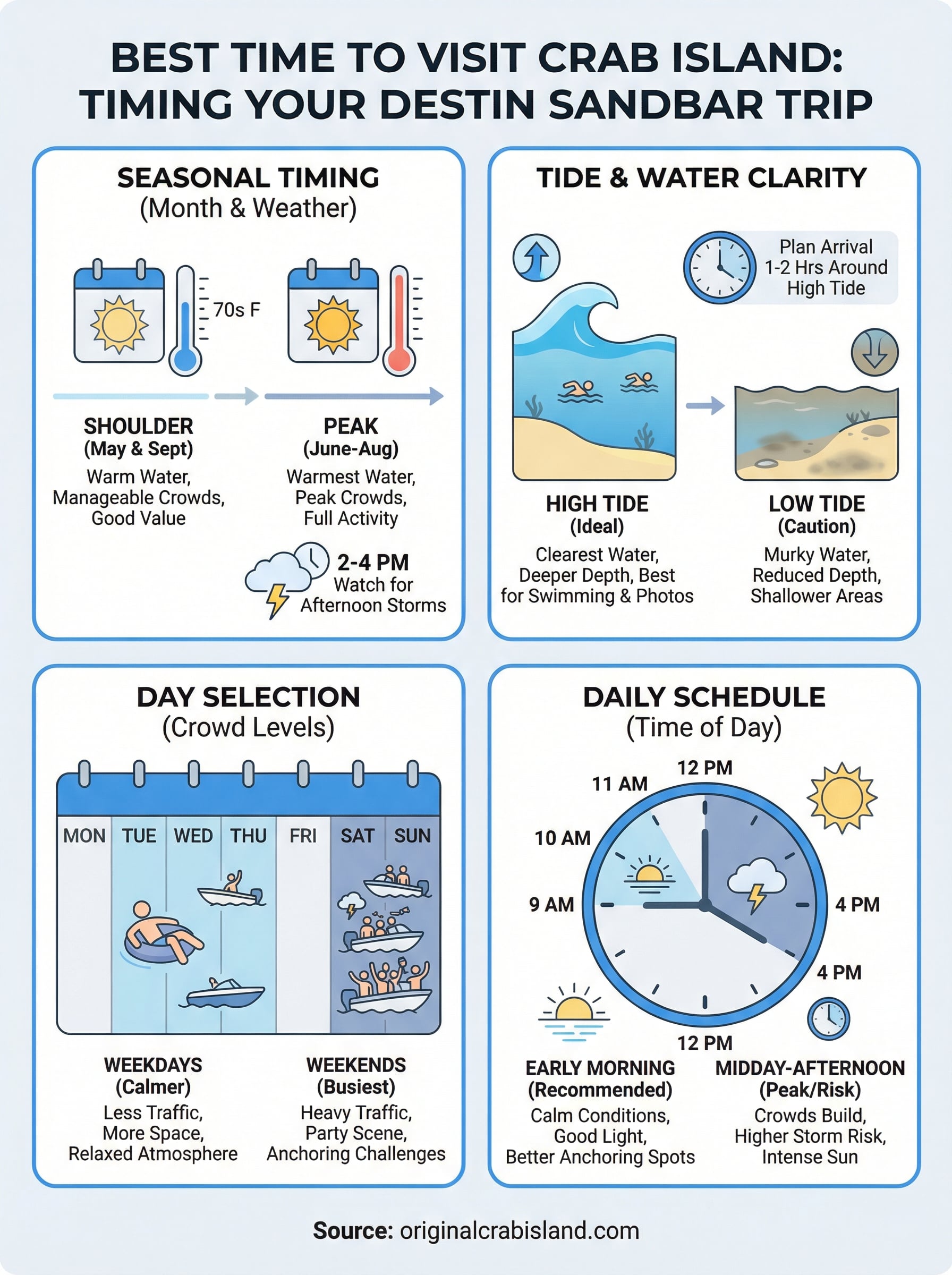
Mornings beat afternoons for two reasons. The sandbar stays calmer before midday, and Florida’s afternoon thunderstorms build in summer. If the company cancels for weather, you reschedule or take a full refund. If weather cuts your trip short after launch, pricing prorates.
Frequently asked questions
How much does it cost to rent a pontoon boat at Crab Island?
A half-day pontoon boat rental costs $375 for 4 hours and a full day costs $575 for 8 hours. Both rates cover up to 13 passengers and include one full tank of fuel. Larger groups spread the cost efficiently, dropping the per-person price to under $30 for a half day at full capacity.
How many people fit on one pontoon?
Up to 13 passengers, including babies and children. Every Crab Island pontoon rental caps at that number regardless of passenger age, so a family of four traveling with two toddlers fills six of the thirteen seats. Groups larger than 13 book a second boat, and the two run together to the sandbar and anchor side by side.
Do I need a boating license to rent a pontoon in Florida?
Not a license, but anyone born on or after January 1, 1988 must complete the Florida Boater Safety Test and carry the card. The FWC offers a free online course taking three to four hours. Renters born before that date need only a valid driver’s license.
Is fuel included in the rental price?
Yes. Every Crab Island pontoon rental includes one full tank of fuel at no extra charge. Most groups never exhaust it, since the sandbar sits minutes from the dock. If you do burn past the tank, you pay for the refill at return.
Do the pontoons have slides?
Double-decker pontoons include a slide off the upper level. Single-deckers do not carry one. Request a double-decker when you book, because they reserve fastest during summer weekends and holiday weeks from May through August. Families with kids old enough to swim usually rate the slide as the highlight of the trip.
Can I take the pontoon into the Gulf of Mexico?
No. Pontoons stay in the bay, the harbor, and Crab Island waters. Flat-bottomed hulls handle protected water, not Gulf chop and swell. Crossing into the Gulf violates the rental agreement, puts your deposit at risk, and creates a genuine safety problem. Staff mark the boundary on your map at check-in so you know exactly where the limit sits.
How far is Crab Island from the dock?
Roughly 5 to 15 minutes from HarborWalk Village depending on bay traffic. That short run is why many visitors rent a pontoon boat from a Destin dock rather than farther down the coast. Crab Island sits in Choctawhatchee Bay just north of the Destin Bridge, which is why Destin departures give you the most time on the water.
What time should I arrive for check-in?
Arrive 30 minutes before your departure time, or 45 minutes during peak season from May through August. Check-in covers paperwork, the safety briefing, and boat orientation before you leave the dock. Late arrivals cut into their own water time, because the next group has the boat reserved right behind you.
Can I hire a captain instead of driving?
Yes. Add a captain when you book your pontoon boat rental. This works well for groups who want to fish, groups where nobody holds the required Florida safety card, and anyone who would rather relax than watch for channel markers all afternoon. A captain also handles anchoring at the sandbar, which takes practice in a shifting tide.
What happens if the weather turns bad?
If Original Crab Island cancels for unsafe conditions, you reschedule or take a full refund. If weather forces an early return after you launch, your pricing prorates for the time you actually spent on the water. Trip protection allows rescheduling up to one hour before launch, which covers most summer thunderstorm situations.
Is parking available at the dock?
Parking at 214 Harbor Blvd runs first-come, first-served. Free overflow parking sits across the street at 310 Mountain Drive when the main lot fills. Paid lots nearby charge around $15 per vehicle during busy periods. Arriving 45 minutes early in peak season gives you time to park without rushing your check-in.
Do kids need to wear life jackets?
Florida law requires children under six to wear a USCG-approved vest while the boat is underway. Vests in all sizes come aboard every rental at no extra cost. Older passengers must have a vest available even when not wearing it.
Can we bring our own food and drinks?
Yes. Coolers come with every Crab Island pontoon rental, so pack whatever your group wants for the day. Grilling onboard is not permitted for fire safety reasons. Floating vendors sell food and drinks at the sandbar during season if you would rather travel light, though prices there run higher than the grocery store.
What is the best time of day to visit Crab Island?
Mornings. The sandbar draws its biggest crowds around midday, and summer afternoons bring real thunderstorm risk along the Emerald Coast. Launch your pontoon boat rental early and you get calmer water, easier anchoring, and a better shot at a full trip without weather interruption. Families with small children benefit most from beating the midday crowd.
How far ahead should I book a Crab Island pontoon rental?
Book your Crab Island pontoon rental at least a week ahead for summer weekends, and further out for double-deckers or holiday dates. Peak season runs May through August. Off-season bookings often go through with a few days’ notice.
Book your pontoon
Original Crab Island runs pontoons, jet skis, parasailing, fishing charters, and helicopter tours from one HarborWalk Village location. Book the boat and the add-ons together and your group stays on one schedule.
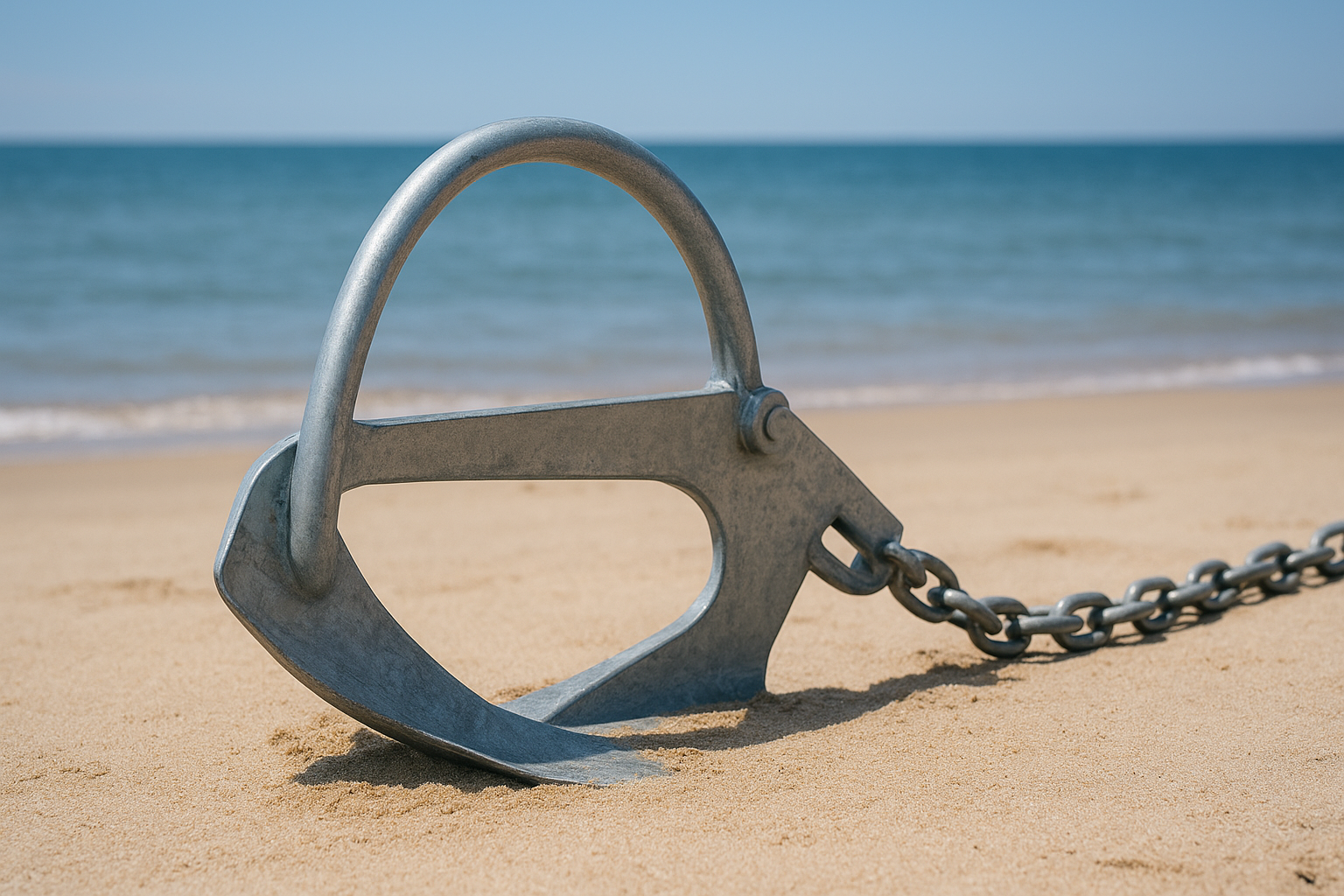
Destin, Florida sits on the Gulf of Mexico where the bottom is mostly sand and soft mud, which means anchoring can go sideways fast if you don’t have the right gear. At Original Crab Island, we spend our days on these waters running pontoon rentals, fishing charters, and guided trips to Crab Island’s famous sandbar. We’ve dragged, set, and reset more anchors than we can count, and we know firsthand what holds and what doesn’t in the best anchor for sand and mud debate.
The wrong anchor will skip across a soft bottom or pull free the moment the current shifts, not exactly ideal when you’re floating over a sandbar with your family or trying to hold position on a fishing spot. Anchor design, fluke shape, and weight all play a role, and the differences between types matter more than most people realize in soft substrate conditions.
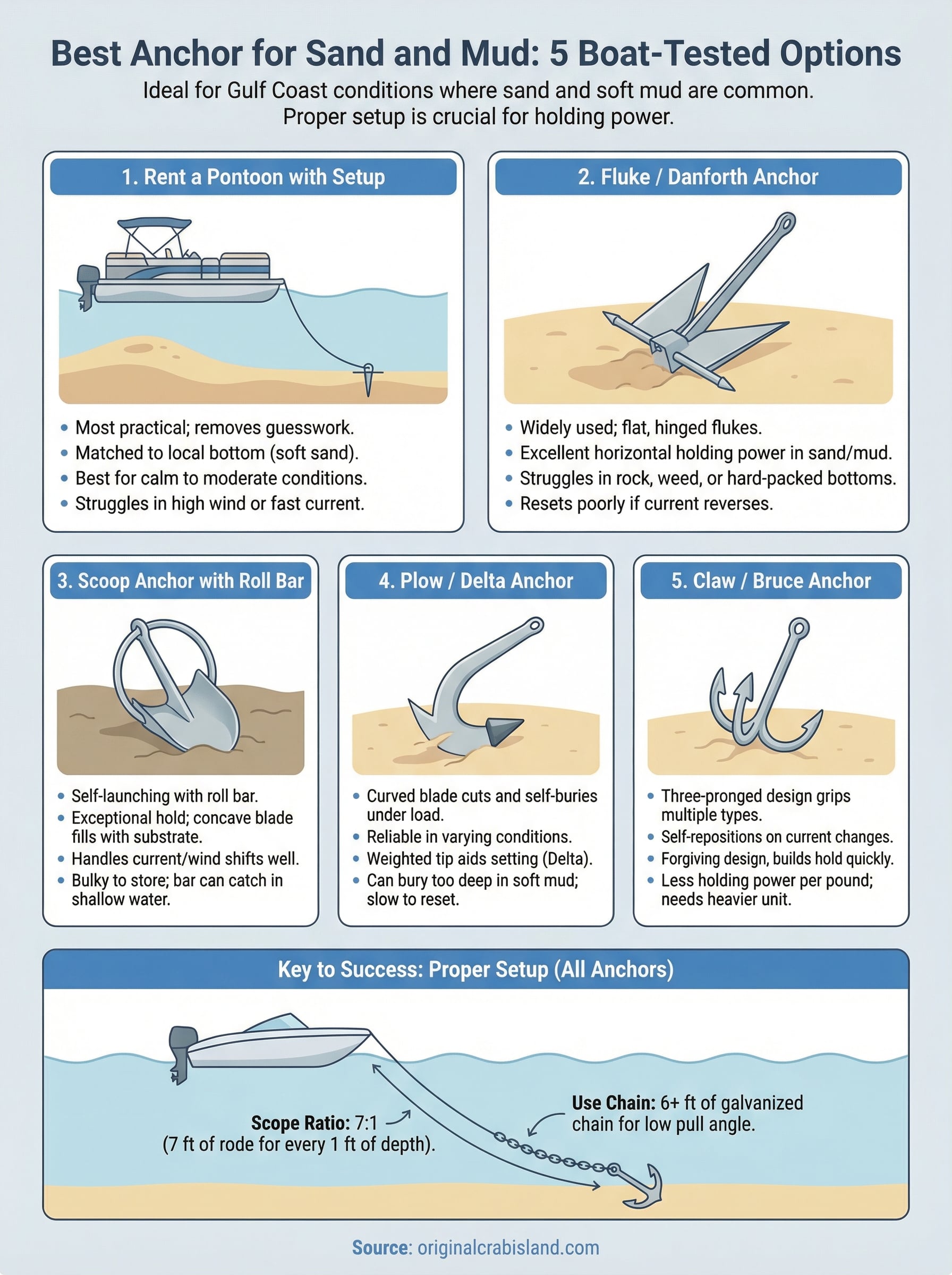
We put together this list of 5 boat-tested options that actually perform in the sandy, muddy bottoms common across the Gulf Coast and similar waters. Each anchor is evaluated for holding power, ease of setting, and overall reliability, so you can pick the right one for your boat and the conditions you’ll face out there.
1. Rent a pontoon with a sandbar anchor setup
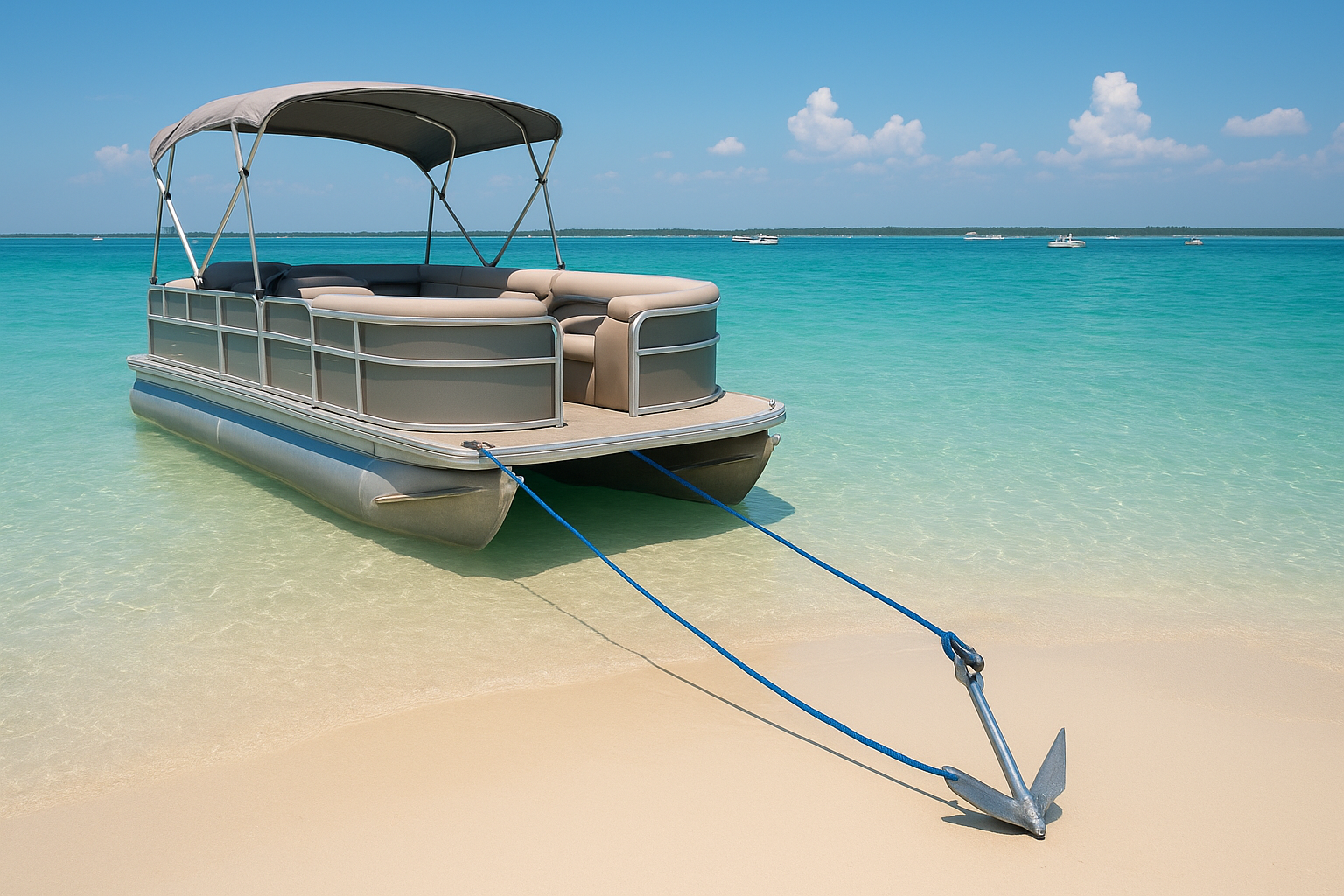
If you’re visiting Crab Island or a similar Gulf Coast sandbar without a boat, renting a pontoon with a built-in anchor setup is the most practical option on this list. Most reputable rental operators rig their boats with anchors suited to the local bottom, which in Destin means soft sand and occasional mud in the shallows around the sandbar.
Why it works in sand and mud
Pontoon rentals in sandbar-heavy areas typically come equipped with fluke-style or spike anchors chosen for shallow, sandy conditions. The setup is already matched to the local bottom, so you skip the guesswork entirely. On a busy weekend at Crab Island, dozens of pontoons sit anchored side by side, and the boats that stay put are almost always running the right anchor for the conditions.
A pre-rigged rental removes the guesswork from anchoring in soft substrate, which matters more than most people expect when a current shift can drag a poorly set anchor in minutes.
When it struggles
Even the best sandbar setup has limits. If wind picks up sharply or passing wakes put repeated load on the anchor line, a light spike or small fluke can break free. Rental anchors are sized for calm to moderate conditions, not for fast tidal current or rough open water. Watch for these specific situations:
Wind above 15 knots sustained
Anchoring in channel water with active current
Wakes from large vessels passing at speed
What to check before you leave the dock
Before you pull away, confirm the rental includes at least one anchor and enough rode to reach the bottom with proper scope. A 7:1 scope ratio is a solid standard: for every foot of water depth, deploy seven feet of anchor line.
Verify the shackle connecting the chain to the anchor is pinned tight.
Confirm the bow cleat is secure and properly mounted.
Ask the rental staff what bottom conditions to expect at your destination.
Price range
Pontoon rentals with sandbar anchor setups typically run $350 to $700 for a half-day, depending on boat size and the operator. That price covers everything you need with no separate gear purchase.
Original Crab Island’s pontoon rentals include anchor setups matched to local Gulf Coast conditions, so you arrive at the sandbar ready to drop anchor and stay put.
2. Fluke or Danforth anchor
The Danforth, also called a fluke anchor, is the most widely used option for sandy and muddy bottoms on the Gulf Coast. Its flat, hinged flukes dig into soft substrate quickly and build strong horizontal holding power once set. For boaters searching for the best anchor for sand and mud, this design delivers reliable performance at a reasonable price point.
Why it works in sand and mud
The fluke design works by pivoting downward as load is applied, driving the pointed tips into the bottom. Soft sand and mud allow the flukes to bury deeply, which is what creates solid hold. Once set, a properly sized Danforth resists lateral movement even when wind or current shifts direction gradually over time.
When it struggles
Danforth anchors have trouble in rocky or weedy bottoms where the flukes can’t penetrate or get fouled before they set. Hard-packed sand causes the flukes to skip along the surface without biting in. The anchor also resets poorly if the current reverses sharply.
Sizing and setup
Match anchor weight to your boat length and beam. A 13-lb Danforth handles boats up to 20 feet; a 22-lb model works for boats between 20 and 28 feet. Run at least 6 feet of chain between the anchor and rope rode to keep the pull angle low and horizontal.
A low pull angle is essential: any upward force lifts the flukes out of the bottom instead of driving them deeper.
Price range
Danforth-style anchors cost $30 to $120 depending on size and material. Galvanized steel models hold up well in saltwater and are the better long-term investment for coastal boating.
3. Scoop anchor with roll bar
The scoop anchor, often sold under the Rocna or Manson Supreme name, features a concave scoop-shaped blade and a roll bar that tips the anchor into the correct position before it sets. For boaters who want a self-launching anchor that works across multiple bottom types, the scoop design is one of the strongest performers in the best anchor for sand and mud category.
Why it works in sand and mud
The roll bar forces the tip down automatically as the anchor sinks, so it enters the bottom at the right angle every time without adjustment. Once the scoop buries, it develops exceptional holding power relative to its weight because the concave blade fills with substrate and resists pull in any direction. Current reversals and wind shifts don’t dislodge it the way they can a Danforth.
The self-orienting roll bar removes the single biggest cause of anchoring failure: an anchor that lands on its side and never sets properly.
When it struggles
The roll bar adds bulk and weight, which makes storage awkward on smaller boats. In extremely shallow water, the bar can catch on the bottom before the blade buries fully.
Sizing and setup
A 10-kg scoop anchor handles most boats up to 30 feet. Pair it with 6 to 8 feet of galvanized chain and nylon rode to absorb shock loads and keep the pull angle low.
Price range
Scoop anchors with roll bars run $150 to $400 depending on size and brand. Galvanized steel is the practical choice for saltwater use.
4. Plow or Delta anchor
The plow anchor and its fixed-shank variant the Delta share a curved, pointed blade that cuts into soft substrate and self-buries under load. Both designs have built a strong reputation on boats that need to hold in varying conditions, and they remain a go-to choice for cruisers and charter operators across the Gulf Coast.
Why it works in sand and mud
The plow shape drives the tip into the bottom the moment the rode goes tight, and continued load pulls the blade deeper rather than lifting it out. Sand and mud allow the tip to penetrate quickly, which means holding power builds fast after the anchor sets. Delta anchors add a weighted tip that keeps the point oriented downward even before contact, making self-setting more reliable than a traditional two-piece plow.
A weighted tip on a Delta anchor removes the need to back down slowly, which matters when you’re anchoring in current and want the anchor set before the boat swings sideways.
When it struggles
Plow anchors have trouble in very soft mud where the blade buries so deeply that retrieval becomes a real fight. They also reset slowly when a current reversal lifts them free, which is a limitation compared to scoop designs.
Sizing and setup
A 14-lb Delta handles boats up to 30 feet reliably. Pair it with 6 feet of galvanized chain and nylon rope rode to reduce shock loading on the set.
Price range
Plow and Delta anchors typically cost $80 to $250, depending on size and material, making them a practical mid-range option for the best anchor for sand and mud applications.
5. Claw or Bruce anchor
The claw anchor, originally sold under the Bruce brand, uses a three-pronged curved blade that grips multiple bottom types without requiring a full reset after direction changes. Gulf Coast charter operators use it for its consistent behavior in sandy and muddy substrate, exactly the conditions you encounter around a popular Gulf sandbar.
Why it works in sand and mud
The three curved prongs spread load across multiple contact points, so the anchor buries steadily as the rode tightens. A wind shift or current reversal simply rolls the claw into a new position rather than pulling it free from the bottom.
The claw’s self-repositioning design makes it one of the more forgiving anchors when tidal swings reverse overnight current direction.
Sand and mud let the prongs penetrate without much resistance, which means holding power builds quickly after you set the anchor and back down on it.
When it struggles
The claw produces less holding power per pound than modern scoop designs, so you need a heavier unit for equivalent performance. Avoid it in these specific situations:
Very soft, deep mud where the prong geometry loses lateral resistance
Hard or rocky bottoms where the prongs can’t bite in
Sizing and setup
A 14-lb claw handles most boats up to 30 feet in moderate conditions.
Use 6 feet of galvanized chain between the anchor and your rope rode to keep the pull angle flat and maximize hold in sand and mud.
Price range
Claw anchors run $60 to $180 based on size, placing them at the budget-friendly end of the best anchor for sand and mud options.
Galvanized steel holds up better than painted steel in saltwater and is the more practical long-term choice for coastal boating.
Quick wrap-up
Each anchor type on this list performs differently in soft substrate, and the right choice depends on your boat size, the conditions you expect, and how much storage space you have. For most Gulf Coast boating in sand and mud, a Danforth handles calm days well, a scoop with roll bar handles current reversals better, and a Delta or claw covers you when conditions shift without warning. If you want a clean shortcut to the best anchor for sand and mud experience without buying any gear, a pre-rigged rental removes the whole question from the equation.
Visiting Destin and planning a trip to the sandbar? Your quickest path to a day on the water is skipping the gear research entirely and booking a rental with everything already set up for local Gulf Coast conditions. Reserve a pontoon rental at Original Crab Island and spend your time on the water instead of worrying about whether your anchor will hold. For more options, explore our Pontoon rentals page. For more options, explore our Deep sea fishing Destin page. For more options, explore our Servicios página.
You’ve booked your Destin vacation, picked your dates, and now you’re ready to get out on the water. But then a question stops you mid-scroll: do you need a boating license to rent a boat in Florida? It’s one of the most common concerns we hear from visitors planning a trip to Crab Island, and the answer is simpler than most people expect.
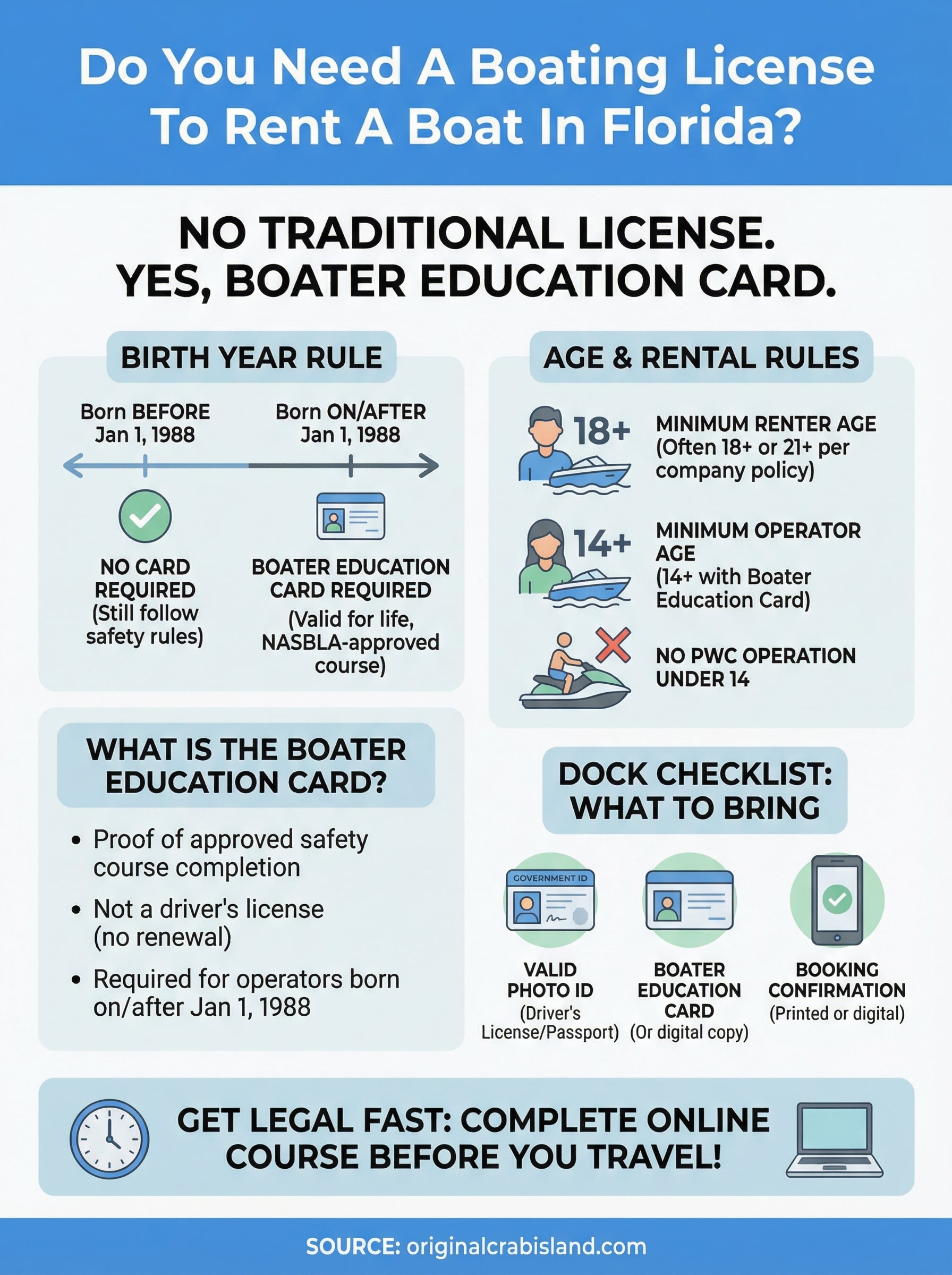
Florida does not require a traditional "boating license" the way your state requires a driver’s license. Instead, the state uses a Boater Education Card, and whether you need one depends on your age and birth year. The distinction matters, because showing up unprepared can delay or derail your day on the water.
At Original Crab Island, we rent pontoon boats, jet skis, and other watercraft out of Destin every day, so we walk customers through these requirements constantly. This article breaks down exactly what Florida law says, who needs a Boater Education Card, how to get one before your trip, and what documentation you should bring to the dock. No guesswork, no last-minute surprises.
Understand what Florida calls a boating license
Florida does not issue a traditional boating license. Instead, the state requires a Boater Education Card, which proves you completed an approved safety course. This card is issued by the Florida Fish and Wildlife Conservation Commission (FWC) and stays with you permanently once you earn it. There is no renewal process, no written test at a DMV office, and no annual fee attached to it. When visitors ask whether you need a boating license to rent a boat in Florida, they are almost always asking about this card without realizing it has a different name.
What the Boater Education Card actually is
The Boater Education Card is a wallet-sized certification card that confirms you passed an approved boater safety course. Florida accepts courses from several providers, but the curriculum must meet the standards set by the National Association of State Boating Law Administrators (NASBLA), which oversees boater education across the country. Once you pass the course and receive your card, it never expires. You keep it for life, and you are required to carry it on the water any time you operate a motorized vessel and fall within the age-based rules.
The card proves education, not permission. Florida does not grant or revoke your right to boat through a licensing system the way a DMV controls your right to drive.
How this differs from a traditional driver’s license
A driver’s license is a government-issued credential tied to your identity, your driving record, and ongoing renewal requirements. A Boater Education Card does not work that way. Florida does not maintain a boating record in the same structure as a driving record, and there is no state office you must visit to obtain the card. You simply complete an approved safety course, pass the final exam, and receive your card directly from the course provider.
This distinction matters when you plan your trip. Getting your card does not require a government appointment. Many providers offer the full course online, which means you can finish it from home before you ever arrive in Destin.
Learn who must carry a boater education card in Florida
Florida applies its Boater Education Card requirement based on your birth year, not just your current age. If you were born on or after January 1, 1988, you must carry a valid Boater Education Card any time you operate a motorized vessel on Florida waters. This rule applies whether you own the boat, rent it, or borrow it from someone else.
If you were born on or after January 1, 1988, you cannot legally operate a rented motorized vessel in Florida without a Boater Education Card on your person.
The birth year rule that determines your requirement
People born before January 1, 1988 are exempt from the card requirement under Florida law, though they still must follow all other boating regulations on the water. If you fall into that group and wonder whether you need a boating license to rent a boat, the short answer is no card required, but safe boat operation and knowledge of local rules still apply to you.
For anyone born on or after January 1, 1988, the rule is firm. Rental companies throughout Florida are required to verify compliance before handing over the keys, and a marine law enforcement officer can ask to see your card at any point while you are on the water. Failing to carry your card can result in a fine, and it can also prevent you from getting out on the water at all.
Follow Florida age rules for renting and operating
Florida separates the Boater Education Card requirement from the minimum age rules for renting and operating a boat. You must understand both before you arrive at the dock. Most rental companies in Florida require renters to be at least 18 years old to sign a rental agreement, though some companies set their minimum at 21. These are business policies, not state law, but they carry the same practical weight.
Age minimums that apply to operators on the water
Florida state law prohibits anyone under the age of 14 from operating a personal watercraft, such as a jet ski, without a supervising adult on board. For standard motorized vessels, children between 14 and 17 may operate a boat only if they hold a valid Boater Education Card. If you wonder whether you need a boating license to rent a boat as a teenager, the card requirement still applies to you.
Anyone under 14 cannot legally operate a personal watercraft in Florida, even with a Boater Education Card.
Rental companies also check the age of the primary operator listed on the rental agreement, not just the person who signs it. If someone under the minimum age will be driving the boat at any point during your rental, the company can refuse the rental or end it early. Plan ahead and confirm the operator ages with the rental company before your trip.
Know what Destin and Crab Island renters must bring
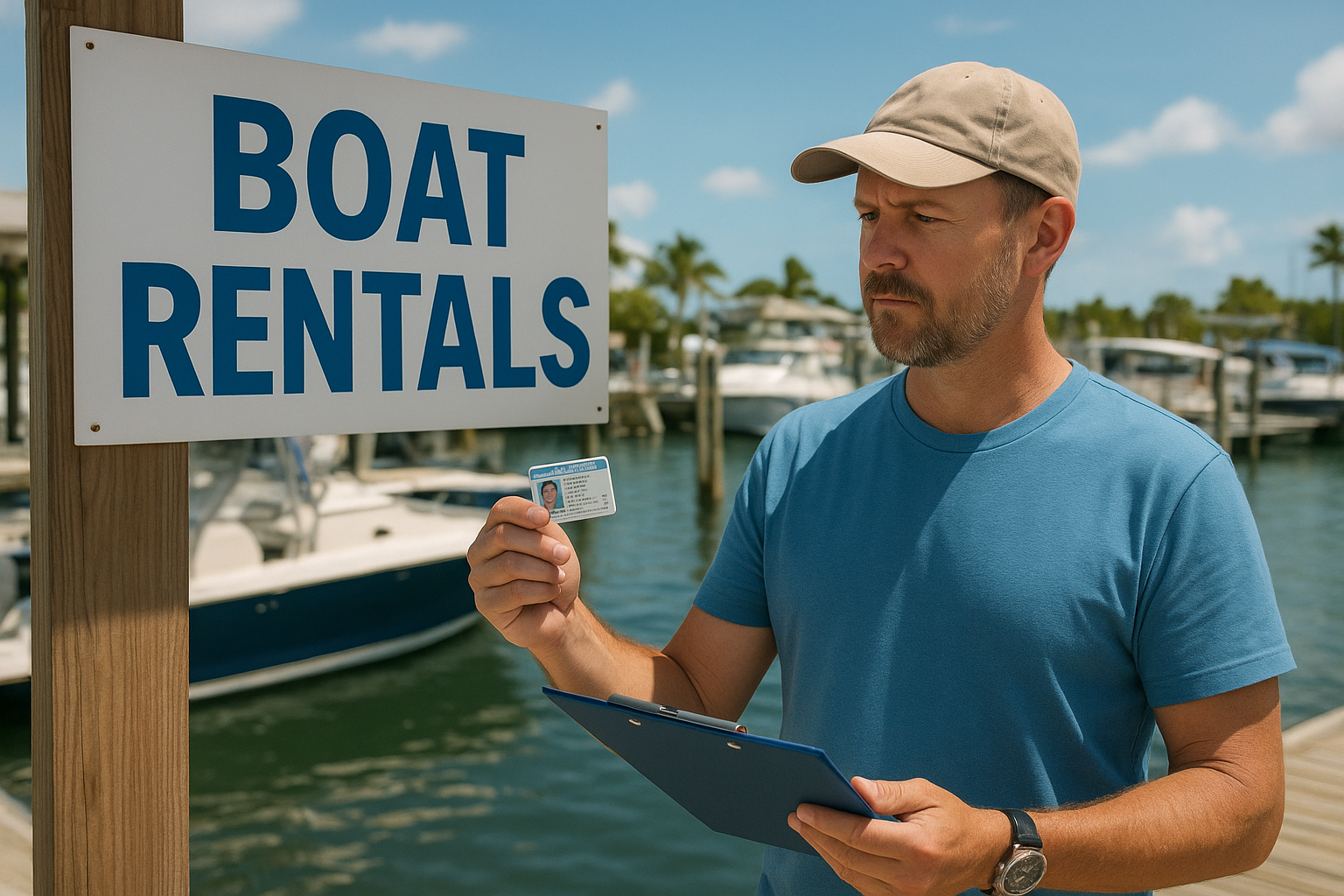
When you rent a boat through Original Crab Island in Destin, the check-in process moves faster when you arrive with the right documents already in hand. Staff will verify your Boater Education Card and valid government-issued ID before releasing any vessel, and missing either one means you cannot get on the water that day.
Arriving without your Boater Education Card does not give you a pass at the dock. Rental staff are required to verify compliance before handing over any motorized vessel.
Documents to have ready before you hit the dock
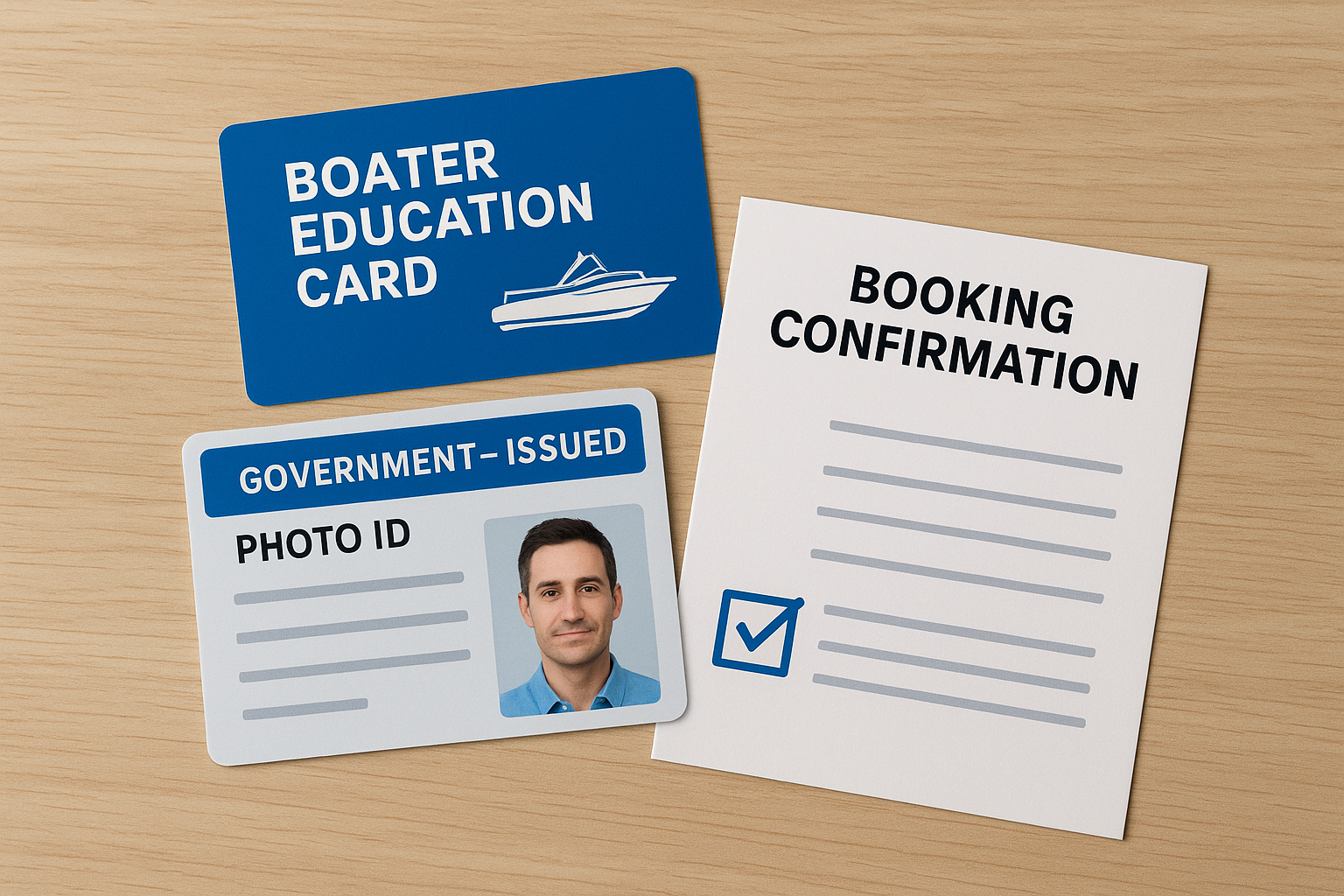
Whether you wonder do you need a boating license to rent a boat or just want to confirm the checklist, the answer comes down to three items you should carry with you. Your government-issued photo ID (a driver’s license or passport) confirms your identity and age. Your Boater Education Card satisfies Florida’s education requirement for anyone born on or after January 1, 1988. If you completed your course online, bring a printed or digital copy as a backup in case your physical card has not yet arrived in the mail.
Bring your booking confirmation as well, whether printed or on your phone, so staff can match your reservation quickly. Groups should confirm ahead of time which person will serve as the primary operator, since that individual carries the legal responsibility for having the correct documentation on board during the rental period.
Get legal fast with a simple before-you-go plan
If you still wonder do you need a boating license to rent a boat in Florida, the real question to focus on now is how fast you can check this off your list. Getting your Boater Education Card takes less time than most people expect, and finishing it before your trip removes all the stress from your check-in day at the dock.
Completing your course online before you travel is the single fastest way to arrive in Destin fully prepared to get on the water.
Complete your online course before you pack
Florida accepts online boater safety courses that meet NASBLA standards, and most take only a few hours to finish at your own pace. You choose when you sit down, how fast you move through the material, and when you take the final exam. Once you pass, your card ships directly to your home address, so you can pack it alongside your ID before you ever leave for Destin.
Confirm your card status before your departure date
Before you leave home, take five minutes to verify that your physical card has arrived or that you have a digital backup ready on your phone. Rental staff accept a printed certificate as temporary proof while your card is in transit, but you should contact your course provider directly to confirm what backup documentation they issue. Arriving with both your ID and your card means your rental starts on time, with no delays at the dock.
Wrap it up and book with confidence
Now you have a clear answer to do you need a boating license to rent a boat in Florida. The state requires a Boater Education Card for anyone born on or after January 1, 1988, and most rental companies in Destin set their minimum renter age at 18. Completing your online course before your trip takes only a few hours and removes every documentation hurdle before you reach the dock.
Your checklist is straightforward: bring a valid photo ID, your Boater Education Card, and your booking confirmation. All three items together mean your rental starts on time with no delays and no scrambles at check-in.
When you are ready to get out on the water, book your pontoon boat, jet ski, or parasailing adventure with Original Crab Island. The Emerald Coast is right there, and your best day on the water starts the moment you arrive prepared and ready to go.
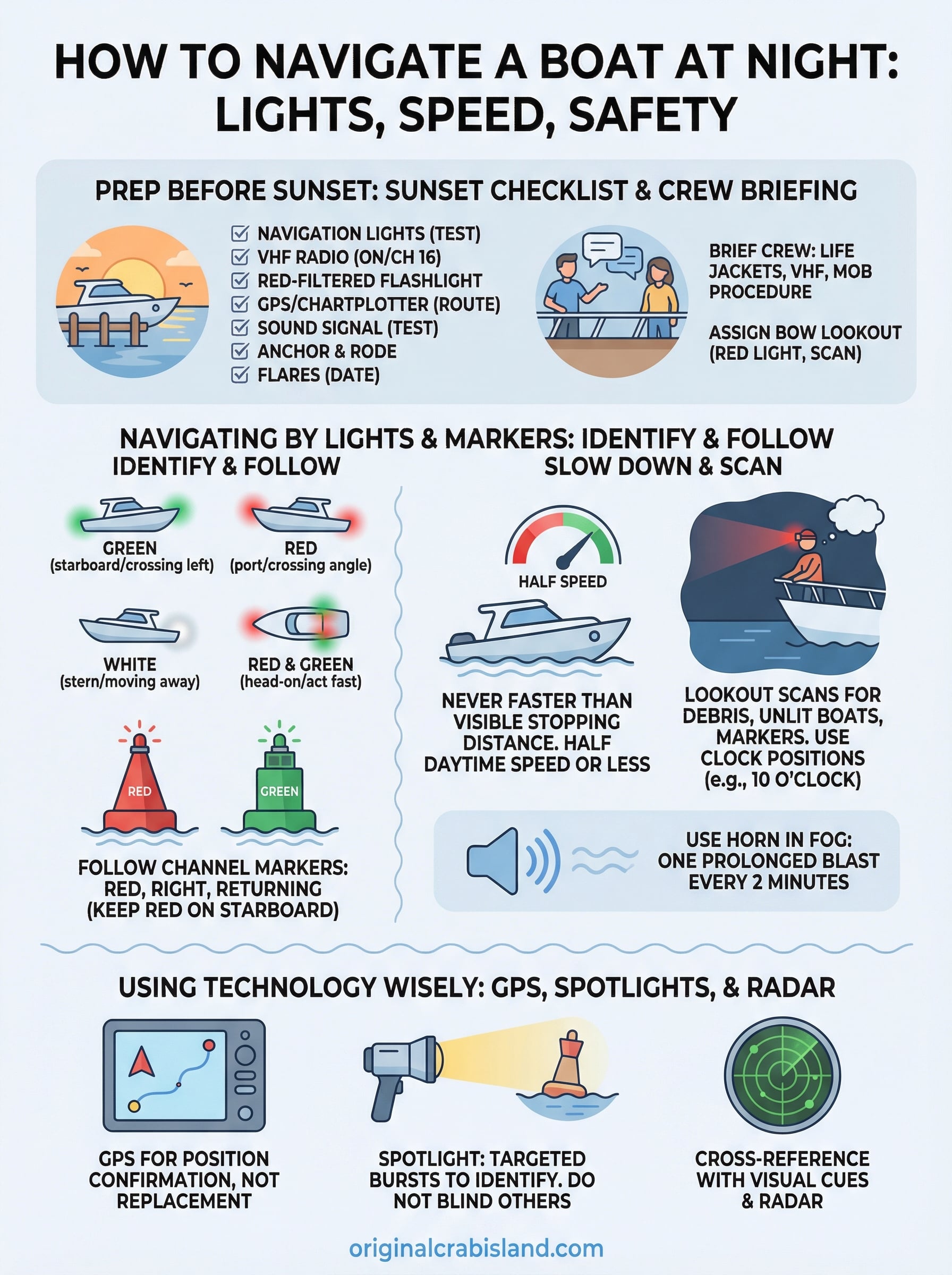
The sun drops behind the Gulf of Mexico, the Destin Harbor lights flicker on, and suddenly everything you thought you knew about boating changes. Knowing how to navigate a boat at night requires a different skill set than daytime cruising, your depth perception shrinks, familiar landmarks disappear, and other vessels become nothing more than colored lights on dark water. It’s one of the most common concerns we hear from guests at Original Crab Island before they head out for sunset cruises or evening returns from Crab Island.
Night boating isn’t something to fear, but it does demand respect. Reduced visibility affects every decision you make on the water, from reading channel markers to judging the distance and direction of approaching traffic. Without the right preparation, a routine trip back to the dock can turn stressful fast.
This guide covers the practical essentials, protecting your night vision, understanding navigation lights, managing safe speeds, and carrying the right equipment for after-dark operation. Whether you’re renting a pontoon for an evening on the Emerald Coast or running your own boat home after a long day of fishing, these are the skills that keep you and your passengers safe.
What changes at night and what you need first
Boating after dark isn’t just daytime boating with the lights off. Your entire sensory toolkit shifts, and the water you confidently crossed at noon becomes a very different environment. Depth cues vanish, the horizon blurs with the sky, familiar channel markers blend into the background glow of shore lights, and the distance and speed of other vessels become hard to judge. Knowing how to navigate a boat at night safely starts with accepting that your usual reference points are gone and building new habits around what you can reliably use.
Your eyes need more time than you think
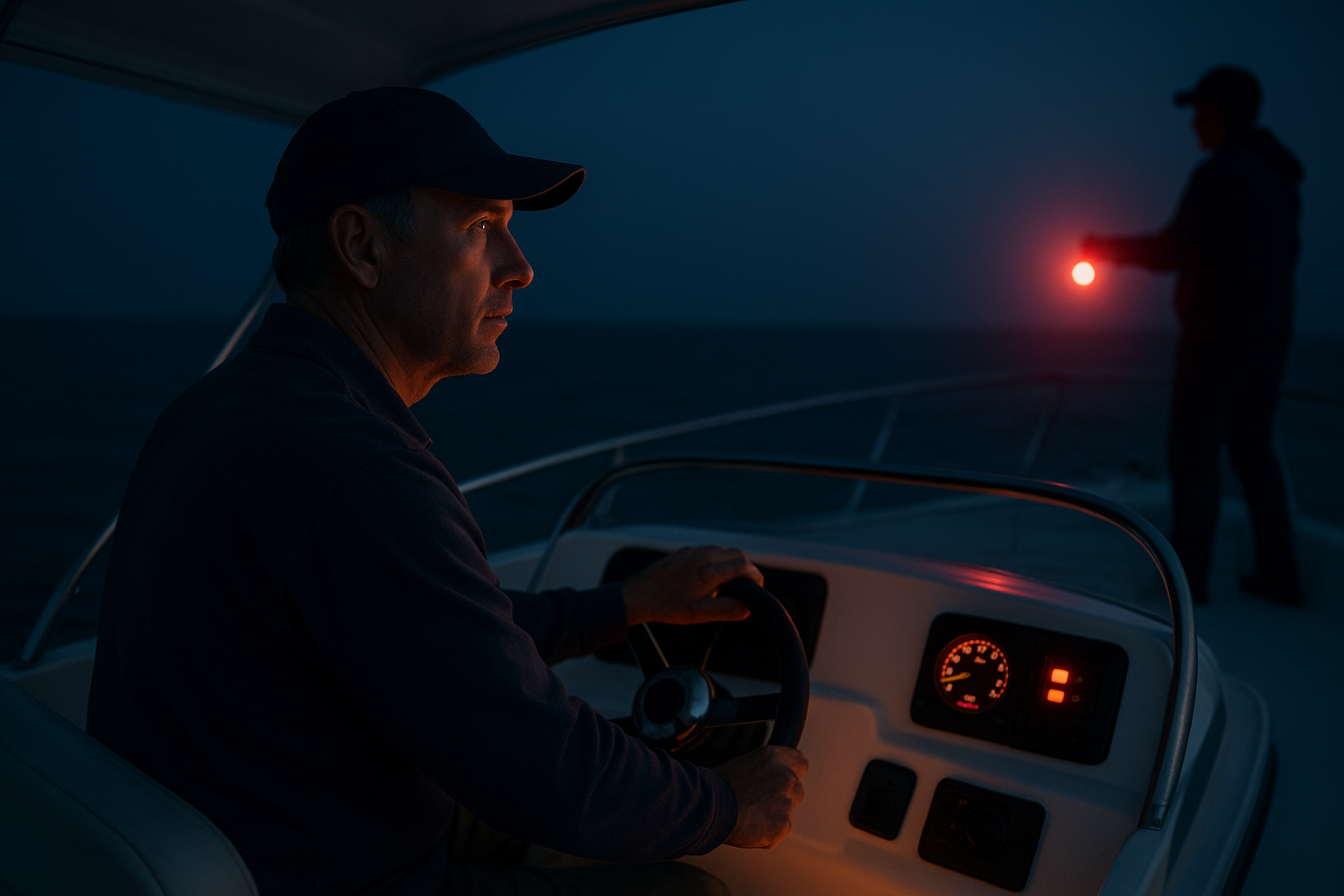
Your eyes require 20 to 30 minutes to fully adjust to darkness through a process called dark adaptation. During that window, the rods in your retinas gradually take over from the cones, giving you workable low-light vision. The problem is that a single burst of white light, a phone screen, an open hatch, or a poorly aimed flashlight, resets that process almost instantly. You’ll be effectively blind for several minutes every time it happens.
Protect your night vision by switching to red-filtered light sources inside the cabin and keeping all white light pointed away from the helm.
One practical technique is averted vision: instead of looking directly at a faint object, shift your gaze about 10 to 15 degrees to the side. Your peripheral rods pick up low-light detail far better than your central vision does. Practice this before you need it, not while you’re trying to identify a buoy at the last second.
The gear you need before you leave the dock
Running at night without the right equipment isn’t just risky, it’s illegal in U.S. waters under USCG regulations. Before you cast off after sunset, confirm you have every item on this list:
Equipment
Why it matters at night
Properly functioning navigation lights
Required by law; lets others see your position and direction
Handheld VHF radio
Emergency communication when cell service drops
Red-filtered flashlight
Preserves night vision during chart checks
Waterproof GPS or chartplotter
Confirms your position when landmarks disappear
Whistle or air horn
Required sound signal for low visibility conditions
Flares (current expiration date)
Visual distress signals if you need help
Anchor and rode
Lets you stop safely if conditions become unsafe
Check every item on that list before sunset, not at the dock in the dark. Missing gear at night is a much harder problem to solve than missing gear in the afternoon.
Step 1. Prep your boat and crew before sunset
Prepping before the sun goes down is the single most effective thing you can do when learning how to navigate a boat at night. Once darkness falls, finding a missing piece of gear or briefing a confused passenger becomes significantly harder and more stressful. Run every check while you still have natural light, and you’ll start the night run with confidence instead of scrambling at the dock.
Walk through a pre-departure checklist
A thorough checklist removes guesswork and keeps you from forgetting something critical once the dock lights are on. Walk the boat stem to stern and verify each item before you cast off:
Navigation lights: Turn them on and visually confirm bow, stern, and sidelights are working
Horn or whistle: Test the signal to confirm it’s loud and functional
Flares: Check expiration dates and store them in a dry, accessible location
Fuel level: Calculate your round-trip consumption and add a 25% safety buffer
VHF radio: Power it on, confirm the battery charge, and tune to Channel 16
Anchor and rode: Confirm they’re rigged and ready to deploy quickly
Running this checklist in daylight takes five minutes and prevents problems that could take hours to resolve after dark.
Brief your crew before you leave
Your passengers need to know what to expect before the lights disappear. Tell them where the life jackets are stored, how to use the VHF radio, and what to do if someone falls overboard. Keep the briefing short and specific.
Assign at least one person as a dedicated bow lookout, responsible for watching for floating debris, unlit vessels, and channel markers. A crew that knows its role responds faster and calmer when something unexpected happens on the water.
Step 2. Use navigation lights and markers to orient fast
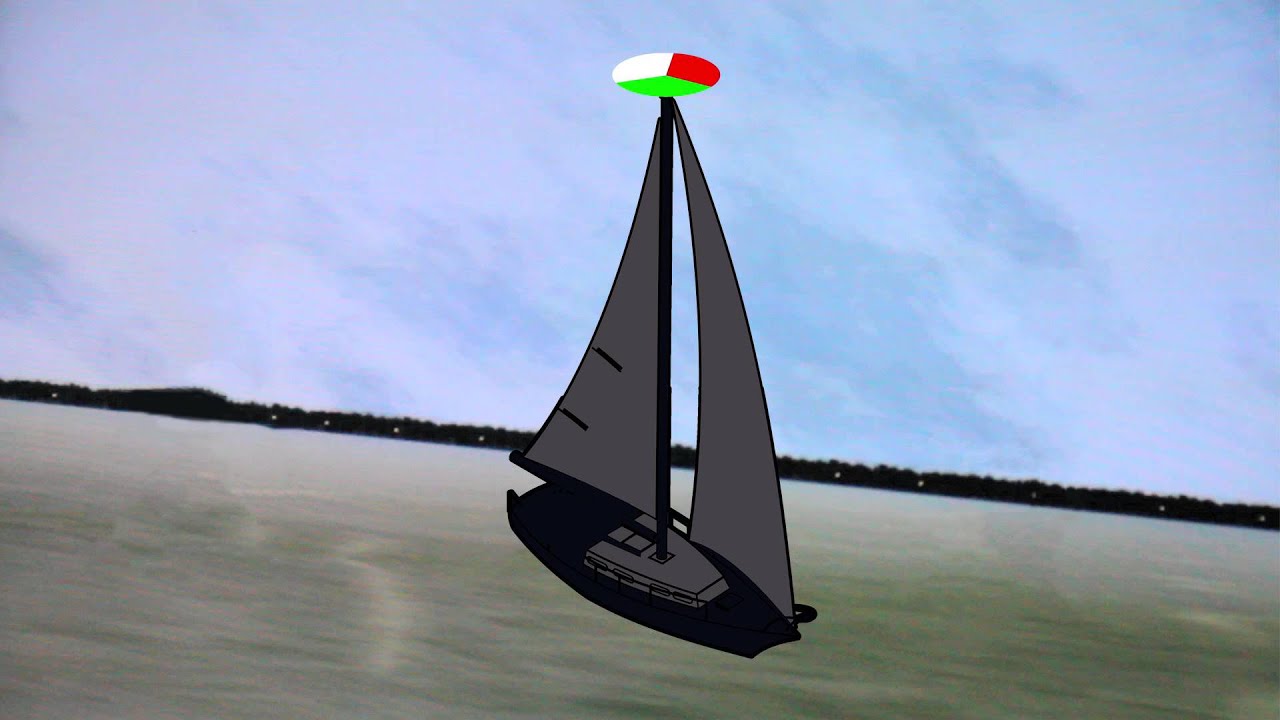
Understanding what the lights around you mean is one of the most critical skills when learning how to navigate a boat at night. Every vessel broadcasts its position, heading, and type through a standardized system of colored lights, and reading those signals correctly tells you whether another boat is crossing your path, heading toward you, or moving away. Get this wrong and you are guessing in the dark.
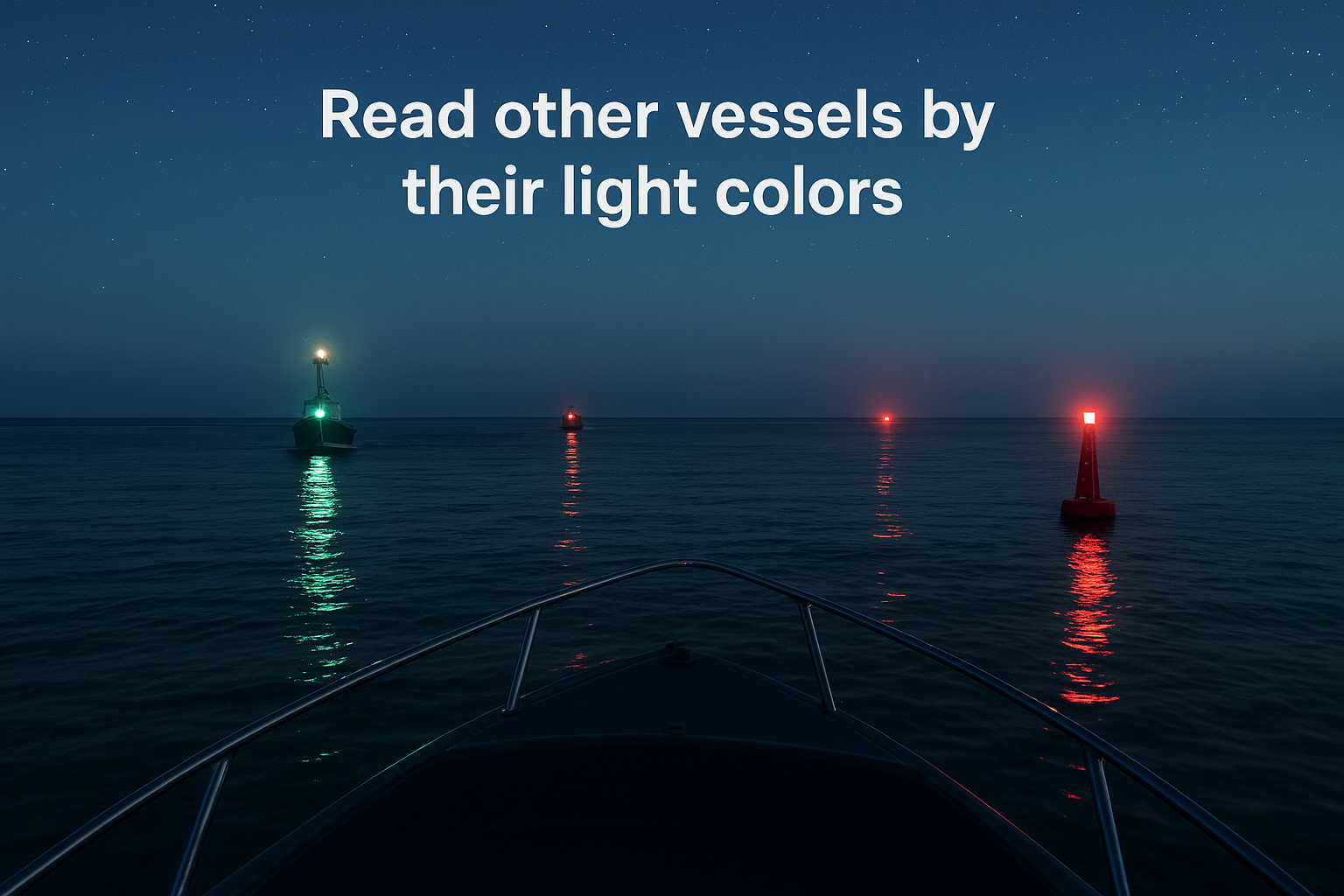
Read other vessels by their light colors
When you spot lights on the water, your first job is to identify the color pattern and determine where that vessel is headed. The table below covers the configurations you will encounter most often on coastal waters:
What you see
What it means
Green light only
Looking at the starboard side; vessel may be crossing from your left
Red light only
Looking at the port side; assess the crossing angle carefully
White stern light only
Vessel is moving away from you
Red and green together
Vessel is heading directly at you
If you see both a red and green light growing larger at the same time, that boat is coming straight at you and you need to act immediately.
Follow buoys and channel markers in sequence
Red and green buoys mark safe water channels in U.S. waters, and the rule "red, right, returning" tells you to keep red markers on your starboard side when heading back to port. At night, these buoys display flashing colored lights that match their daytime colors, so follow the same sequence after dark that you would in daylight.
Move marker to marker rather than cutting across open water, and you stay in the safest lane available. Memorize the flash patterns for the buoys on your route, since some use quick flashes and others use slow group flashes to signal specific hazards or channel turns ahead.
Step 3. Control speed, keep a lookout, use sound
Speed is the variable you control most directly when figuring out how to navigate a boat at night, and it’s the one most boaters get wrong. The core rule is simple: never travel faster than the speed that allows you to stop within your visible range. At night, that range shrinks dramatically, so your speed must shrink with it.
Slow down and match your sight distance
Cutting speed feels counterintuitive when you want to get home, but it gives you the reaction time you need to avoid floating debris, unlit objects, or swimmers that appear with almost no warning after dark. A good starting point for most recreational boats in unfamiliar nighttime waters is half your normal daytime cruising speed, adjusted further based on how well you can see ahead.
The moment visibility drops below what you can scan in the time it takes to stop, you are already going too fast.
Use the following guidelines to calibrate your speed to conditions:
Condition
Recommended action
Clear night, familiar waters
Reduce to 50-60% of daytime speed
Hazy or foggy conditions
Reduce to minimum steerage speed
Heavy boat traffic
Slow further and increase lookout frequency
Post a lookout and use sound signals
Assign one crew member to stand at the bow with a red-filtered light and watch for anything the helm cannot see. That person should scan continuously and report back verbally using clock positions, such as "object at ten o’clock, close." This system keeps the helm informed without requiring the driver to break focus from the water ahead.
In reduced visibility or fog, U.S. regulations require you to sound one prolonged blast every two minutes under power. Keep your horn within reach at the helm so you never have to search for it when you need it fast.
Step 4. Use GPS, radar, and spotlights without mistakes
Technology is one of the most powerful tools you have when figuring out how to navigate a boat at night, but it also creates specific pitfalls if you rely on it carelessly. Each device serves a distinct purpose, and using them incorrectly or leaning on them as a substitute for judgment can put you in a worse position than not having them at all.
Use your GPS as your primary reference
Your GPS chartplotter confirms your position continuously so you are never guessing where you are relative to shallow water, channel edges, or fixed hazards. Set it to show your planned route as a visible track and glance at it regularly rather than staring at it for extended periods. Staring at the screen destroys your night vision and pulls your attention away from the water directly in front of you.
Cross-reference your GPS position with at least one visual reference, such as a buoy or a channel light, every time you update your course.
Before departure, load your waypoints in daylight and walk through the full route on screen so you already know what to expect when you run it in the dark. Rely on GPS to confirm, not to replace, your awareness of what is around you.
Point spotlights without blinding yourself or others
A handheld spotlight is most useful for identifying specific objects close to the boat, not for illuminating the entire water ahead. Sweeping a bright white beam across the water at night will collapse your night vision instantly and can temporarily blind the operator of an oncoming vessel, which creates a collision risk rather than preventing one. Use short, targeted bursts aimed low at the object you need to identify, then switch it off.
Ready for your next night run
Knowing how to navigate a boat at night comes down to preparation, patience, and respecting the limits of what you can see. Protect your night vision, brief your crew before sunset, read every light pattern around you, match your speed to your visibility, and use your GPS as a confirmation tool rather than a replacement for situational awareness. Each step in this guide builds on the last, and applying them together is what separates a smooth night run from a stressful one.
The Emerald Coast rewards boaters who take it seriously. Evening returns from Crab Island, sunset cruises through the harbor, and late-day fishing trips are some of the best experiences this area offers, but only when you handle them with the right skills. If you want a well-equipped, professionally maintained boat for your next outing on the water, plan your trip with Original Crab Island and make your evening on the Gulf one worth talking about.
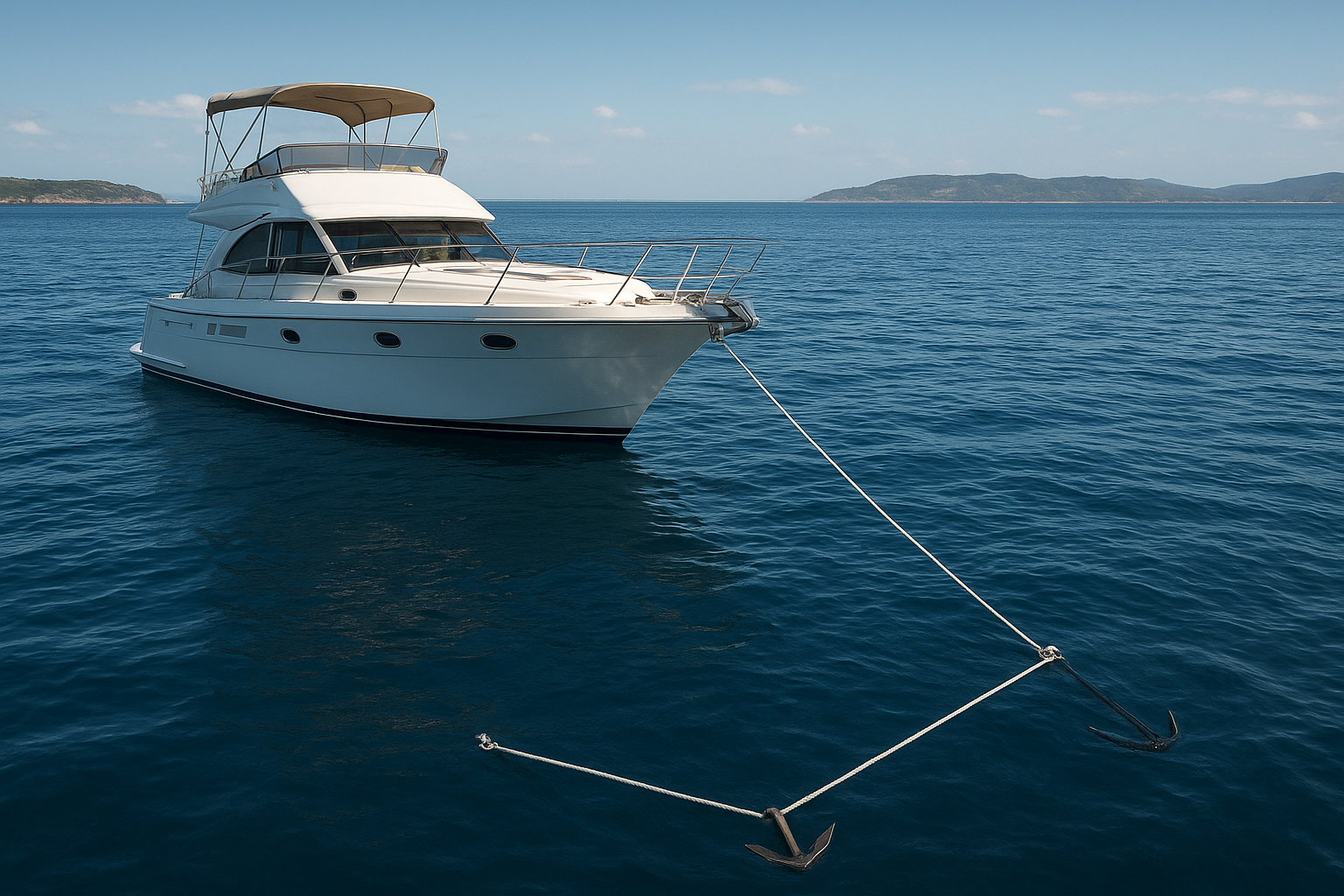
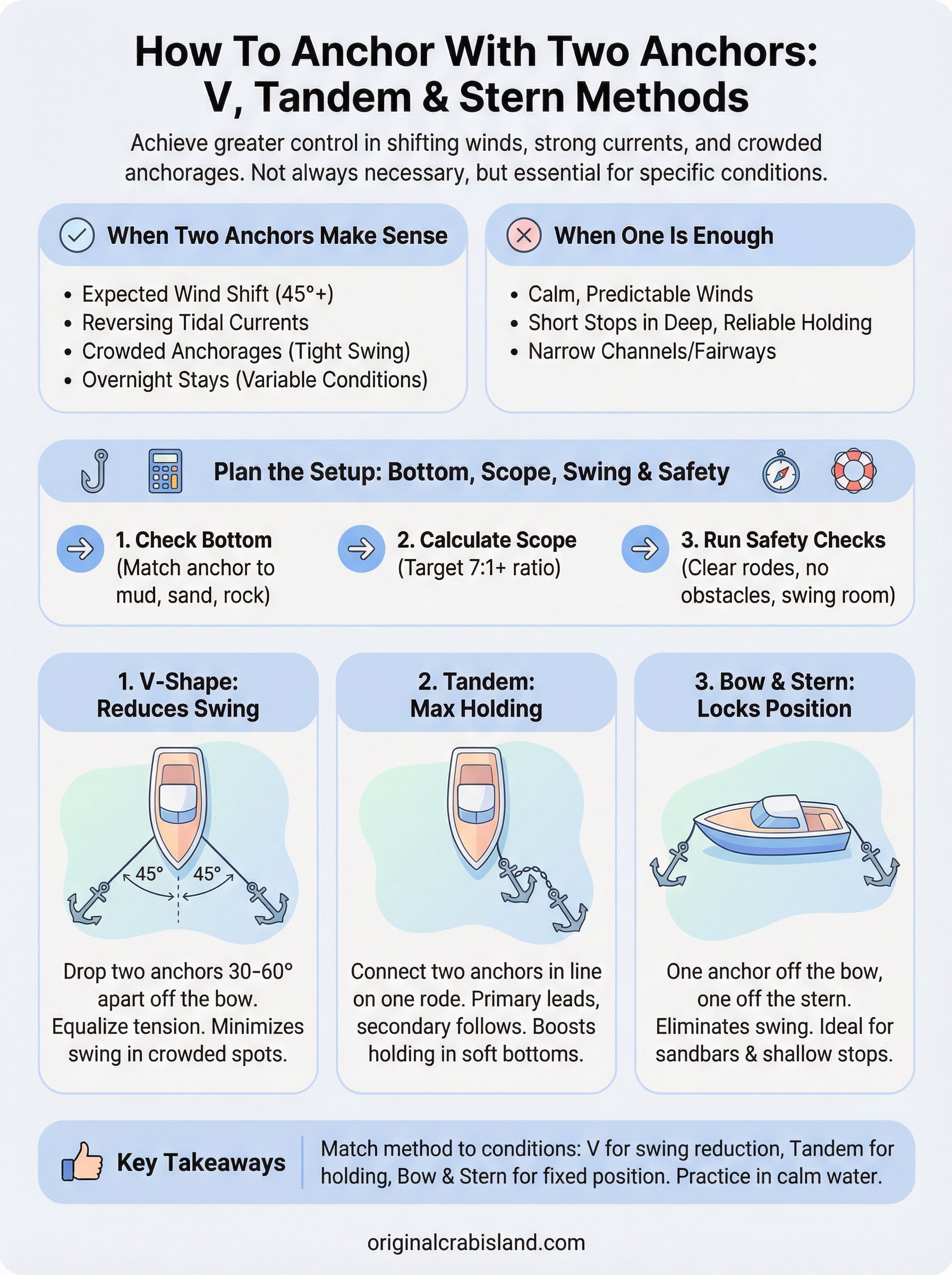
A single anchor works fine in calm conditions, but wind shifts, strong currents, and crowded anchorages can turn a peaceful day on the water into a stressful one. That’s exactly when knowing how to anchor with two anchors becomes a genuine skill worth having. Whether you’re holding position at a busy sandbar like Crab Island or riding out changing tides in Destin’s harbor, a two-anchor setup gives you the control that one hook simply can’t provide.
At Original Crab Island, we put people on the water every day, from pontoon rentals to fishing charters across the Emerald Coast. We’ve seen firsthand how proper anchoring separates a relaxing afternoon from a drifting disaster. Anchoring technique matters, especially in the shifting currents and shallow sandbars around Destin, Florida.
This guide breaks down the three main two-anchor methods, V-shape, tandem, and bow-and-stern, with clear steps, situational advice, and tips to help you anchor confidently no matter the conditions. Let’s get into it.
When to use two anchors and when not to
Two anchors aren’t always better than one. Using two anchors incorrectly can create real problems: tangled rodes, limited swing room, and difficulty getting underway fast when conditions change. Before you learn how to anchor with two anchors, you need to know when the technique actually helps you and when it just adds unnecessary work.
When two anchors make sense
Several specific situations call for a two-anchor setup. The clearest one is an expected wind shift, where the forecast shows conditions changing direction by more than 45 degrees during your stay. A single anchor pivots with you, which sounds fine until the hook drags on a new angle. A second anchor holds you from that direction before the shift even happens.
If you’re anchoring at a busy sandbar or tidal area where conditions change quickly, two anchors protect both your position and the boats around you.
Strong reversing currents are another good reason to set two hooks. Tidal areas like Destin harbor and the sandbar at Crab Island see water flowing hard in one direction, then switching completely a few hours later. One anchor can drag or flip when the load reverses. Setting a bow-and-stern or tandem setup keeps you planted through the full tidal cycle.
Two anchors also help when swing room is tight. In a crowded anchorage, you can’t afford to arc 180 degrees around your hook when the wind shifts. A V-shape setup reduces that swing radius significantly, keeping you off neighboring boats and giving everyone more breathing room.
Here’s a quick reference for when to use two anchors:
Situation
Two Anchors?
Reason
Wind shift expected (45+ degrees)
Yes
Prevents dragging on new angle
Reversing tidal currents
Yes
Holds through full tidal cycle
Crowded anchorage
Yes
Reduces swing radius
Overnight stay
Yes
Extra security during variable conditions
Calm, stable wind
No
Extra setup adds complexity without benefit
Short stop in deep, reliable holding
No
One anchor is sufficient
Narrow channel or fairway
No
Two rodes create a serious tangle risk
When one anchor is enough
Calm, predictable conditions with a steady wind direction and solid holding bottom don’t require two anchors. If you’re making a brief stop in deep water with good scope and reliable ground, a single well-set anchor handles the job without the added complexity. Pulling two anchors in a hurry when a squall rolls in or you need to move fast costs you time you may not have.
Plan the setup: bottom, scope, swing, and safety checks
Before you drop any anchor, spend a few minutes assessing your situation. Rushing the setup is the most common reason two-anchor rigs fail. Knowing your bottom type, calculating your scope, understanding your swing arc, and running a quick safety check will make every method of how to anchor with two anchors work better and hold longer.
Check the bottom and scope
Bottom composition directly affects which anchor type holds best and how much rode you need. Soft sand and mud suit a fluke or Danforth-style anchor, while rocky or grassy bottoms respond better to a plow or claw. For a two-anchor setup, target a scope ratio of at least 7:1 (rode length to water depth) on each hook.
Water Depth
Minimum Scope (7:1)
Recommended Scope (10:1)
5 ft
35 ft
50 ft
10 ft
70 ft
100 ft
15 ft
105 ft
150 ft
Cutting scope short is one of the fastest ways to drag anchor, especially when current or wind shifts direction.
Calculate your swing and run safety checks
Swing radius depends on how much rode you deploy and which method you choose. A V-shape setup cuts your swing to roughly half compared to a single anchor, while a bow-and-stern setup reduces it to almost nothing. Before you commit to a position, mark your GPS coordinates so you can detect any drift before it becomes a real problem.
Run through these checks before setting either hook:
Confirm no underwater obstacles (cables, moorings) in your drop zone
Check that both rodes are clear of the prop and rudder
Verify neighboring boats have room even with your reduced swing
Keep a knife or rode cutter within reach in case you need to cut free quickly
Set two anchors in a V shape
The V-shape method works well when you need to reduce swing radius in a crowded anchorage or hold through a forecasted wind shift. In this setup, you drop two anchors off the bow at angles between 30 and 60 degrees apart, creating a triangular load distribution that keeps the bow pointed into a wider range of wind directions. This is one of the most practical ways to apply how to anchor with two anchors in real, changing conditions.
The wider the angle between your two anchors, the less you’ll swing, but also the more lateral load each hook must absorb, so don’t exceed 60 degrees in strong current.
Position and drop the first anchor
Motor into the wind and pick your drop point for the first anchor. Back down slowly while paying out rode, targeting your 7:1 scope minimum, then cleat it off briefly to let the hook set. Once you feel resistance and the boat stops backing, anchor one is holding. Don’t move to the second hook until the first has a firm bite.
Use these signs to confirm anchor one has set properly:
The boat stops drifting backward
The rode holds tension and angles downward
Throttling gently in reverse creates no additional drift
Set the second anchor and equalize the load
Swing the bow 30 to 60 degrees off your first anchor’s direction using short bursts of throttle, then drop the second anchor in that new direction. Back down again, paying out the same scope length as the first. Once both hooks are set, ease out on the first rode until both lines carry equal tension. Run each rode through a bow chock to keep them separated and clear of the prop.
Step
Action
1
Motor into wind, drop anchor one
2
Back down and set scope at 7:1 minimum
3
Swing bow 30 to 60 degrees off anchor one
4
Drop anchor two, back down to set
5
Equalize tension on both rodes
Set two anchors in tandem for max holding
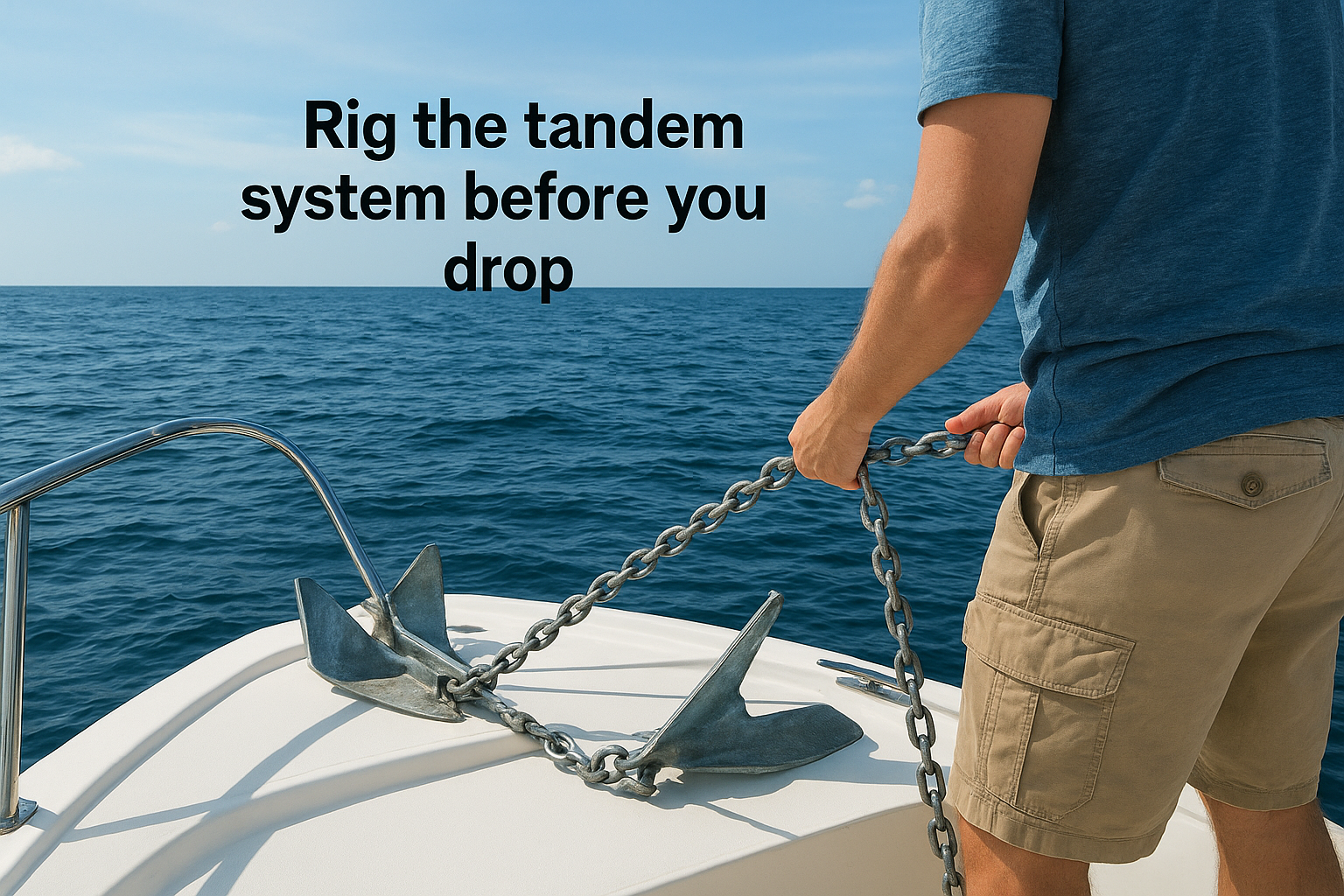
Tandem anchoring connects two anchors on the same rode, one behind the other, with the primary anchor leading and a secondary anchor set back along the chain or line. This method doesn’t reduce swing like the V-shape, but it dramatically increases raw holding power in soft or unreliable bottoms where a single hook tends to plow or skip. It’s one of the most effective ways to apply how to anchor with two anchors when your main concern is staying put rather than minimizing arc.
Tandem anchoring is especially useful in sandy, silty, or grassy bottoms where a single anchor struggles to get a consistent bite.
Rig the tandem system before you drop
Connecting the two anchors correctly before you deploy saves you a lot of trouble once you’re in position. Attach the secondary anchor to the primary anchor’s crown using a short length of chain, typically 3 to 6 feet. The secondary anchor should be a different style if possible, since a plow paired with a fluke covers a wider range of bottom conditions than two of the same type. Keep both anchors on deck and sorted before you motor into position.
Drop and set both anchors as a unit
Motor into the wind exactly as you would for a single-anchor deployment. Lower both anchors together, letting the primary hit the bottom first while the secondary trails just behind it on the short chain. Back down slowly at your full 7:1 scope minimum, giving the system time to settle and dig before you apply real load.
Use this sequence to confirm the tandem rig is holding:
Primary anchor digs in and the rode goes taut
Secondary anchor pulls tight against the primary’s crown
Backing down with moderate throttle produces no drift
GPS position holds steady for at least two minutes
Set a bow and stern anchor for sandbars
The bow-and-stern method is purpose-built for sandbars, swimming stops, and shallow tidal flats where you need to sit in one fixed orientation without any swing at all. Instead of two anchors off the bow, you drop one off the bow and one off the stern, locking the boat in place. This is the most practical way to apply how to anchor with two anchors at a spot like Crab Island, where boats need to hold their bow toward the sandbar while people swim or wade, and drifting sideways into a neighboring boat is not an option.
Bow-and-stern anchoring eliminates nearly all swing, which is exactly what you need in a crowded, shallow area where every foot of space matters.
Position the boat and drop the bow anchor
Pull into your chosen spot bow-first, with the stern facing open water or the direction of current. Drop your bow anchor while slowly backing down, setting it with a 5:1 to 7:1 scope suited to the shallow depth. Cleat off the bow rode once the anchor bites and holds firm against a short burst of reverse throttle before moving to the next step.
Run the stern anchor and lock the position
Pay out extra bow rode to give yourself enough room to deploy the stern anchor without pulling the bow hook free. Move to the stern, drop the second anchor straight back into the water, then take up tension on both rodes simultaneously until the boat sits centered between the two hooks with equal load on each line. Use this checklist to confirm the setup is holding:
Bow rode and stern rode both carry firm tension
Boat shows no lateral drift or rotation
Both rodes run clear of the prop and swim platform
Key takeaways and next steps
Knowing how to anchor with two anchors comes down to matching the right method to your actual conditions. The V-shape cuts your swing in crowded anchorages, tandem anchoring maximizes holding power in soft bottoms, and the bow-and-stern setup locks you in place at sandbars and shallow stops. Each method works, but only when you pick the right one for the situation.
Before you head out, spend time checking your bottom type, calculating scope, and confirming swing room. Rushing any of those steps is the fastest way to drag anchor and ruin an otherwise great day on the water. Practice each method in calm conditions first so the steps feel automatic when you actually need them.
Every year, thousands of preventable accidents happen on the water because boaters skip the basics. Whether you’re renting a pontoon at Crab Island or taking your own vessel into the Gulf of Mexico, understanding US Coast Guard boating safety standards isn’t optional, it’s what keeps you, your passengers, and everyone else on the water out of harm’s way.
At Original Crab Island, we put guests on the water in Destin every single day. Pontoon rentals, jet skis, fishing charters, we see firsthand how a little knowledge goes a long way. Our team keeps every vessel stocked with required safety equipment and walks renters through the essentials before departure. But we also believe that boaters themselves should know the rules, not just rely on a rental company to handle it.
This guide breaks down what the U.S. Coast Guard actually requires of recreational boaters, from life jackets and fire extinguishers to navigation rules and distress signals. You’ll also find information on boating safety courses, who needs to take them, and how certification works in Florida. Whether you’re a first-timer headed to Crab Island or a boat owner brushing up before the season, this is the reference you need.
What US Coast Guard boating safety covers
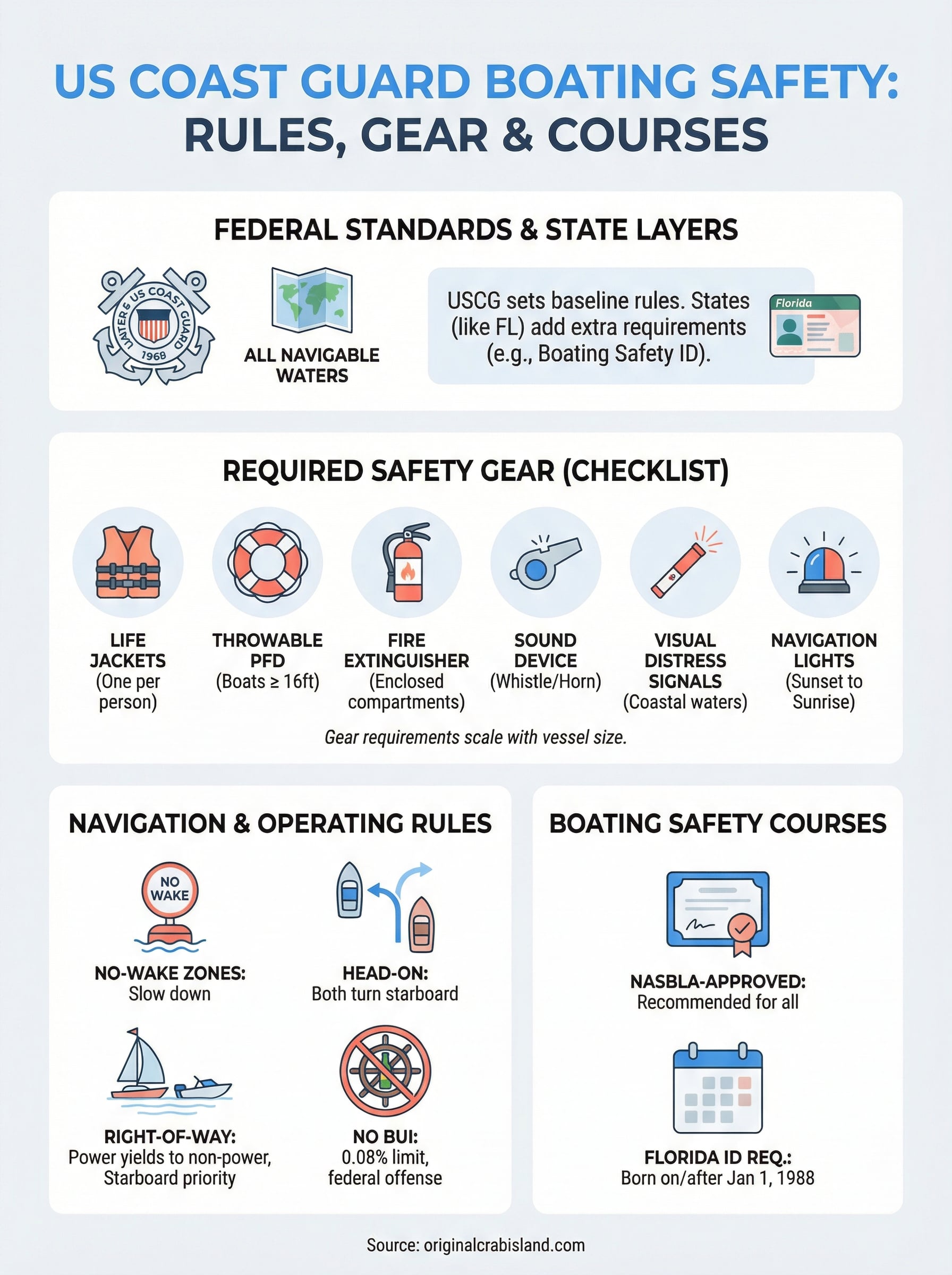
US Coast Guard boating safety is a federal framework that sets the minimum standards all recreational boaters must follow on navigable U.S. waters. The Coast Guard operates under the Department of Homeland Security and has the authority to board, inspect, and cite any vessel operating in U.S. waters, including inland lakes, rivers, and coastal areas. If you rent or own a boat anywhere in the country, these rules apply to you.
Federal authority and what it means for you
The Coast Guard writes the baseline rules, but states layer their own regulations on top. In Florida, for example, state law requires boaters born after January 1, 1988 to carry a Boating Safety Education ID card to operate a motorized vessel. Checking both federal and state requirements before you launch is essential, because the federal minimum alone might not keep you legal on Florida waters.
Knowing only the federal rules is not enough. Florida adds its own requirements, and ignoring them can result in fines or being ordered off the water.
The main categories of regulation
US Coast Guard boating safety standards break down into several clear categories, each targeting a specific risk that has caused injuries or deaths on the water.
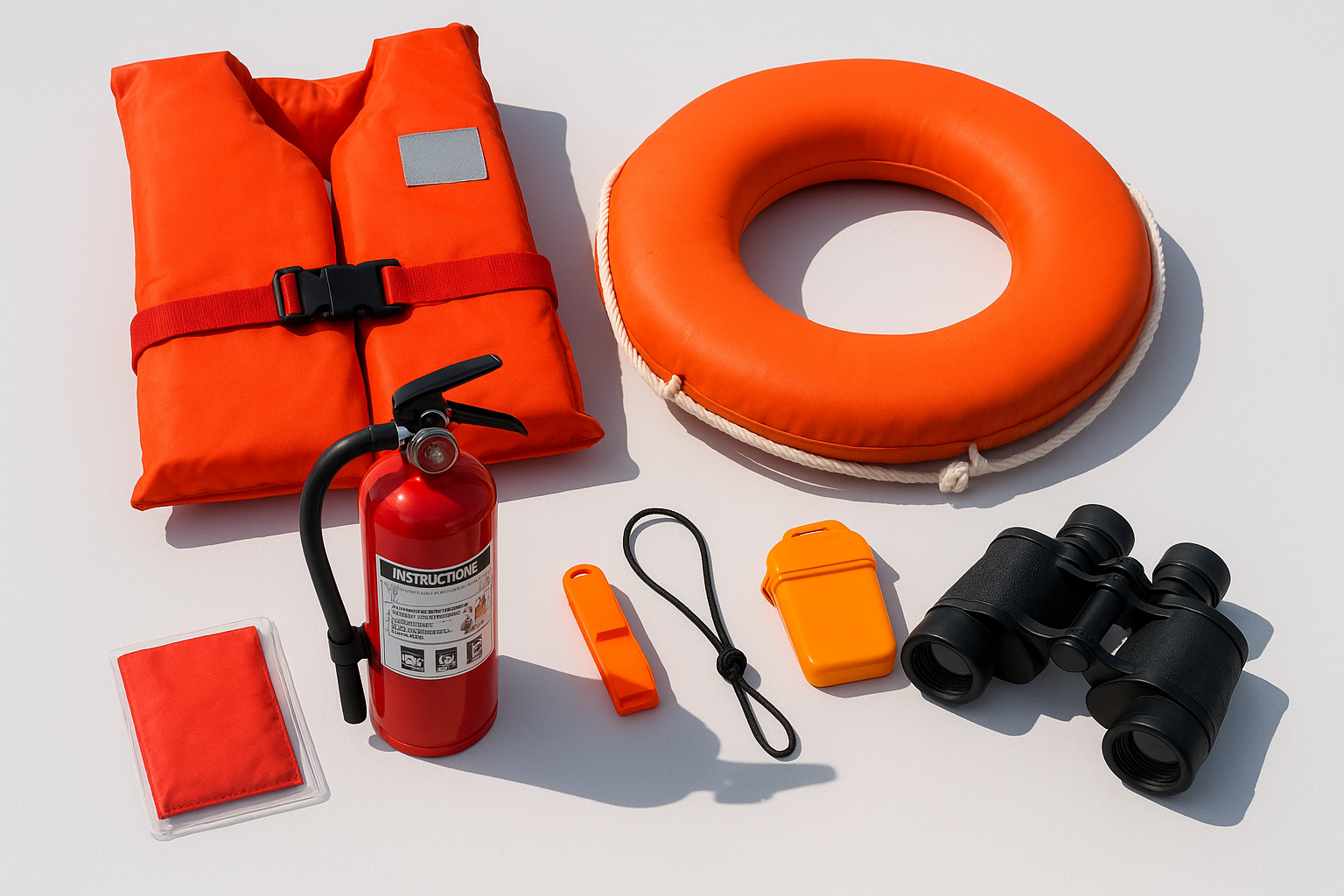
Personal flotation devices (PFDs): Every person on board must have access to a properly fitting life jacket.
Visual distress signals: Flares and other signaling devices are required on certain vessel types and waters.
Fire extinguishers: Required on boats with enclosed engine compartments or built-in fuel tanks.
Sound-producing devices: Whistles or horns are mandatory for vessels of a certain length.
Navigation lights: Required any time you operate between sunset and sunrise or in reduced visibility.
Vessel registration: All motorized boats must be registered with the state and display a valid registration decal.
These categories form the foundation of what every boater is responsible for knowing before leaving the dock.
Why Coast Guard boating safety rules matter
Boating accidents kill hundreds of Americans every year, and the U.S. Coast Guard’s Recreational Boating Statistics show that operator error and missing safety equipment are the leading causes. US Coast Guard boating safety rules exist to cut those numbers, and they work when people follow them. Ignoring these regulations puts lives at risk, including your passengers, nearby swimmers, and other boaters sharing the same water.
The Coast Guard reports that in over 75% of fatal boating accidents, the victim was not wearing a life jacket.
The real cost of ignoring the rules
Non-compliance carries serious financial and legal consequences. If a Coast Guard officer boards your vessel and finds missing required equipment, you can face civil penalties starting at several hundred dollars per violation. In Florida, operating without a valid Boating Safety Education ID card adds another layer of fines. Here is a quick breakdown of what violations can cost you:
Missing or expired PFDs: fines per person on board
No fire extinguisher: immediate citation and potential order to return to dock
Unregistered vessel: fines plus impoundment risk
How rules protect everyone on the water
Boating happens in shared, open spaces where your decisions directly affect other people. Proper navigation lights keep other vessels from colliding with you after sunset. Carrying required sound-producing devices lets you signal your position in low-visibility conditions. The rules reflect decades of accident data, and following them is the most effective thing you can do to keep everyone safe.
Required safety gear checklist by boat type
US coast guard boating safety requirements vary based on the length and type of your vessel, so what you need on a 16-foot rental pontoon differs from what a 30-foot yacht must carry. Knowing exactly what applies to your boat before you leave the dock keeps you legal and prepared.
Gear requirements scale with vessel size, so always check the specific rules for the boat you are operating, not just the general list.
What every boat must carry
Every recreational vessel operating in U.S. waters shares a core set of required equipment regardless of size. These are the items a Coast Guard officer will check during an inspection:
Equipment
Requirement
Life jackets (PFDs)
One Coast Guard-approved jacket per person on board
Type IV throwable PFD
Required on boats 16 feet and longer
B-1 fire extinguisher
Required on boats with enclosed compartments
Sound-producing device
Whistle or horn for vessels under 65 feet
Visual distress signals
Required on coastal waters and the Great Lakes
Navigation lights
Required between sunset and sunrise
Additional gear for larger vessels
Boats 26 feet and longer face stricter fire extinguisher requirements, typically needing multiple B-1 units or a single larger B-2 extinguisher. Larger vessels also require a backfire flame arrester on gasoline engines and must carry a ventilation system for enclosed fuel compartments. Check the U.S. Coast Guard’s official equipment requirements to confirm what applies to your specific vessel length.
Navigation and operating rules you must follow
US coast guard boating safety goes beyond carrying the right gear. You also need to know operating rules that govern how you move your vessel on the water, because breaking them puts you on a collision course with other boats, swimmers, and fixed structures.
Collision is the top type of boating accident reported to the Coast Guard, and most result from operator inattention or failing to follow right-of-way rules.
Speed and right-of-way on the water
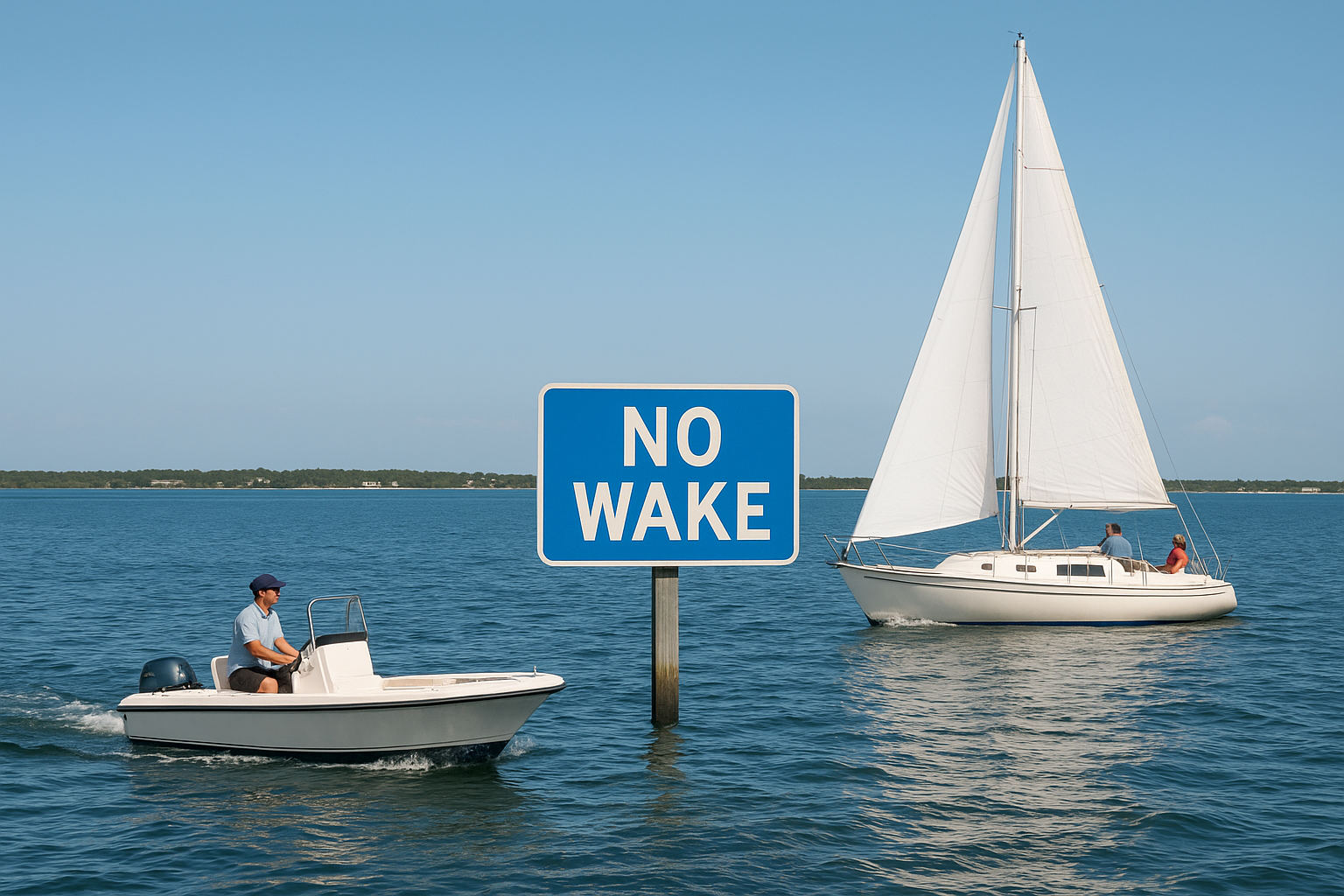
No-wake zones require you to slow to minimum speed in harbors, marinas, and near swim areas. When two motorized vessels approach head-on, both must turn to starboard (right) to avoid collision. Core right-of-way rules to know:
Power vessels yield to sail and human-powered craft
The vessel on the right (starboard) has right of way in crossing situations
Overtaking vessels must stay clear of the boat being passed
Alcohol and impairment on the water
Operating a vessel under the influence (BUI) is a federal offense with a blood alcohol limit of 0.08%, the same as driving. Florida law enforcement actively patrols waterways like Destin Harbor, and officers can stop your vessel for probable cause at any time.
Fatigue and sun exposure amplify alcohol’s effects on the water, so rotate operators on longer trips and stay hydrated to keep your judgment sharp throughout the day.
Boating safety courses and certification options
US coast guard boating safety education is available through several formal channels, and completing an approved course is one of the most effective ways to protect yourself and everyone on your boat. In Florida, the legal requirement is specific: if you were born on or after January 1, 1988, you must carry a Boating Safety Education ID card to legally operate a motorized vessel.
Completing a recognized safety course is the fastest path to getting your Florida Boating Safety ID card before you get on the water.
Florida’s mandatory education requirement
The Florida Fish and Wildlife Conservation Commission (FWC) administers the state’s boating education program. You must pass an approved course and exam to receive your ID card, which you carry on the water at all times when operating a motorized boat.
Completing the requirement happens only once since the ID card never expires. Bring the physical card or an approved digital copy every time you operate a motorized vessel in Florida.
Where to find approved courses
The National Association of State Boating Law Administrators (NASBLA) approves courses that meet federal standards, and Florida accepts these for your ID card requirement. Providers are listed directly on the FWC’s official website.
Online courses let you finish at your own pace before your vacation starts, while classroom options are available locally through FWC-approved providers in the Destin area.
Online courses: complete at home before your trip
Classroom courses: available through local FWC-approved providers
On-water training: optional but strongly recommended for first-time boaters
Next steps before you head to Crab Island
You now have a solid understanding of us coast guard boating safety requirements, from required gear to navigation rules and certification. Before you launch, run through the checklist: confirm your life jackets, fire extinguisher, and visual distress signals are on board and in good condition. If you were born after January 1, 1988, carry your Florida Boating Safety Education ID card every time you operate a motorized vessel.
Taking a NASBLA-approved course online before your trip costs little time and puts you in a far better position on the water. If you prefer to skip the logistics of owning or trailering a boat, renting from a reputable local operation is a practical and stress-free option.
At Original Crab Island, our well-maintained fleet and experienced staff handle the equipment side so you can focus on enjoying the Emerald Coast. Book your Crab Island experience and get on the water with complete confidence.
You booked a dolphin cruise in Destin, now you’re standing in front of your suitcase wondering what to wear on a dolphin cruise without looking like you packed for the wrong trip. It’s a fair question. You’ll be out on the water for a couple of hours, somewhere between full beach mode and a casual boat outing, and the wrong outfit can turn a great experience into a sunburned, windblown mess.
At Original Crab Island, we run dolphin cruises out of Destin, Florida, and we see every wardrobe choice imaginable, some smart, some regrettable. After years on the water, we know exactly what works and what doesn’t when you’re cruising the Emerald Coast looking for dolphins. The sun is stronger than you think, the wind picks up fast, and salt spray is always a factor.
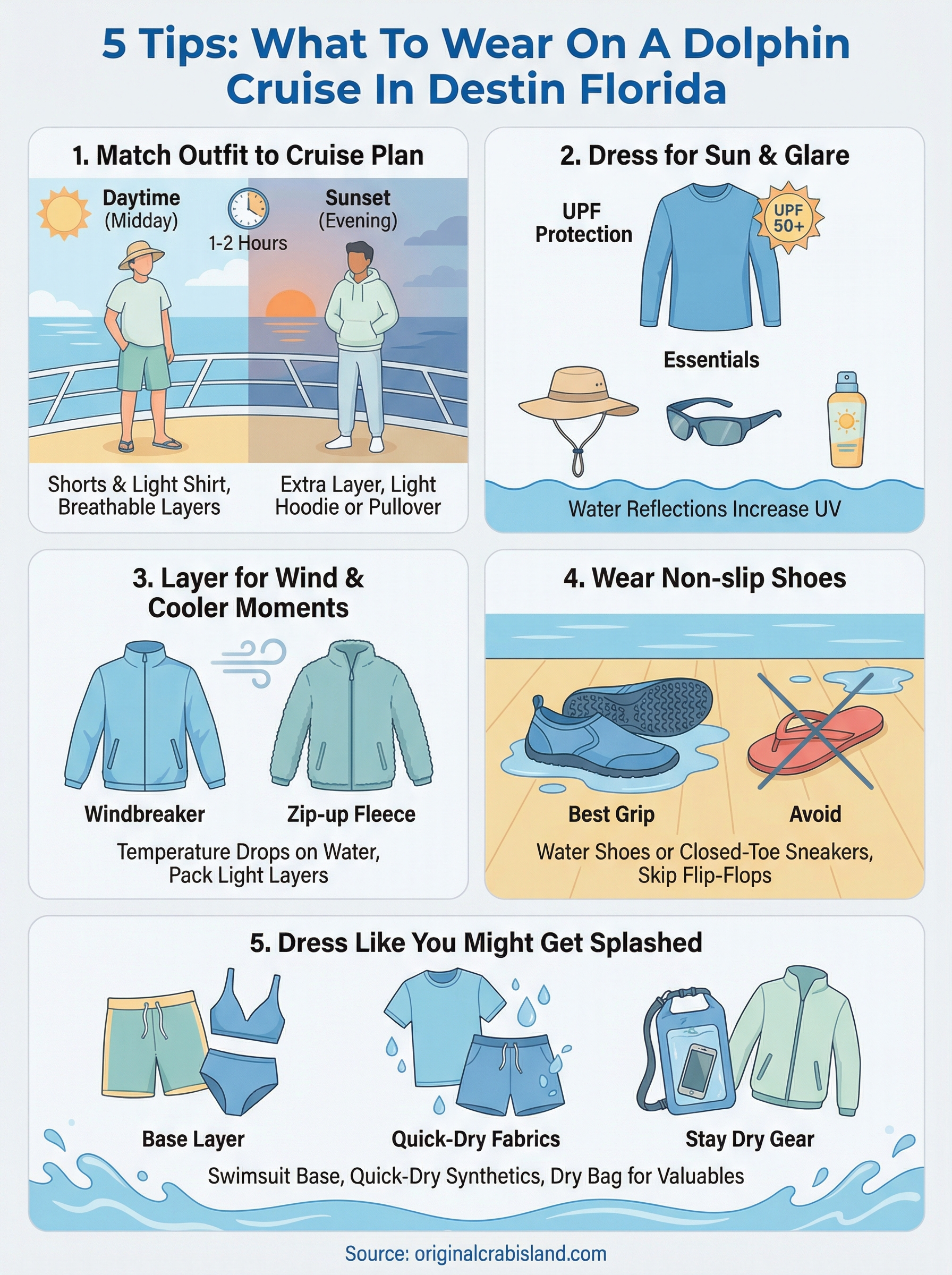
Here are five straightforward tips to help you dress right, stay comfortable, and actually enjoy the ride from start to finish.
1. Match your outfit to your dolphin cruise plan
Before you decide what to wear on a dolphin cruise, you need a basic picture of the cruise itself. A two-hour midday cruise in July calls for something very different than a sunset cruise in October, and your outfit should start with that information, not with whatever’s on top of your suitcase.
Choose clothing based on cruise length and time of day
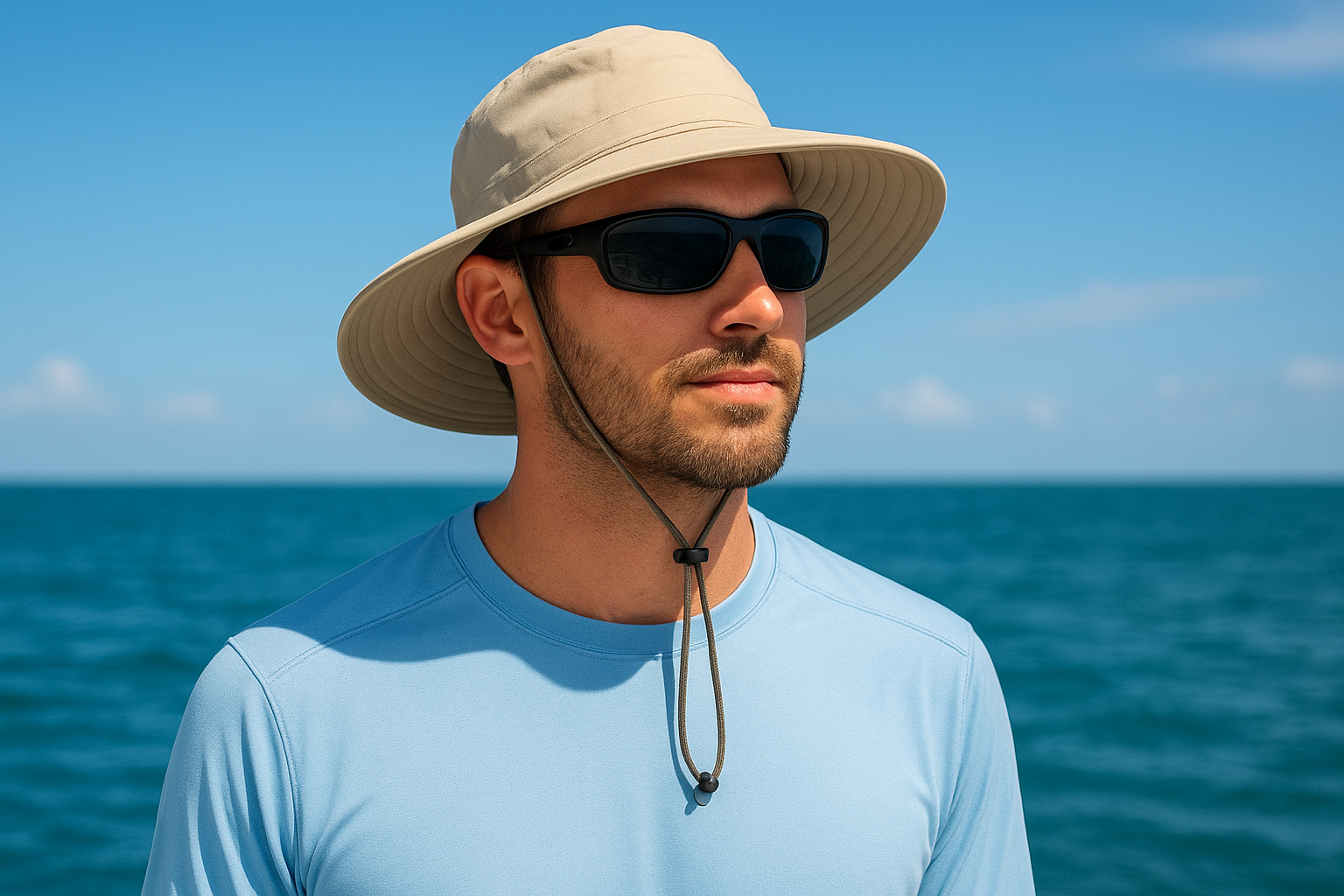
A short morning cruise in spring means cooler temperatures and softer sun, so light pants and a long-sleeve shirt work well. A midday summer cruise flips that completely. You want minimal, breathable layers that handle direct sun and humidity without making you uncomfortable for the whole ride.
Plan around the boat layout and ride style
Dolphin cruises involve standing, shifting to open seating, and moving around the deck to follow dolphins as they surface. Your clothing needs to move with you and not restrict your range of motion. Loose shorts and a fitted top beat stiff jeans or anything bulky every time on a moving boat.
Tight or heavy clothing traps heat fast on a sunny open deck, so prioritize fit and fabric before anything else.
How Original Crab Island dolphin cruises typically run
Our Destin dolphin cruises operate on open-deck pontoon boats, which means full sun exposure and direct wind the entire time. You’re not sheltered inside a cabin, so conditions affect you throughout the trip. Most cruises run one to two hours, long enough that a thoughtful outfit makes a real difference in how comfortable you feel by the end.
Quick checklist before you leave the condo or hotel
Run through this before you head out:
Breathable top (moisture-wicking fabric or a cotton blend)
Shorts or light pants that allow easy movement
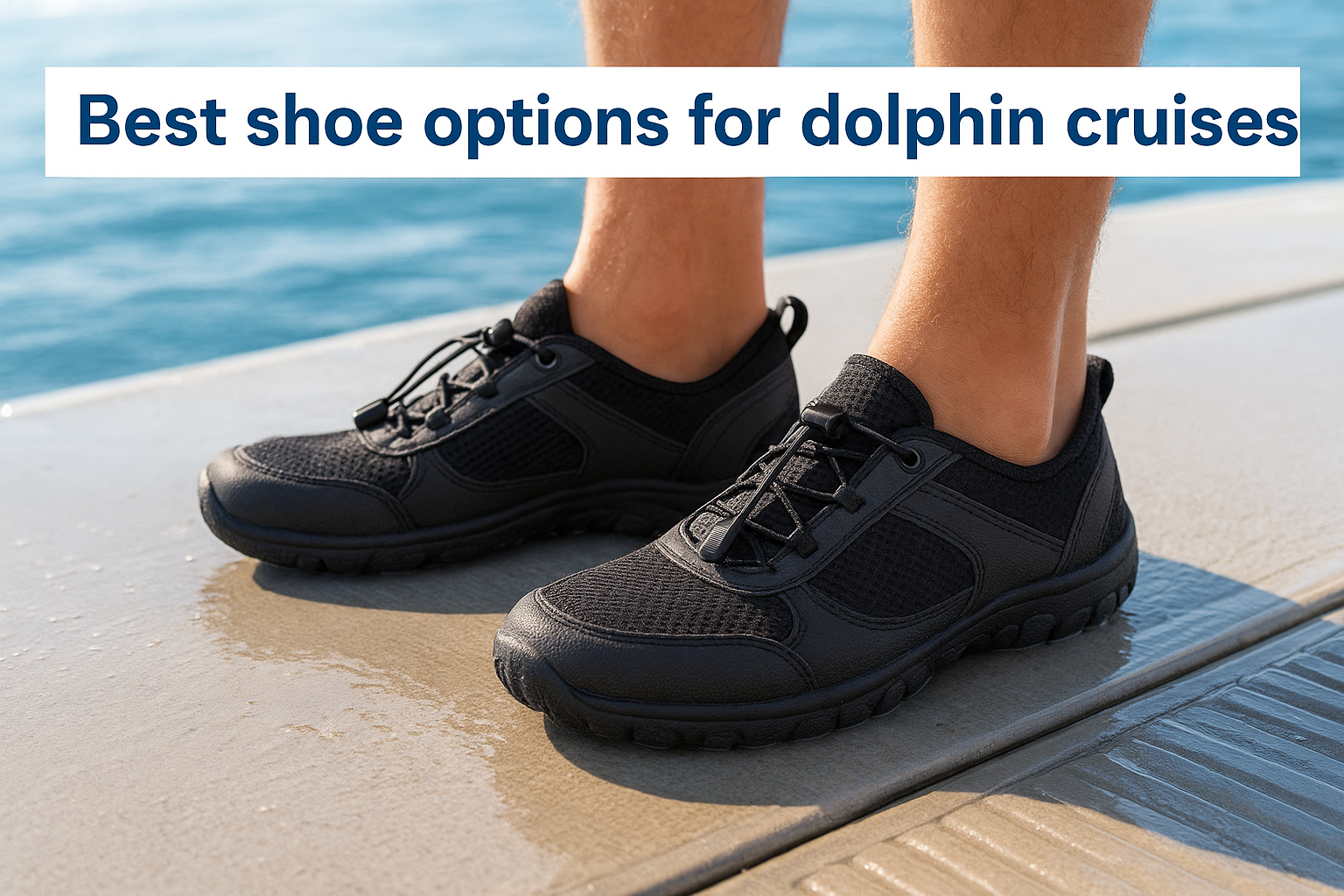
Non-slip shoes (more detail in tip 4)
Hat and sunglasses that fit securely (more detail in tip 2)
A light layer for wind (more detail in tip 3)
2. Dress for Destin sun and water glare
Destin’s Gulf water amplifies UV exposure by reflecting sunlight back at you from below. Knowing what to wear on a dolphin cruise here means sun protection comes first, before you even think about style.
Wear breathable, quick-dry basics
Start with a moisture-wicking top and quick-dry shorts as your base layer. Synthetic blends or light cotton stay breathable in Gulf Coast heat and dry fast if you catch any spray during the cruise.
Add UPF protection the easy way
A UPF 50+ long-sleeve shirt protects your arms, neck, and shoulders for the full cruise. It beats relying on sunscreen alone when wind and sweat are constant factors on an open deck.
UPF-rated clothing is more reliable than sunscreen on open, moving boats where conditions work against reapplication.
Pick a hat and sunglasses that stay put
Grab a wide-brim hat with a chin strap so the wind does not take it overboard. Polarized, wraparound sunglasses block side glare off the water and reduce eye strain throughout the trip.
Good styles to look for:
Wide-brim hat with adjustable chin strap
Wraparound polarized sunglasses with UV400 rating
Apply sunscreen without ruining your outfit
Apply it 15 minutes before boarding so it absorbs fully into your skin. Choose mineral spray formulas that dry quickly and leave fewer stains on fabric or seat cushions.
3. Layer for wind and cooler moments
Wind on the water hits differently than wind on land, and Destin’s Gulf breeze can drop your comfort level fast even when the air temperature feels fine onshore. Knowing what to wear on a dolphin cruise means planning for wind, not just heat.
Bring a light layer even on warm days
Pack a lightweight windbreaker or zip-up fleece in your bag. It takes up almost no space but makes a real difference once the boat picks up speed and the breeze cuts through your shirt.
Good options to pack:
Lightweight nylon windbreaker
Zip-up synthetic fleece
What to wear on sunset dolphin cruises
Sunset cruises cool down quickly as the sun drops, so bring an extra layer beyond what you’d carry for a midday trip. A light hoodie or long-sleeve pullover works well and keeps you comfortable throughout the ride without overheating earlier in the evening.
Temperatures on the water can feel 10 degrees cooler than the beach once the sun goes down.
What to do if the forecast changes fast
Check the hourly forecast on the morning of your cruise. If clouds roll in or wind speeds climb, swap your shorts for light pants and add your windbreaker before you board.
Common layering mistakes that make you colder
Avoid heavy cotton layers like sweatshirts, which absorb moisture and stay damp from spray or humidity. Synthetic fleece or nylon shells dry fast and keep you warm even when conditions turn wet.
Fabrics to skip:
Heavy cotton sweatshirts
Denim jackets
4. Wear non-slip shoes that can handle a wet deck
A wet boat deck is slippery, and the right footwear keeps you stable when the boat rocks or water splashes across the surface. Knowing what to wear on a dolphin cruise includes your feet, which most people overlook until they’re sliding around on a moving pontoon.
Best shoe options for dolphin cruises
Water shoes with rubber soles o closed-toe sneakers give you the best grip on a wet deck. Look for styles with siped or textured soles that channel water away rather than ride on top of it.
When sandals work and when they don’t
Sandals with heel straps and textured footbeds work reasonably well on calm days. Flip-flops, however, offer zero grip and pop off easily when you move quickly around the deck.
Flip-flops are the most common footwear mistake people make on open-deck boat tours.
What to avoid for safety and comfort
Skip smooth-soled leather shoes or dress sandals entirely. They become dangerously slick the moment deck boards get wet, and they take forever to dry out.
Tips for kids’ footwear and foot protection
Put kids in strap-secured water shoes with rubber soles. Their feet stay protected from hot deck surfaces and rough edges, and the straps keep the shoes on when they run around the boat.
5. Dress like you might get splashed
Knowing what to wear on a dolphin cruise includes planning for spray and splash. Dolphins surface close to the vessel, waves catch the hull, and the deck gets wet. Dress with that reality in mind so nothing surprises you out there.
Do you need a swimsuit or regular clothes
A swimsuit or swim shorts as your base layer is the simplest solution. They handle moisture without weighing you down and let you relax fully when the water finds you.
A swimsuit base layer removes stress about getting wet and lets you focus on the dolphins instead.
Best fabrics and fits for staying comfortable when wet
Choose quick-dry synthetics like polyester or nylon instead of cotton. Loose-fitting clothes dry faster and feel more comfortable against your skin when damp from spray.
What to bring if you want to stay dry
Pack a lightweight waterproof shell over your base layer before boarding. Keep your phone and valuables in a waterproof dry bag so spray never becomes a problem.
Backup clothing plan for after the cruise
Leave a full change of clothes in your car or rental. Dry shoes and a fresh shirt matter more than you’d expect if you’re heading to lunch or shopping straight after the cruise wraps up.
Quick recap and next steps
Here’s the short version of what to wear on a dolphin cruise in Destin: breathable, quick-dry clothes form your base, sun protection covers your skin and eyes, a light layer handles the wind, non-slip shoes keep you steady on a wet deck, and splash-ready fabrics mean you enjoy the ride instead of worrying about your outfit. Those five things together cover everything the Gulf Coast can throw at you on an open-deck cruise over one to two hours on the water.
Your preparation starts before you board, not when you arrive at the dock. Original Crab Island runs dolphin cruises out of Destin on open-deck pontoon boats, putting you close to where dolphins actually surface along the Emerald Coast. Dress right, show up ready, and you’ll spend the whole trip watching dolphins instead of managing an uncomfortable outfit. Book your Destin dolphin cruise with Original Crab Island and get your reservation confirmed before your dates fill up. For more options, explore our Servicios página.
Destin sits right at the edge of the Gulf of Mexico, where inshore flats, nearshore reefs, and deep-sea waters converge to create one of the most productive fishing destinations in the Southeast. If you’re wondering what fish are in season in Destin, the short answer is: something is always biting. But the species change dramatically from month to month, and knowing what’s running makes the difference between a cooler full of fish and a long, quiet boat ride.
Red snapper, cobia, mahi-mahi, king mackerel, amberjack, flounder, Destin’s waters cycle through dozens of species across the year. Some are governed by strict state and federal seasons, while others are available year-round. This guide breaks down exactly which fish you can target during each month of 2026 so you can plan your trip with confidence.
At Original Crab Island, we run fishing charters out of Destin that put you on the water with experienced captains who know these seasonal patterns inside and out. Whether you’re booking a deep-sea trip for your first offshore slam or want to target a specific species during its peak run, we’ll match you with the right charter. Below, you’ll find a month-by-month breakdown of what’s in season, what’s biting, and when to book.
1. Plan your trip with Original Crab Island
Booking through Original Crab Island gives you access to captains who already know these waters across every season of the year. Each charter is built around a specific type of water and a target set of species, so the right first step is choosing a trip that matches what you want to catch and how far offshore you’re comfortable traveling.
Trips you can book and what each one targets
Original Crab Island runs inshore, nearshore, and offshore fishing charters out of Destin. Each trip type targets a different set of species depending on how far from shore you go.
Inshore: Flounder, redfish, and speckled trout in the bay, estuaries, and grass flats
Nearshore (10-60 feet): King mackerel, Spanish mackerel, and cobia along coastal structure
Offshore (100+ feet): Red snapper, amberjack, grouper, and mahi-mahi over deep reefs
Half-day and full-day options are available. Your captain will walk you through which trip fits your target species before you leave the dock.
When to choose inshore, nearshore, or offshore
Your choice of water depends on two key factors: the species you want and the time of year. Inshore fishing stays accessible and calm year-round, making it a strong option for families and beginners. Nearshore action peaks from spring through fall when mackerel and cobia push along the coast. Offshore trips are best from May through October when Gulf conditions are most stable and the bigger species like snapper and grouper are fully in season.
Telling your captain which species you’re targeting is the fastest way to land on the right trip type.
What to pack for a Destin fishing day
Bring SPF 50 or higher sunscreen and plan to reapply every two hours on open water. A wide-brim hat, polarized sunglasses, and a light long-sleeve shirt cut down sun exposure better than sunscreen alone. Pack enough water for the full duration of your trip, and carry a soft cooler if you plan to keep your catch. For offshore runs, take seasickness medication the evening before departure.
Safety and comfort tips for families and groups
Wear a life jacket during boarding and docking, and follow the captain’s instructions whenever conditions shift on the water. Children should stay away from the gunwale while the boat is moving. For groups with young kids, designate one adult to stay at the stern and watch the children so the captain can run the trip safely and focus on putting you on fish.
Questions to ask a captain before you book
Before you confirm, ask your captain what fish are realistic targets on your specific date, since knowing what fish are in season in Destin changes what the captain will plan around. Confirm what gear and bait are included, the exact departure time and trip length, and what the rescheduling policy is if weather forces a change. A captain who answers these questions clearly is one worth booking.
2. January
January is one of the quieter months on the Destin fishing calendar, but that does not mean it’s slow. Knowing what fish are in season in Destin during winter helps you target the right species instead of chasing fish that have moved on.
What’s biting in January
Sheepshead are one of the best bets in January, moving into docks, bridges, and pilings to feed. Speckled trout also remain active in the bay and estuary areas during warmer stretches of the month.
Best places to fish in January
Focus your effort on Choctawhatchee Bay for trout and sheepshead, particularly around bridge pilings and submerged structure. Nearshore reefs in 15 to 40 feet of water hold gag grouper and some red snapper for those willing to make the run on calm days.
January rewards anglers who fish structure hard rather than covering open water.
Best techniques and bait for January
Sheepshead respond best to fiddler crabs or fresh shrimp fished tight against pilings with minimal weight. For trout, slow your presentation down and use suspending lures or live shrimp under a popping cork, since cold water makes fish less aggressive toward fast-moving baits.
What the weather changes for your trip
Water temperatures drop into the low 60s and occasionally dip into the upper 50s in January. Expect stronger cold fronts to push through every week or two, which can keep boats at the dock for a day or two at a time. Build flexibility into your schedule.
Regulations to check before you fish
Red snapper remains closed in January under federal Gulf rules. Check the Florida Fish and Wildlife Conservation Commission for current gag grouper and trout limits before your trip, as these can shift between seasons.
3. February
February is still winter on the Gulf, but Destin rarely locks up completely. Understanding what fish are in season in Destin during February sets your expectations correctly and helps you book the trip that actually delivers results.
What’s biting in February
Sheepshead continue to dominate the inshore bite in February, often in larger numbers than January as they move closer to their spring spawn. Speckled trout remain active on warmer days, and pompano start showing up along sandy beaches and nearshore structure as water temperatures creep higher by the end of the month.
Best places to fish in February
The Destin Harbor jetties and bridge pilings are your best starting points for sheepshead. Nearshore reefs in 20 to 50 feet of water hold gag grouper for anglers who wait for a calm weather window to make the run safely.
A calm winter day offshore in February can be surprisingly productive for grouper if you’re willing to wait for the right forecast.
Best techniques and bait for February
Use fiddler crabs or sand fleas to target sheepshead and pompano, keeping your bait tight to the bottom. For nearshore grouper, vertical jigging or live pinfish over ledges and hard bottom produces consistent results throughout the month.
What the weather changes for your trip
February brings unpredictable cold fronts that push water temperatures back down after a warm stretch, slowing the bite significantly. Plan around a multi-day forecast rather than a single-day snapshot, since back-to-back calm days in February are worth rearranging your schedule to catch.
March marks the start of the spring transition in Destin, and the fishing shifts noticeably from the slow winter pace. Understanding what fish are in season in Destin during March helps you capitalize on the species that arrive early and stay active through summer.
What’s biting in March
Cobia begin their spring migration along the Gulf Coast in March, making them one of the most exciting inshore and nearshore targets of the month. Pompano continue to run strong along beaches and nearshore structure, while sheepshead remain active in the bay before dispersing after their spawn. Key species to target this month:
Cobia (migration picks up mid-month near the surface)
Pompano (sandy beaches and nearshore bars)
Sheepshead (bay pilings and bridge structure)
Best places to fish in March
Nearshore reefs and Gulf-facing structure in 20 to 60 feet of water are your best spots for intercepting migrating cobia. For pompano, sandy beaches and nearshore bars on the east side of Destin produce consistent action throughout March.
Cobia in March often swim near the surface, so keep your eyes open and have a jig ready to pitch.
Best techniques and bait for March
Live eels or large jigs worked near the surface produce best for cobia when you can spot them moving. For pompano, small jigs tipped with sand fleas fished tight to the bottom cover the most water efficiently.
What the weather changes for your trip
March weather in Destin is inconsistent but improving. Cold fronts still push through early in the month, but windows of calm, warm days grow more frequent by late March. Water temperatures climb into the mid-60s by month’s end, triggering more species to become active and feeding.
Regulations to check before you fish
Red snapper remains closed through most of March under federal Gulf regulations. Confirm current cobia size and bag limits with the Florida Fish and Wildlife Conservation Commission before your trip, as these rules apply statewide.
5. April
April is the month when Destin fishing genuinely shifts into high gear. If you’ve been wondering what fish are in season in Destin as spring picks up, April gives you one of the most diverse target lists of the year, with multiple species running simultaneously across inshore, nearshore, and offshore waters.
What’s biting in April
Cobia continue their spring migration strongly through April, making them one of the top nearshore targets of the month. Spanish mackerel arrive in larger numbers along the coast, and pompano remain active on sandy nearshore structure. Key species to target this month:
Cobia (nearshore surface migration, most active mid-April)
Spanish mackerel (coastal reefs and nearshore structure)
Pompano (sandy beaches and nearshore bars)
Gag grouper (offshore reefs before summer pressure builds)
Best places to fish in April
Focus nearshore effort on Gulf-facing reefs and coastal structure in 20 to 80 feet of water for cobia and mackerel. Offshore reefs in 100 to 200 feet start producing consistent grouper action, and the Destin jetties remain reliable for inshore pompano throughout the month.
April gives you legitimate options across all three water types, so match your charter to your target species rather than choosing arbitrarily.
Best techniques and bait for April
Live bait like pinfish or eels worked near the surface covers cobia effectively. Spanish mackerel respond well to fast-trolled spoons or small jigs in the 1/4 to 1/2 oz range worked through baitfish schools.
What the weather changes for your trip
April water temperatures climb into the low-to-mid 70s, which activates feeding across most species. Cold fronts still push through occasionally but move faster, leaving longer windows of calm, fishable weather compared to March.
Regulations to check before you fish
Red snapper remains federally closed through April ahead of the summer season opener. Verify current cobia and gag grouper size and bag limits with the Florida Fish and Wildlife Conservation Commission before your trip.
6. May
May is the month many Destin anglers circle on the calendar. Water temperatures climb into the upper 70s, species diversity peaks, and the fishing calendar opens up in ways that no other month can match. If you’re researching what fish are in season in Destin before a spring or early summer trip, May gives you more target options than virtually any other time of year.
What’s biting in May
Red snapper season typically opens in late May under federal Gulf regulations, which immediately makes offshore trips a top priority. Alongside snapper, cobia continue running strong, mahi-mahi start showing up in offshore blue water, and king mackerel move aggressively through nearshore and coastal zones.
Red snapper (offshore reefs, federal season opener)
Mahi-mahi (blue water offshore, weed lines)
King mackerel (nearshore reefs and coastal structure)
Cobia (surface migration continuing through mid-May)
Best places to fish in May
Offshore reefs in 60 to 200 feet of water are your primary target for snapper and amberjack. For mahi, look for floating weed lines and debris in deep blue water beyond 100 feet, where these fish concentrate and feed actively.
May is the one month where booking an offshore trip early in the morning gives you a realistic shot at multiple species in a single outing.
Best techniques and bait for May
Live bait or cut cigar minnows fished on a knocker rig produce consistent red snapper action. For mahi, trolling ballyhoo through weed lines and pitching live bait to fish you can see on the surface both produce results.
What the weather changes for your trip
Gulf conditions in May are generally the most stable of the year, with calm mornings and manageable afternoon winds. Afternoon thunderstorms can develop quickly, so plan to be heading back to the inlet by early afternoon on days when storms are in the forecast.
Regulations to check before you fish
Confirm the exact federal red snapper season opener date for 2026 through NOAA Fisheries before booking, since the opener can shift year to year. Check current king mackerel and cobia bag limits with the Florida Fish and Wildlife Conservation Commission at myfwc.com before you leave the dock.
7. June
June is peak fishing season in Destin. If you’ve been researching what fish are in season in Destin during the height of summer, June delivers the most productive offshore conditions of the year, with red snapper fully open and blue water species pushing into range across the Gulf.
What’s biting in June
Red snapper draw offshore anglers to reefs throughout June, making them the headline species of the month. The summer heat activates multiple species simultaneously, giving you realistic options across both offshore and nearshore water.
Red snapper (offshore reefs, federal season fully open)
Amberjack (deep structure and reefs in 80 to 150 feet)
Mahi-mahi (blue water weed lines beyond 100 feet)
King mackerel (nearshore reefs and coastal zones)
Best places to fish in June
Target offshore reefs in 60 to 150 feet of water for snapper and amberjack. For mahi-mahi, run to blue water beyond 100 feet and look for floating weed lines where these fish concentrate heavily during the peak summer push.
June weed lines stack mahi-mahi in numbers you won’t find at any other point in the year.
Best techniques and bait for June
Use live bait or cut cigar minnows on a knocker rig for red snapper over hard bottom. For amberjack, heavy jigs or large live pinfish worked vertically over structure produce aggressive strikes consistently throughout the month.
What the weather changes for your trip
June mornings are typically calm with flat seas, making longer offshore runs manageable. Afternoon thunderstorms build quickly in the Gulf heat, so plan to be heading back before early afternoon on days when storm activity is forecast.
Regulations to check before you fish
Confirm your federal red snapper season dates and bag limits through NOAA Fisheries for 2026. Check amberjack and king mackerel limits with the Florida Fish and Wildlife Conservation Commission at myfwc.com before you leave the dock.
8. July
July sits at the absolute peak of Destin’s fishing season. If you want to know what fish are in season in Destin during the height of summer, July gives you red snapper, mahi-mahi, amberjack, and king mackerel all running hard at the same time across multiple water depths.
What’s biting in July
Red snapper remain the headline offshore target throughout July, drawing the largest crowds of the year to Gulf reefs. Mahi-mahi continue pushing through blue water weed lines, and amberjack hold aggressively over deep structure from 80 to 150 feet.
Red snapper (offshore reefs, federal season open)
Mahi-mahi (blue water beyond 100 feet)
Amberjack (deep structure, 80 to 150 feet)
King mackerel (nearshore coastal zones and reefs)
Best places to fish in July
Offshore reefs in 60 to 150 feet of water are your primary target for snapper and amberjack. For mahi, run into deep blue water past 100 feet and search for floating weed lines and debris where these fish congregate.
Early morning offshore runs in July put you over fish before afternoon heat and storms build up.
Best techniques and bait for July
Use live bait or cut cigar minnows on a knocker rig for red snapper over hard bottom structure. Heavy jigs or large live pinfish worked vertically produce consistent amberjack strikes throughout the month.
What the weather changes for your trip
July mornings are typically calm, but afternoon thunderstorms develop fast over the Gulf. Plan your departure early and aim to reach the inlet by early afternoon on storm-forecast days.
Regulations to check before you fish
Confirm federal red snapper bag limits and season dates for 2026 through NOAA Fisheries. Check current amberjack size and bag limits with the Florida Fish and Wildlife Conservation Commission at myfwc.com before you leave the dock.
9. August
August keeps the summer fishing pace running strong in Destin, though the calendar is starting to shift in ways worth knowing before you book. If you want to understand what fish are in season in Destin heading into late summer, August delivers solid offshore action while some inshore species begin their early fall transition.
What’s biting in August
Red snapper season may be winding toward its close in August depending on the federal season length set for 2026, so confirm your dates before booking an offshore trip. Mahi-mahi continue running through blue water weed lines, amberjack hold firm over deep structure, and flounder begin showing up in stronger numbers in the bay and nearshore zones as late summer approaches.
Red snapper (offshore reefs, season may close mid-to-late August)
Mahi-mahi (blue water weed lines beyond 100 feet)
Amberjack (deep structure, 80 to 150 feet)
Flounder (bay grass flats and nearshore sandy bottom)
Best places to fish in August
Target offshore reefs in 60 to 150 feet for snapper and amberjack while the season remains open. For flounder, focus effort on grass flats and sandy transitions inside Choctawhatchee Bay, where they stage actively in late summer.
Book your offshore snapper trip early in August rather than waiting, since the federal season can close with little advance notice.
Best techniques and bait for August
Use live or cut bait on a knocker rig for red snapper over hard bottom. Flounder respond consistently to slow-dragged live mud minnows or paddle tail soft plastics worked tight to the bottom.
What the weather changes for your trip
August heat is at its peak, with Gulf water temperatures reaching the low-to-mid 80s. Afternoon thunderstorms remain a daily threat, so plan early morning departures and target returning to the dock by early afternoon.
Regulations to check before you fish
Confirm your exact federal red snapper season closing date for 2026 through NOAA Fisheries. Verify current amberjack and flounder size and bag limits with the Florida Fish and Wildlife Conservation Commission at myfwc.com before you leave the dock.
10. September
September marks the start of the fall transition in Destin, and the fishing calendar shifts in ways that catch a lot of anglers off guard. Knowing what fish are in season in Destin during this month keeps you pointed at the right species rather than chasing summer targets that are starting to thin out.
What’s biting in September
Flounder move aggressively through the bay and nearshore zones in September, making them the standout inshore target of the month. King mackerel continue running strong along coastal structure, and amberjack hold firmly over deep offshore reefs through the month.
Spanish mackerel (nearshore reefs and coastal areas)
Best places to fish in September
Focus inshore effort on grass flats and sandy transitions inside Choctawhatchee Bay, where flounder stage actively ahead of their fall run. Nearshore reefs in 20 to 60 feet produce consistent king and Spanish mackerel action throughout the month.
September flounder numbers build steadily through the month, so the later you go, the stronger the inshore bite gets.
Best techniques and bait for September
Live mud minnows or paddle tail soft plastics dragged slowly along the bottom produce flounder consistently. For king mackerel, fast-trolled spoons or live bait worked through baitfish schools along coastal reefs generates aggressive strikes.
What the weather changes for your trip
September water temperatures begin dropping from the August peak into the upper 70s by month’s end. Afternoon storms become less frequent than in summer, giving you more reliable afternoon fishing windows compared to July and August.
Regulations to check before you fish
Red snapper season is typically closed by September under federal Gulf rules. Confirm current flounder and amberjack size and bag limits with the Florida Fish and Wildlife Conservation Commission at myfwc.com before your trip.
11. October
October delivers one of the best inshore fishing months of the entire Destin calendar. If you want to know what fish are in season in Destin heading into fall, October rewards anglers who shift their focus from offshore targets to the species actively running through the bay and nearshore zones.
What’s biting in October
Flounder hit their peak run in October, staging along grass flat edges and sandy bottom transitions as water temperatures cool. Redfish also move into strong feeding patterns throughout the bay, and Spanish mackerel stay active along nearshore structure through most of the month.
Flounder (bay grass flats and sandy nearshore bottom)
Redfish (bay grass flats, marsh edges, and nearshore structure)
Spanish mackerel (nearshore reefs and coastal zones)
Amberjack (deep structure, 80 to 150 feet)
Best places to fish in October
Focus your inshore effort on grass flat edges and sandy transitions inside Choctawhatchee Bay, where flounder and redfish concentrate heavily during the fall run. Nearshore reefs in 20 to 60 feet keep producing Spanish mackerel action throughout the month.
October is the strongest month of the year for flounder in Destin, so prioritize inshore bay trips if that species is your goal.
Best techniques and bait for October
Use live mud minnows or slow-rolled paddle tail soft plastics dragged tight to the bottom for flounder and redfish. Spanish mackerel continue responding to fast-trolled spoons worked through baitfish schools along coastal reefs.
What the weather changes for your trip
Water temperatures drop into the mid-to-upper 70s through October, improving fish activity significantly compared to the summer heat. Cold fronts begin moving through more frequently, but fishing windows between fronts are typically calm and highly productive.
Regulations to check before you fish
Red snapper remains closed under federal Gulf rules in October. Confirm current flounder and redfish size and bag limits with the Florida Fish and Wildlife Conservation Commission at myfwc.com before heading out.
12. November
November moves Destin’s fishing firmly into fall mode, and understanding what fish are in season in Destin during this month means shifting your focus away from offshore targets. Cooler water temperatures pull redfish, speckled trout, and sheepshead into active feeding patterns across the bay and nearshore zones.
What’s biting in November
Redfish and speckled trout are the headline species of the month, feeding actively on grass flats and in bay channels as water temperatures cool into the mid-60s. Sheepshead also begin staging around pilings and bridge structure in growing numbers as November progresses.
Redfish (bay grass flats and nearshore structure)
Speckled trout (bay grass flats and deeper bay channels)
Sheepshead (dock pilings and bridge structure throughout Destin Harbor)
Best places to fish in November
Choctawhatchee Bay is your most productive location for redfish and speckled trout throughout the month. Bridge pilings and dock structure throughout the Destin Harbor area hold sheepshead in increasing numbers as November advances toward winter.
November delivers solid inshore fishing with lighter crowds and multiple species feeding actively across the bay at the same time.
Best techniques and bait for November
Live shrimp under a popping cork produces consistent speckled trout action over grass flats in 3 to 6 feet of water. For redfish, slow-rolled soft plastics or cut mullet worked near structure and sandy bottom transitions covers the most water efficiently.
What the weather changes for your trip
Water temperatures drop into the mid-to-low 60s through November, and cold fronts push through on a more regular schedule than in October. Fishing the days immediately after a front passes typically delivers the strongest bite, since trout and redfish feed hard once conditions stabilize.
Regulations to check before you fish
Flounder season may close during November under Florida state rules, so confirm exact dates with the Florida Fish and Wildlife Conservation Commission before targeting them. Check current redfish and speckled trout size and bag limits through the same source before your trip.
13. December
December closes out the fishing calendar in Destin on a quieter but productive note. If you want to know what fish are in season in Destin heading into the final month of the year, the answer centers almost entirely on inshore and nearshore structure fishing where sheepshead, speckled trout, and redfish feed actively through the cold.
What’s biting in December
Sheepshead are the standout inshore target in December, staging in large numbers around dock pilings, jetties, and bridge structure throughout the Destin area. Speckled trout also remain active in the bay on warmer stretches, particularly during the days immediately following a cold front when conditions stabilize.
Best places to fish in December
Focus your effort on dock pilings and jetties inside Destin Harbor and throughout Choctawhatchee Bay for sheepshead. Deeper bay channels in 6 to 10 feet of water hold speckled trout through December, especially on overcast days when fish move off the flats and seek thermal refuge in deeper water.
December sheepshead numbers peak around the Destin jetties, making them one of the most reliable inshore targets of the entire winter season.
Best techniques and bait for December
Use fiddler crabs or fresh shrimp presented tight to pilings with minimal weight for sheepshead. For speckled trout, a slow-sinking lure or live shrimp under a popping cork worked in deeper bay channels consistently outperforms fast-moving presentations in cold water.
What the weather changes for your trip
December water temperatures drop into the low-to-mid 60s and can dip into the upper 50s during the strongest cold fronts of the month. Plan your trip around multi-day calm windows rather than single-day forecasts, since fronts move through frequently and shift the bite quickly.
Regulations to check before you fish
Confirm current speckled trout and redfish size and bag limits with the Florida Fish and Wildlife Conservation Commission before your trip. Red snapper remains federally closed, and flounder regulations may still apply depending on the state season calendar for 2026.
Next steps
You now have a clear picture of what fish are in season in Destin across every month of the year. The species change, the water conditions shift, and the regulations move with the calendar, but Destin consistently delivers productive fishing for anglers who plan around the right targets at the right time. Knowing your month and your target species before you book puts you miles ahead of anglers who show up hoping for the best.
Booking the right charter makes all the difference between a great trip and a frustrating one. Experienced captains who know these seasonal patterns will put you on fish faster and give you a realistic plan before you ever leave the dock. If you’re ready to get out on the water, book a fishing charter with Original Crab Island and let a local captain handle the rest. Your fish is out there. For more options, explore our our rentals página.
Timing matters more than most people realize when planning a trip to the sandbar. The best time to visit Crab Island depends on what kind of experience you’re after, whether that’s crystal-clear water at high tide, a laid-back morning with your family, or the full-on floating party scene that Destin’s most famous shallow-water hangout is known for.
We run pontoon boats, jet skis, and guided trips out to Crab Island every season at Original Crab Island, so we see firsthand how the experience shifts depending on the month, the tide, and even the time of day. A Tuesday morning in May looks nothing like a Saturday afternoon in July, and neither one is wrong, they just attract very different crowds. Knowing what to expect helps you pick the window that actually fits your group.
This guide breaks down the best times to visit Crab Island by season, tide schedule, crowd level, and water conditions. We’ll cover peak months versus shoulder season, what high tide means for water clarity and depth, and when to show up if you want the sandbar mostly to yourself. No guesswork, just local knowledge from a crew that’s out there daily.
Why timing matters at Crab Island
Crab Island isn’t a fixed experience. The water depth, crowd size, and overall atmosphere shift dramatically depending on when you show up. During low tide in the off-season, the sandbar can feel almost empty, while a peak summer weekend turns it into one of the busiest floating social spots on the Gulf Coast. Choosing the right window isn’t about luck; it’s about knowing what drives those changes.
The difference between a calm Tuesday morning and a packed Saturday afternoon at Crab Island can separate a relaxing family outing from a full-on party scene on the water.
The season sets the baseline
Florida’s Gulf Coast tourism calendar runs from roughly Memorial Day through Labor Day, and Crab Island follows that same pattern. Summer brings warmer water, longer days, and peak visitor numbers. If you’re deciding on the best time to visit Crab Island for a quieter experience, late April through May or September into early October gives you warm enough conditions without the full summer surge.
Here’s how the seasons generally break down:
Spring (April-May): Light crowds, warming water, strong visibility
Summer (June-August): Peak crowds, warmest water, full vendor activity
Fall (September-October): Thinning crowds, still comfortable, often the best value
What the crowd level actually changes
A busy sandbar means anchored boats packed side by side, floating vendors moving through constantly, and louder music coming from every direction. That’s genuinely fun if you’re there for the party atmosphere, but it creates real challenges if you’re bringing young kids or older family members who need calmer conditions.
Your group’s comfort level and goals should drive the timing decision. A couple looking for calm, clear water needs a completely different plan than a bachelorette group of twelve that wants the full social experience the sandbar is famous for.
How tides affect water clarity and safety
Tides at Crab Island directly control water depth and visibility, shaping everything from how safe it is to wade out to how the water looks in photos. At high tide, water over the sandbar typically reaches waist to chest depth, which keeps sediment settled and the Gulf’s emerald color intact.
High tide gives you the clearest water
High tide is when Crab Island matches the photos you’ve seen online. Deeper water settles the sand, so visibility stays sharp and swimming feels comfortable for the whole group.
If the best time to visit Crab Island for water quality is your priority, check a local Destin tide chart and plan your arrival within one to two hours of high tide. That window gives you the best depth and clarity before conditions start shifting.
Tidal windows in Destin typically cycle twice daily, so even a morning low tide can be followed by usable afternoon conditions.
Low tide reduces depth fast
Low tide can drop water levels quickly and noticeably, leaving parts of the sandbar shallow or exposed. Watch for these specific changes when tides are falling:
Murky water from stirred-up sediment near the bottom
Reduced swimming depth, especially toward the sandbar edges
Fewer anchored boats, which signals most visitors have already moved on
How to pick the best month and weather window
Month selection and weather awareness are two separate decisions, and both shape how good your day on the water actually turns out. May and September consistently deliver the strongest conditions for most visitors, balancing warm Gulf water with manageable crowd sizes before and after the summer rush.
May and September hit the sweet spot
If finding the best time to visit Crab Island is your main planning goal, these two shoulder months give you the most flexibility. Water temperatures in May typically sit in the mid-70s Fahrenheit, warm enough for comfortable swimming without the wall-to-wall boat traffic that July brings. September offers that same breathing room after the summer crowds thin out.
September often delivers some of the clearest water of the year, since summer traffic has dropped and afternoon storm activity starts to ease off.
May: Water warming up, light crowds, vendors fully operational
September: Post-summer calm, still comfortable, excellent visibility
Watch for Gulf weather patterns
Florida’s Gulf Coast runs afternoon thunderstorm cycles through summer, typically hitting between 2 and 4 p.m. Plan your visit to wrap up by early afternoon during June through August to avoid getting caught in a fast-moving storm while you’re out on the sandbar.
How to choose the best day and time of day
Once you’ve picked your month, narrowing down the specific day and arrival time makes a bigger difference than most visitors expect. The best time to visit Crab Island shifts even within a single week, and weekday mornings consistently deliver a calmer, more comfortable experience than weekend afternoons for the majority of groups.
Weekdays beat weekends for crowd control
Saturdays and Sundays draw the heaviest traffic to the sandbar, pulling in both tourists and local day-trippers who pack the water with anchored boats. If your schedule allows any flexibility, aim for Tuesday through Thursday, when boat traffic drops noticeably and you have real room to spread out without competing for a spot.
A midweek visit in July still gives you the full summer atmosphere, just without the shoulder-to-shoulder anchoring that defines weekend peak hours.
Arrive early for the calmest conditions
Getting out to the sandbar between 9 and 11 a.m. puts you there before the afternoon crowd builds and before Gulf storm activity starts cycling in. Early arrivals also get calmer water surfaces, better light for swimming visibility, and first pick of anchoring positions before the sandbar fills up around midday.
What to pack and plan for a smooth visit
Preparation separates a smooth day on the sandbar from one spent scrambling. What you bring and how you book shapes the whole experience, especially if you’re trying to time your visit around tides and lighter crowds.
Gear that makes the day easier
Packing the right items keeps your group comfortable from launch to return. Sun protection and hydration are non-negotiable on the open water, where shade is limited and reflection off the Gulf intensifies the heat.
Reef-safe sunscreen protects both your skin and the water quality at the sandbar, which stays healthier when visitors use it consistently.
Bring these essentials for any visit:
SPF 50 or higher sunscreen, applied before you leave the dock
Water shoes for walking the sandbar bottom
Plenty of drinking water since vendors on the sandbar charge premium prices
A dry bag for phones and wallets
Book your rental ahead of time
Knowing the best time to visit Crab Island only pays off if your boat is already reserved. Summer weekends fill rental slots fast, and showing up without a booking on a peak Saturday often means waiting or missing the tide window you planned around. Lock in your rental before you travel.
Quick recap and next step
Picking the best time to visit Crab Island comes down to three things: the season, the tide, and the time of day. Shoulder months like May and September give you warm water with thinner crowds. Arriving within an hour or two of high tide keeps the water clear and deep enough for comfortable swimming. Weekday mornings between 9 and 11 a.m. consistently beat weekend afternoons for space, calm conditions, and better anchoring spots.
Your group’s goals matter just as much as the calendar. Families with young kids benefit from early weekday windows, while groups chasing the full social scene thrive on summer weekends. Either way, the sandbar rewards visitors who plan ahead over those who show up and hope for the best.