Crab Island Boating Laws: A Local Captain’s Guide to Staying Safe and Legal on the Sandbar
 Hey there, fellow water lovers. Captain Mike Smith here, born and raised in Destin, 34 years running boats around this incredible stretch of the Emerald Coast. If you’re headed to the famous sandbar, this is one guide you’ll actually want to read before you push off the dock. We’re talking Crab Island boating laws, and I promise to make it painless.
Look, nobody wants to spend their vacation reading rule books. But knowing the basics of Crab Island boating laws is the difference between a smooth, fun day and an awkward chat with a Florida Fish and Wildlife officer. The good news? Most of these rules are common sense, and once you know them, you’ll feel like a local. Let’s get into it.
Why Crab Island Boating Laws Exist
First, a quick “why.” Crab Island sits in the Choctawhatchee Bay, just north of the Destin bridge, in a busy stretch of water shared by thousands of visitors every weekend. Pontoons, jet skis, paddleboards, charter boats, fishing vessels, the works. With that much going on, Crab Island boating laws exist to keep everyone safe, protect the bay, and make sure that floating party doesn’t turn chaotic.
These laws are a mix of federal regulations (the United States Coast Guard), state laws (Florida), and local rules specific to the Destin area. The combination might sound complicated, but most of it boils down to: drive smart, look out for swimmers, and don’t be that guy.
| Rule | Who It Applies To | The Requirement | Enforced By |
|---|---|---|---|
| Life Jackets | Every vessel | USCG approved jacket for every passenger, accessible | USCG, FWC |
| Kids Under 6 | Vessels under 26 ft underway | Must wear life jacket at all times | FWC |
| Boater Education | Anyone born on or after Jan 1, 1988 | Florida approved course required for 10+ HP vessels | FWC |
| BUI Limit | All boat operators | Blood alcohol limit 0.08 | FWC, local marine patrol |
| No Wake Zones | All vessels in marked zones | Idle speed only, no wake behind boat | FWC, local marine patrol |
| Vessel Capacity | All vessels with capacity plate | Do not exceed posted passenger limit | USCG |
| Jet Ski Age | All PWC operators | Must be at least 14 years old | FWC |
| PWC Night Use | All jet skis | No operation from sunset to sunrise | FWC |
| Towed Riders | Tubing, skiing, wakeboarding | USCG approved life jacket required | USCG, FWC |
| Fire Extinguisher | Most powered vessels | USCG approved, charged, accessible | USCG |
| Navigation Lights | All vessels at night | Required from sunset to sunrise and in low visibility | USCG |
| Sound Signal | All vessels | Working horn or whistle on board | USCG |
| Dolphin Protection | All boaters and swimmers | No chasing, feeding, or harassing wildlife | NOAA, federal law |
| Trash Discharge | All vessels | No dumping trash or sewage in Florida waters | FWC, EPA |
USCG Safety Regulations: The Foundation
Let’s start with the big one. Every legitimate rental, charter, and tour boat operating around Crab Island falls under United States Coast Guard safety regulations. This is federal law and it shapes a huge chunk of the Crab Island boating laws you’ll encounter.
What does USCG compliance mean in practice? Boats must carry a US Coast Guard approved life jacket for every person on board. Throwable flotation devices are required on most vessels. Fire extinguishers, navigation lights, sound signaling devices (a horn or whistle), and visual distress signals all have to be aboard and in working order. Capacity plates are posted on every vessel and the passenger limit is legally enforced.
Charter captains hold USCG issued licenses that require training, testing, drug screening, and ongoing renewal. Rental fleets are required to provide a safety briefing before you leave the dock. When you book a boat through Original Crab Island, all of that is squared away before you ever step aboard.Life Jacket Rules: The One Everyone Should Know
Of all the Crab Island boating laws, life jacket rules are probably the most important. Florida state law requires that every vessel carry a wearable, USCG approved life jacket for each person on board. They have to be the right size, in good condition, and accessible (not buried under coolers and beach bags).
Children under six years old must wear a life jacket at all times while on a vessel under 26 feet that is underway in Florida waters. That’s not optional. Underway means anchor up and moving, which includes the trip out to Crab Island.
Anyone being towed (think tubing or water skiing) must wear a USCG approved life jacket. Same goes for personal watercraft (jet ski) riders. Every Crab Island boating laws conversation comes back to this point because it’s the rule that saves lives most often.
No Wake Zones and Speed Limits
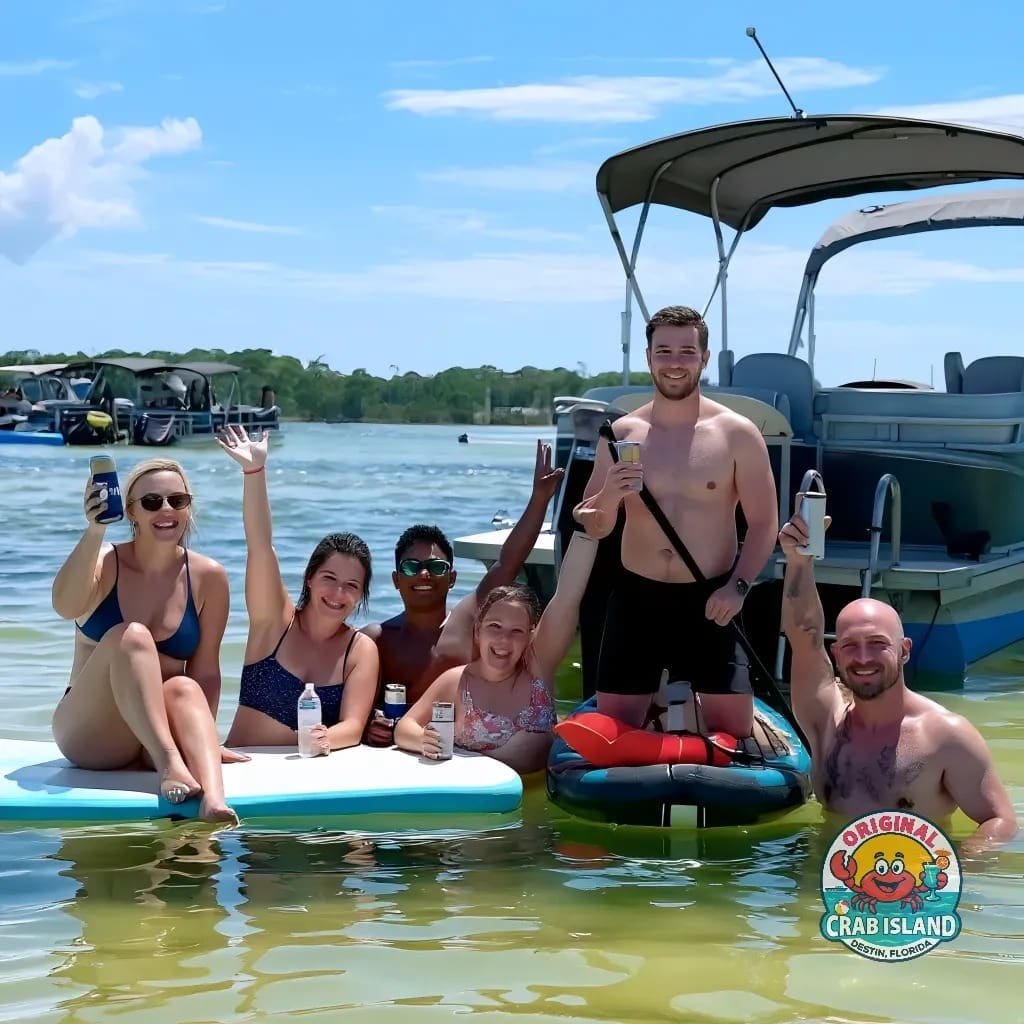 Crab Island is surrounded by no wake zones and idle speed zones, which is a huge part of why the sandbar feels safe even when it’s crowded. Crab Island boating laws around speed are strict, and for good reason.
No wake means your boat moves slowly enough that it doesn’t create a wake behind it. Idle speed means just above engine idle, the slowest your boat can go and still have steering. These zones are clearly marked with signs and buoys around the sandbar, the Destin bridge, the harbor, and most of the channels. Pay attention to them.
Beyond the no wake zones, Florida vessels must operate at a “reasonable and prudent” speed at all times. That language covers a lot of ground, but the bottom line is: don’t haul tail through crowded water, near swimmers, or in poor visibility.
Boater Education Requirements in Florida
Here’s a Crab Island boating laws point that surprises a lot of visitors. Florida law requires anyone born on or after January 1, 1988 to complete a state approved boater safety course to operate a vessel with 10 horsepower or more. You’ll need to carry your boater education ID card and a photo ID while operating the boat.
If you’re renting a boat in Destin and you fall into that age bracket, the rental company will check. Most rentals offer a quick onboard orientation, but the formal course requirement still applies. You can complete the course online in a few hours through Florida Fish and Wildlife approved providers, and it’s good for life.
“Most folks who get tripped up on Crab Island boating laws aren’t trying to do anything wrong, they just didn’t know,” says Captain Mike Smith. “Spend 20 minutes reading the basics or taking the Florida course, and you’re set. After 34 years out here, I can tell you the visitors who know the rules have the best days. Hands down.”
Alcohol and Boating: The Rule That Catches People
Time for the conversation nobody wants but everyone needs. Crab Island boating laws around alcohol are no joke. Florida operates under BUI laws (Boating Under the Influence), and the legal blood alcohol limit for operating a vessel is 0.08, same as driving a car.
Penalties for BUI are serious: fines, jail time, loss of boating privileges, and a permanent record. The Florida Fish and Wildlife Commission patrols Crab Island regularly during peak season, and they will pull you over.
Here’s the simple play: if you want to drink, don’t drive the boat. Designate a sober captain, book a charter, or use a rental service where someone else handles the wheel. Passengers are welcome to enjoy responsibly. The driver stays sober. That’s it.
Navigation Rules and Right of Way
 Crab Island boating laws around navigation follow standard USCG navigation rules, often called “rules of the road.” A quick rundown of the basics:
When two boats are approaching head on, both turn to starboard (right). When crossing paths, the boat on the right has the right of way. Power boats yield to sailboats and to non motorized craft like paddleboards and kayaks. Larger commercial vessels generally have right of way over recreational boats, especially in narrow channels.
Inside the Destin Harbor and around Crab Island, you’ll also see channel markers (red and green buoys) that show you the safe navigable water. The classic memory trick: “red right returning,” meaning when you’re coming back from the Gulf into the harbor, red markers should be on your right.
Anchoring at Crab Island
Anchoring properly is one of those Crab Island boating laws that’s more etiquette than enforcement, but it matters. You can drop anchor pretty freely at the sandbar, but a few rules apply.
Don’t anchor in the marked channels, because that blocks traffic and creates real hazards. Give other boats reasonable space, generally enough that you won’t swing into them as the tide and wind shift. Make sure your anchor is set and holding before you start the party. A drifting boat is a dangerous boat.
Jet Ski Rules
Personal watercraft (jet skis) have their own slice of Crab Island boating laws. Operators must be at least 14 years old in Florida and carry a boater safety ID if born on or after January 1, 1988. Life jackets are required at all times, no exceptions. Operating between sunset and sunrise is illegal for PWCs in Florida. Reckless operation, including jumping wakes within 100 feet of another boat, is prohibited.
If you’re renting a jet ski, the rental company will walk you through these rules. Take that briefing seriously. The rules exist because jet ski crashes are a leading cause of injuries on the bay.
Trash, Wildlife, and Protecting the Bay
A handful of Crab Island boating laws focus on protecting the bay itself. It’s illegal to discharge trash, sewage, or contaminants into Florida waters. Bring trash bags, pack out what you bring in, and use designated pump out stations for marine heads.
Federal law (the Marine Mammal Protection Act) makes it illegal to chase, feed, touch, or harass wild dolphins. The dolphins around Crab Island are protected, and so are the manatees and sea turtles you might see. Watch from a respectful distance and let the wildlife do its thing.
What Happens If You Break the Rules
The Florida Fish and Wildlife Conservation Commission, the US Coast Guard, and local marine patrol all enforce Crab Island boating laws. Violations can mean warnings, fines, suspended privileges, or in serious cases, arrest. None of it is the way you want to spend a vacation day.
The good news is, enforcement officers around here are generally pretty reasonable if you’re clearly trying to do things right. Most stops end with friendly advice rather than tickets.
Show Up Smart, Have a Blast
After 34 years out here, I can tell you Crab Island boating laws aren’t there to ruin your fun. They’re there to make sure everyone gets to have it. Show up prepared, follow the basics, and the bay will reward you with the best day of your trip.
Now go check your life jackets, plan your day, and we’ll see you out on the water. For more options, explore our Crab Island services página.
