
Rip currents are responsible for over 100 drownings in the United States every year, and the Gulf Coast beaches around Destin see their fair share. Knowing how to spot a rip current before you step into the water is one of the most practical safety skills any beachgoer can have, whether you’re wading with your kids near the shore or heading out to Crab Island for the day. At Original Crab Island, we put guests on the water daily, pontoon rentals, jet skis, parasailing, fishing charters, and water safety is something we take seriously. Our staff sees the conditions around Destin’s shoreline and the Emerald Coast firsthand, and we know that a fun day on the water starts with knowing what to watch for. This guide breaks down seven visible signs you can use to identify a rip current from shore before you ever get wet. You’ll learn what to look for in the water’s color, how wave patterns shift, and what the movement of foam and debris is telling you. Each sign is something you can spot with your own eyes, no special equipment needed.
What a rip current looks like in Destin
 Destin’s Gulf water is famously clear and green-tinted, which actually works in your favor when you’re trying to read the surf. A rip current disrupts that visual pattern in ways you can learn to recognize. Knowing how to spot a rip current here is slightly different from other coastlines because the Emerald Coast’s shallow sandbars and clear water make some signs more visible, while the calm appearance of the Gulf on a low-wind day can make others easy to miss.
The water color difference
The most reliable visual cue is a distinct band of discolored water cutting through the normal surf zone. In Destin, a rip current often looks darker than the surrounding water because it’s pulling deeper, sandier water away from the bar. Sometimes it looks brown or murky against the green-blue of the calmer water on either side. 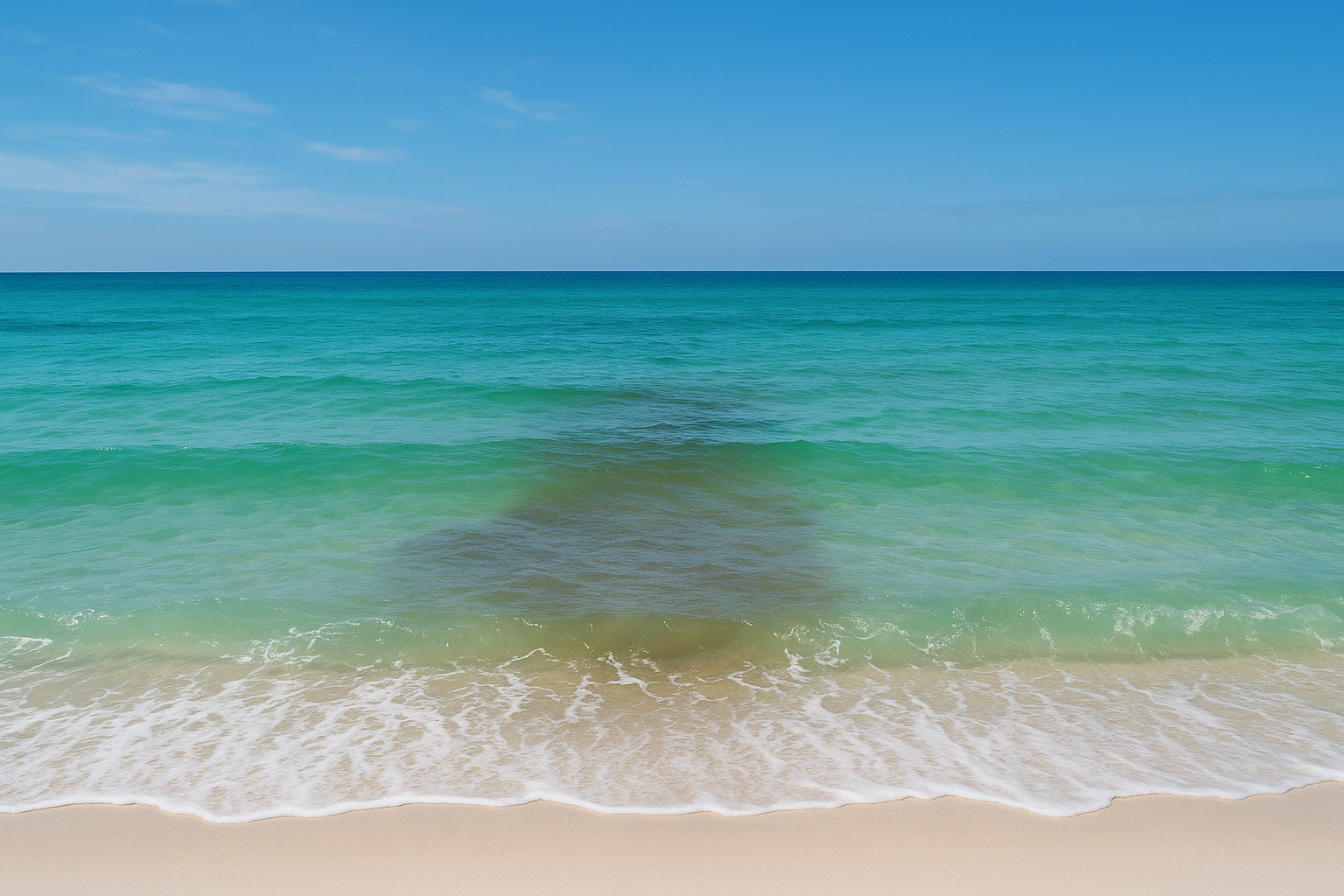
If you see a strip of water that looks a noticeably different color from what’s around it, treat that as a warning until you can rule it out.
This color difference is clearest when you look from an elevated spot, like a beach access boardwalk or a dune, rather than from the waterline. The higher your vantage point, the easier it is to see the full shape of the channel.
Surface texture and foam movement
A rip current also changes the surface texture of the water. While waves around it are breaking and foaming normally, the rip channel often looks choppy, rippled, or even smoother and flatter than the surf on either side. That flat patch in the middle of breaking waves is the current pushing water offshore, suppressing the wave action above it. Watch where foam and floating debris travel. In normal surf, foam moves toward shore. In a rip, it moves steadily away from the beach, often in a straight or slightly curved line out past the break.
Where rips form near Destin and Crab Island
Rip currents don’t form randomly. They need a gap in a sandbar or a break in a submerged structure to push water offshore. Destin’s sandbar system and the shallow flats around Isla del Cangrejo create natural conditions where rips can develop quickly, even on days that look calm from the beach.
Common spots along Destin’s Gulf beaches
The most active formation areas include jetties, piers, and natural breaks in sandbars. Structures like the Destin East Jetty funnel water in ways that concentrate current, and any gap along Henderson Beach or Crystal Beach is a likely spot. Breaks between sandbars are the most common trigger you’ll encounter along this stretch of coast. 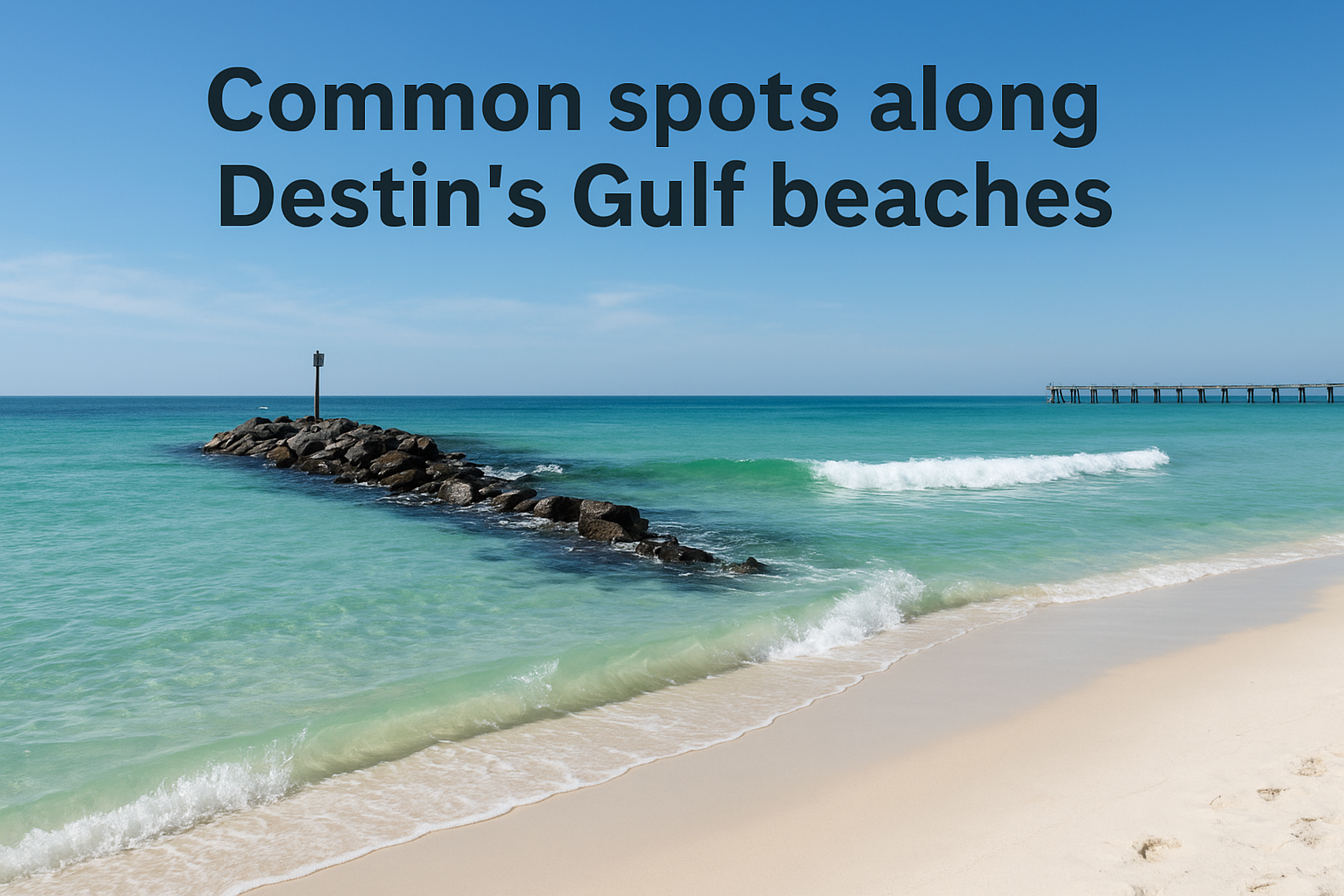
- Near jetties and rock structures
- At natural gaps in sandbars
- Between beach access groins or pilings
- Around the edges of shallow shoals
Near Crab Island and the harbor entrance
Isla del Cangrejo sits in Choctawhatchee Bay rather than the open Gulf, so wave-driven rip currents are less of a concern there. However, strong tidal flow and boat traffic around the sandbar can still create unexpected lateral pulls in the water. Knowing how to spot a rip current matters most on Destin’s Gulf-side beaches, where conditions shift the fastest.
Always check the flag warning system posted at beach access points before you enter the water. Double red flags mean the water is closed to swimmers entirely.
The 7 signs you can spot from the sand
Learning how to spot a rip current comes down to reading a handful of specific visual cues. Each sign below is something your eyes can detect from dry sand before you commit to entering the water.
Scan the surf zone for at least 60 seconds from an elevated spot before you wade in.
The visual checklist
Commit these seven cues to memory and run through them as a quick check every time you approach the Gulf. Spotting even one should prompt you to pick a different entry point or speak to a lifeguard first.
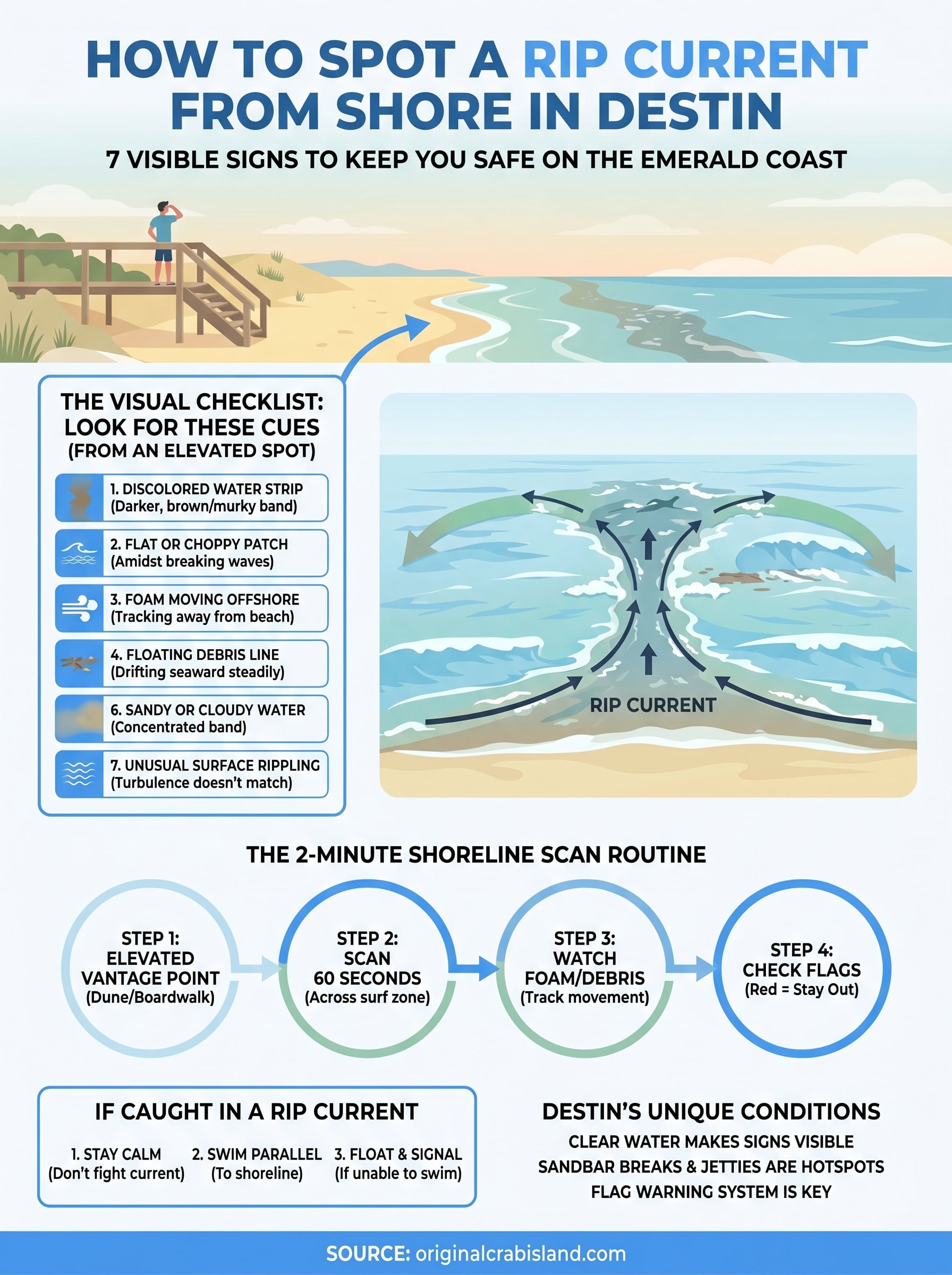
- Discolored water strip – a darker, browner, or murky band cutting through the surrounding green-blue
- Flat or choppy patch cutting through otherwise breaking waves
- Foam moving offshore – tracking away from shore, not toward you
- Floating debris drifting seaward in a steady, defined line
- Gap in the wave break where waves stop forming in a narrow channel
- Sandy or cloudy water concentrated in a distinct band
- Unusual surface rippling or turbulence that doesn’t match the water on either side
These cues frequently cluster together, so seeing two or three at once is a strong signal to stay out of that section of water entirely.
A quick shoreline scan routine
Building a simple habit before you enter the water takes less than two minutes and costs nothing. Knowing how to spot a rip current is only useful if you actually pause and look before you step in. Most people walk straight from their towel to the waterline without stopping, and that is where the risk builds.
The two-minute check before you enter
Start by finding an elevated vantage point, like a dune, a boardwalk ramp, or even just standing on your tiptoes. Height gives your eyes a wider angle across the surf zone. Spend at least 60 seconds watching the water move, not just glancing at it.
Track floating debris or foam for a full minute before deciding whether the water looks safe near your entry point.
Run through this sequence every time:
| Step | What to do | What to look for |
|---|---|---|
| 1 | Scan left to right across the surf zone | Color changes, flat patches |
| 2 | Watch foam and debris movement | Anything drifting offshore |
| 3 | Identify wave gaps | Spots where waves stop breaking |
| 4 | Check posted flag warnings | Red or double-red flags mean stay out |
Repeat this check any time conditions change, including after a storm or a shift in wind direction.
If you get caught in a rip current
Even when you know how to spot a rip current, conditions can change fast or a current can form under your feet while you’re already in the water. Panicking is the most dangerous response you can have, because it burns energy quickly. The rip pulls you offshore, not underwater, and that distinction matters for every decision you make next.
What to do immediately
Stay calm and do not fight the current by swimming straight toward shore. Swimming directly against a rip will exhaust you before you gain any ground. Instead, swim parallel to the shoreline until you clear the channel, then angle back to the beach at a diagonal.
If you cannot swim clear, float on your back, conserve energy, and signal for help by waving one arm above your head.
If someone else is caught
Never enter the water to rescue a struggling swimmer unless you are a trained lifeguard. Throw them something that floats and call 911 immediately. Quick action from shore saves more lives than an untrained water entry.
- Throw a life jacket, a cooler lid, or an inflatable toy
- Shout calm, clear instructions to help them stay focused
- Wave down a lifeguard or call 911 without delay
Quick recap
Knowing how to spot a rip current from shore is a skill you can build in a single afternoon at the beach. Look for discolored water, flat patches in the surf, foam tracking offshore, debris drifting seaward, gaps in the wave break, cloudy bands of sandy water, and unusual surface turbpling. Run through that checklist from an elevated spot before every entry, and check the posted flag system each time you arrive. Your response if you get caught matters just as much as your ability to read the water. Swim parallel to shore, conserve energy, and signal for help rather than fighting the current head-on. Destin’s Gulf beaches offer some of the best water in the country, and a little preparation keeps that experience exactly what it should be. When you’re ready to get out on the water safely, book your next Crab Island adventure with our team. For more options, explore our Destin, fl page. For more options, explore our our services página.
Popular Crab Island Pages
- Alquiler de pontones en Crab Island
- Chárters de pesca en Crab Island
- Crab Island Boat and Yacht Rentals
- Parapente acuático en Crab Island
- Alquiler de motos acuáticas en Crab Island
- Crab Island Helicopter Rides
- Crab Island Snorkeling Tours
- Crab Island Paddleboard Rentals
- Crab Island Kayak Rentals
- Alquiler de bicicletas en Crab Island
- Crab Island Shark Boat
- Crab Island Pirate Ship
- Crab Island Tiki Rentals
- Crab Island Snorkeling Tours


