Everything You Need to Know About Destin Pontoon Rentals
 Planning a trip to Crab Island sounds simple enough—until you start researching pontoon rentals in Destin and realize there are dozens of companies, confusing pricing structures, and licensing requirements nobody mentioned until now.
The reality is that renting a pontoon boat in Destin involves more decisions than most visitors expect. Location affects your travel time to Crab Island by up to 40 minutes roundtrip. Pricing varies by $100 or more depending on when and where you book. And Florida law requires certain renters to obtain a boating certificate before they can legally operate a vessel.
This article breaks down everything that matters when renting a pontoon in Destin—the real costs including hidden fees, which harbor locations actually save time, what Florida requires before you can drive a boat, and how to plan a Crab Island experience worth the investment. Whether you’ve never operated a pontoon or you’re a regular looking for better options, you’ll find the practical information needed to make smart decisions.
The Real Cost of Destin Pontoon Rentals
Destin pontoon rentals typically cost $350-$425 for four hours or $500-$625 for eight hours. Most boats accommodate 10-12 passengers and include fuel, safety equipment, and basic amenities. The closest rentals to Crab Island depart from Destin Harbor, positioning you just 5-10 minutes away by boat.
Half-day rentals (4 hours) run $350-$425 for standard pontoons and $450-$550 for double-deckers with slides. Full-day options (8 hours) cost $500-$625 for standard boats or $650-$850 for double-deckers. Peak season from June through August adds another $50-$100 to these baseline rates.
Location creates significant price variations. Destin Harbor locations command premium rates but put you closest to Crab Island at 5-10 minutes away. Okaloosa Island rentals take 15-20 minutes to reach Crab Island but cost $50-$75 less. Fort Walton Beach offers the most affordable rates with a 25-30 minute travel time to the sandbar.
The advertised rate doesn’t tell the complete story. Rental companies place a $500-$1,000 authorization hold on your credit card for potential damages—this isn’t charged unless something breaks, but it affects your available credit during the trip. Optional extras like lily pads ($50-$75), paddleboards ($25-$50 each), and captain services ($100-$200) can push total costs higher.
Smart renters calculate per-person expenses to determine value. A $400 half-day rental for six people breaks down to $67 per person—comparable to many guided tours. That same rental for 10 people costs just $40 each, making pontoon rentals one of the most affordable water activities when you maximize capacity.
Florida’s Boating License Requirements
Anyone operating a pontoon rental in Florida must be at least 18 years old with valid photo identification. More importantly, anyone born on or after January 1, 1988 needs a NASBLA-approved boating safety certificate to legally operate any motorized vessel in Florida waters.
This licensing requirement catches many tourists unprepared. Rental companies verify credentials before handing over keys, and marine patrol officers routinely stop boats to check compliance. The regulation exists because Florida experiences one of the nation’s highest boating accident rates.
The good news? Florida offers a temporary boating safety certificate that takes most people 2-3 hours to complete online. The process costs $10-15 and provides immediate certification valid for 90 days.
TakeMyBoatTest.com offers the official Florida temporary certificate. The online course covers navigation rules, safety equipment requirements, emergency procedures, and right-of-way scenarios. The system saves progress automatically, allowing breaks as needed. The final exam requires 80% to pass and remains open-book. Most people pass on the first attempt, and failed tests can be retaken immediately at no additional cost.
Digital certificates arrive via email within minutes of passing. Rental companies accept both printed copies and phone screenshots, though having both provides backup in case one becomes unreadable.
Common mistakes include waiting until rental day to complete certification (technical issues or test anxiety can cause delays), assuming other state licenses satisfy Florida requirements (they often don’t), and forgetting to check expiration dates on temporary certificates (they expire exactly 90 days from issue).
Renters born before 1988 skip the licensing requirement entirely, though many Destin pontoon rental companies still mandate orientation videos and signed waivers acknowledging basic boating rules.
Location Makes a Bigger Difference Than Expected
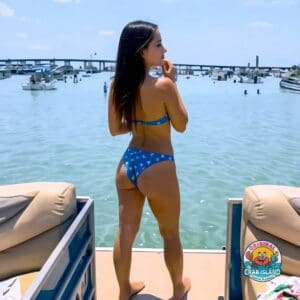 Where you rent your pontoon affects more than just the drive to the marina—it determines how much time you actually spend at Crab Island versus traveling back and forth.
Destin Harbor sits closest to Crab Island at typically 5-10 minutes by pontoon. Major rental companies cluster along Harbor Boulevard, providing easy access to restaurants, shops, and parking. The convenience comes at premium prices around $375-$425 for four-hour rentals. First-time renters and families with small children often find the shorter travel time and accessible location worth the extra expense.
Okaloosa Island positions renters 15-20 minutes from Crab Island while offering rates $50-$75 below Destin Harbor. The route travels through scenic Santa Rosa Sound, providing calmer waters and frequent dolphin sightings. Rental facilities here tend toward smaller operations with more personalized service. The location works particularly well for visitors staying on Okaloosa Island or in Fort Walton Beach who want to avoid Destin traffic.
Fort Walton Beach delivers the most affordable rentals—often $75-$100 less than Destin Harbor rates—but requires 25-30 minutes to reach Crab Island. The extended journey passes through pristine waterways where dolphins and sea turtles appear regularly. Many renters appreciate the longer cruise and use Fort Walton departures to explore quieter destinations like Spectre Island or Joe’s Bayou before joining Crab Island’s crowds.
A 20-minute difference in location means losing 40 minutes of a four-hour rental to travel. That’s swimming time, relaxation time, and exploration time that disappears into transit.
Original Crab Island operates from one of the closest possible locations to Crab Island in Destin Harbor. The proximity translates to less fuel consumption, more water time, and flexibility for multiple trips if supplies run out or bathroom breaks become necessary. The shorter distance also matters when summer afternoon storms roll in—returning to dock takes minutes rather than racing dark clouds from across the bay.
What Comes with Your Rental
Every legitimate pontoon rental includes fuel, Coast Guard-approved life jackets for all passengers, required safety equipment (fire extinguisher, horn, navigation lights), a bimini top for shade, anchor with rope, and a boarding ladder. These items are legally mandated and shouldn’t incur additional charges.
The bimini top covers approximately 60% of the boat, providing partial shade during 4-8 hour trips. Most boats include Bluetooth stereo systems, though this warrants verification before booking if music matters to your group. Fuel tanks come full and return full—fuel costs are included in rental prices, unlike jet ski rentals that often charge separately.
Life jackets are provided in sizes from infant to adult XXXL. They’re not required while anchored, but must remain easily accessible. Children under six years old must wear life jackets anytime the engine runs—not just while moving, but whenever it’s on.
Renters must provide their own coolers, food, and drinks. Boats lack refrigeration, so everything requires ice-packed coolers. Most rental companies allow use of their ice machines before departure. Multiple coolers keep drinks and food organized during all-day trips.
Sun protection determines whether the day ends pleasantly or painfully. Water reflection intensifies UV exposure even under the bimini top. Reef-safe sunscreen (required in some areas), hats with chin straps (regular ones blow off), and UV-protective clothing for children are essential. Sunscreen should be reapplied every 90 minutes minimum.
Water toys create the memorable moments. Floats, noodles, snorkel gear, paddleboards, and water footballs turn anchored time into entertainment. Crab Island’s firm sandy bottom and waist-deep water make it perfect for active play. Waterproof phone cases protect devices while capturing photos.
Additional towels, dry bags for valuables, and trash bags for cleanup round out the essentials. Rental companies appreciate boats returned clean and sometimes offer faster checkout as a result.
Optional add-ons like lily pads ($50-$75) extend the boat’s swim area with giant foam floating mats. Paddleboards ($25-$50 each) enable exploration beyond the anchored boat. Captain services ($100-$200 additional) mean a licensed operator handles all navigation and docking—ideal for groups planning to drink, nervous first-timers, or anyone wanting to fully relax.
Understanding Crab Island Timing
Crab Island isn’t actually an island—it’s a submerged sandbar where Gulf waters meet Choctawhatchee Bay. The unique geography creates shallow, calm waters while maintaining enough depth for boats to anchor nearby.
Arriving between 10am-2pm provides the best anchoring spots and peak activity. Tide timing dramatically affects the experience. At low tide, the sandbar emerges with water only 1-3 feet deep across large areas. Visitors can walk around, play beach games, and children wade safely. This is optimal for families with young kids.
At high tide, water depths reach 3-5 feet across most of the sandbar. The increased depth allows more boats to anchor close together, creating the famous “floating party” atmosphere. Floating vendors circulate more easily, and inflatable water parks operate at full capacity.
Destin’s tide difference ranges 1-2 feet, but that’s enough to completely transform Crab Island. Experienced renters often time arrival for rising tide—anchoring during calm low tide, then enjoying increasing activity as tide rises and more boats arrive.
Navigation from Destin Harbor requires heading east under the Marler Bridge. Marked channels use green markers on the right and red markers on the left when heading toward the Gulf—opposite the usual “red right returning” rule because you’re departing port.
No-wake zones extend from docks through the harbor and under the bridge. Boats must idle at 5mph or less in these areas. Once past the bridge, speeds can increase while remaining alert for jet skis, kayakers, and converging boat traffic.
Crab Island appears as a massive cluster of anchored boats on the north side of East Pass. Approaching slowly is critical—swimmers, paddleboarders, and children on floats surround every anchored vessel.
Beyond Crab Island: Hidden Destinations
 Norriego Point on Okaloosa Island’s eastern tip offers sugar-white sand beaches without Crab Island’s crowds. Water depth allows anchoring 50-100 feet offshore, then swimming or paddling to the beach. Dolphins feed in the pass here frequently, especially during early morning or late afternoon. The beach has no facilities, making it feel like a private island. This spot shines on weekends when Crab Island becomes overwhelming.
Joe’s Bayou off Harbor Boulevard provides calm, protected waters ideal for families with very young children or anyone seeking quiet escape. The bayou rarely experiences waves, making it perfect for first-time pontoon operators practicing anchoring and maneuvering. There are no floating vendors or party atmosphere—that’s the point. Locals visit when they want peaceful water access without chaos.
Spectre Island in Santa Rosa Sound near Fort Walton Beach features an actual beach for walking. This small, undeveloped island has pure white sand and typically hosts fewer than a dozen boats even on busy days. The 20-minute ride from Destin keeps crowds minimal. Clear water around Spectre Island offers better underwater visibility than Crab Island, with opportunities to spot crabs, small fish, and starfish in sandy shallows.
Operating Your Pontoon Safely
Pontoon boats feature simple controls—a steering wheel, throttle lever (push forward for acceleration, pull back for reverse or slowing), and an ignition key. The vessels handle like large cars but respond more slowly, requiring extra time and distance for all maneuvers.
Every rental begins with mandatory safety briefings from dock staff covering ignition, steering, throttle, trim adjustments, and emergency shut-off procedures. Navigation basics include reading channel markers, understanding no-wake zones, and recognizing other boats’ right-of-way. Emergency procedures outline responses to engine failure, running aground, overboard situations, or severe weather.
Leaving the dock requires starting the engine (with safety lanyard attached), letting it warm 30-60 seconds, then untying after everything’s ready. Boats drift quickly even in light wind. Maneuvering from the slip demands patience—pontoons turn slowly and need distance to stop. Idle speed works best in tight quarters, with short reverse bursts to stop momentum.
Channel markers guide safe passage through deep water. Staying between markers toward the channel middle avoids shallow areas that can ground boats. Lighter colored water indicates sandy bottom near the surface. If water changes from dark blue-green to light green-tan, shallow depths are approaching.
Anchoring at Crab Island requires approaching slowly from downwind when possible. Circling once scouts for openings between anchored boats. Adequate space prevents swinging on anchor from hitting neighboring vessels—roughly 30-40 feet of clearance in all directions.
Position where you want to end up, then motor slowly forward about 50-75 feet past that spot. This positioning ensures the anchor lands ahead of final resting position as the boat naturally drifts back when the anchor sets.
Lower (don’t throw) the anchor from the bow while the boat drifts backward. Let out anchor rope slowly. The rope-to-depth ratio should be 5:1 for best holding—in 5 feet of water, let out 25 feet of rope.
Set the anchor by briefly engaging reverse, pulling against it to dig into sand. Test the hold by observing whether position changes relative to nearby boats. Mark a reference point and check every 15-20 minutes initially.
Common Mistakes Renters Make
- Waiting too long to book tops the mistake list. Summer weekends sell out 3-4 weeks ahead at popular companies. Options remain for last-minute bookings, but not necessarily at preferred times or price points.
- Choosing wrong boat sizes creates discomfort. Maxing out capacity—like putting 12 adults on a 12-person pontoon—leaves no room for coolers, bags, or movement. Eight to ten adults are more comfortable on boats rated for twelve.
- Arriving at Crab Island after 1pm on weekends means fighting for anchor space in crowded conditions. The best spots go early. Weekend morning rentals (8am-12pm or 9am-1pm) allow arrival by 10am for easy anchoring and space to spread out.
- Inadequate sun protection sends vacationers back burned and miserable. Marine environments intensify UV exposure through water reflection. SPF 50+ reef-safe sunscreen applied 30 minutes before departure and reapplied every 90 minutes is essential, along with UV-protective clothing.
- Forgetting anchor setup sounds absurd but happens regularly. Groups get excited, jump in the water, and suddenly realize the boat’s drifting because nobody dropped the anchor. Assigning one person as “anchor master” ensures proper setup before anyone enters the water.
- Underestimating time requirements causes rushed, stressful returns. Budget 15 minutes to leave Crab Island (pull anchor, gather everyone, clean up), 10-15 minutes transit to harbor, and 10 minutes to dock and check in. A four-hour rental ending at 2pm means leaving Crab Island by 1:20pm, not 1:50pm.
- Not testing anchor hold leads to drifting boats. After anchoring, turn off the engine and watch for five minutes. Pick a landmark and see if position changes relative to it. If drifting occurs, re-anchor before everyone enters the water.
- Ignoring changing weather endangers everyone. Storms visible 10 miles inland can arrive in 30 minutes. Dark clouds building, lightning flashes (even distant), or sudden wind changes require immediate return to dock.
- Running out of drinking water causes dehydration headaches. The combination of sun, heat, saltwater, and physical activity dehydrates faster than normal. Plan for at least one liter per person for four-hour rentals, two liters for eight hours.
What Sets Quality Rentals Apart
The difference between average and exceptional pontoon rentals extends beyond the boat itself. Original Crab Island has built reputation on understanding what renters actually value and delivering consistently.
Operating from one of the closest possible locations to Crab Island means departure points that reach the sandbar in under 10 minutes. On four-hour rentals, saving 15-20 minutes each way compared to distant locations provides 30-40 more minutes at Crab Island. That’s time for another swim session, more water toy activities, or simply relaxation without rushing.
Closer proximity improves fuel efficiency. While fuel is included in rentals, shorter distances mean companies spend less on fuel—savings they can pass to customers through competitive pricing or better-maintained boats. Weather flexibility matters when afternoon storms threaten. Being 8 minutes from dock rather than 25 minutes provides critical safety margin for monitoring weather and returning before conditions deteriorate.
Fleet quality shows in boat conditions. Walking any Destin harbor reveals clear differences between companies. Well-maintained newer vessels with consistent upgrade cycles outperform 15-year-old pontoons that have been repeatedly patched and repainted. Daily inspections catch small issues before they become on-water problems. Upholstery stays clean and intact, bimini tops lack tears or stuck zippers, and engines start reliably.
Modern amenities like Bluetooth stereos that actually connect, USB charging ports for phones, and upgraded seating that stays comfortable during long rentals seem minor until you’re three hours in with a dead phone and fuzzy radio.
Pre-rental communication sets clear expectations about what to bring, what’s included, check-in procedures, and weather policies. This proactive approach eliminates day-of surprises that derail plans. Dock staff expertise shows in how they brief first-timers—taking time to ensure understanding of navigation, safety procedures, and common situation handling rather than rushing through liability waivers.
Concierge-level service extends to loading coolers, suggesting anchoring spots based on current conditions, and providing local insights about dolphin locations or less-crowded areas. These touches transform transactional boat rentals into hosted experiences.
Flexible policies accommodate vacation plan realities. Weather changes, flight delays, and family emergencies happen. Companies prioritizing customer satisfaction over squeezing every dollar from non-refundable bookings earn loyalty and recommendations.
Years of specializing exclusively in Crab Island access teach what renters actually value versus what sounds good in marketing. Streamlined check-in with online waivers completed beforehand, pre-assigned boats, and efficient dock procedures mean departing within 15 minutes of scheduled times.
Real local knowledge from staff who live in Destin and boat these waters regularly provides insights about which days will be overwhelming versus enjoyable, where to anchor for morning sun or afternoon shade, and which floating vendors serve the best food. Honest guidance about whether pontoon rentals suit specific needs means some groups hear they’re better served by captained tours, kayak rentals, or beach days rather than automatic pontoon bookings.
Community reputation built over years of consistent service results in recommendations from other boaters, locals, and tourism professionals. That reputation requires daily earning through reliable service, not marketing spend.
Making Smart Boat Rental Decisions
Choosing the right Destin pontoon rental transforms from overwhelming decision to straightforward process once you understand what actually matters. Location proximity to Crab Island, transparent pricing, proper licensing, and rental companies prioritizing experience over transactions make the difference between good days and great days on the water.
Location saves more money than expected through time efficiency and fuel costs. Florida’s boating license requirement is non-negotiable but easily handled with 2-3 hours of online work. Weather dictates experience more than boat size or rental duration—respect it accordingly. Crab Island’s appeal multiplies when you know about alternative destinations like Norriego Point or Spectre Island for quieter moments.
Check tide charts before booking. Reserve boat rentals 2-3 weeks ahead for summer weekends. Complete boating certificates if needed. The emerald waters and unforgettable experiences of Destin’s Crab Island await.