Stepping onto a pontoon boat for the first time can feel intimidating, especially when you’re handed the keys and expected to navigate open water. But here’s the good news: learning how to drive a pontoon boat step by step is genuinely straightforward, and these flat-decked vessels are among the most forgiving boats for beginners. At Original Crab Island, we put first-time captains behind the wheel every day on our Destin pontoon rentals, and we’ve seen just how quickly people go from nervous to confident.
Whether you’re planning to cruise out to Crab Island, explore the Emerald Coast with family, or simply enjoy a relaxed afternoon on the water, understanding the basics before you go makes the experience far more enjoyable. You don’t need prior boating experience, just a willingness to learn and respect for the water.
This guide breaks down everything you need to know: from pre-departure checks and starting the engine to steering, docking, and following basic rules of the waterway. By the end, you’ll have the practical knowledge to handle a pontoon boat with confidence on your next trip to Destin.
Before you start: prep, safety, and basic terms
Before you turn the key, you need to understand what makes a pontoon boat tick and what keeps everyone aboard safe. Learning how to drive a pontoon boat step by step starts well before you touch the throttle. You’ll want to familiarize yourself with basic safety equipment, essential terminology, and a quick pre-departure checklist that takes just minutes but prevents hours of headaches on the water.
Essential safety gear and documents
Your pontoon boat must carry specific safety equipment required by the U.S. Coast Guard. You need one properly fitted life jacket for every person aboard, plus a throwable flotation device like a cushion or ring buoy. Check that your fire extinguisher is charged and accessible, especially since you’re operating a vessel with a motor and fuel system. Sound-producing devices (a horn or whistle) are mandatory for signaling other boats.
Rental companies typically handle this for you, but if you’re operating a personal boat or borrowed vessel, you must verify everything is aboard. Beyond gear, confirm that the boat registration is current and displayed properly. You also need to know who’s legally allowed to drive: many states require boaters to complete a safety course and carry a boater education card on the water.
Always verify that all required safety equipment is present and functional before leaving the dock.
Basic pontoon terminology you need to know
Understanding boat language helps you communicate clearly and follow instructions from dock staff or other boaters. The bow is the front of your pontoon, while the stern is the back. When you face forward, port refers to your left side and starboard means your right. These terms stay consistent regardless of which way you turn.
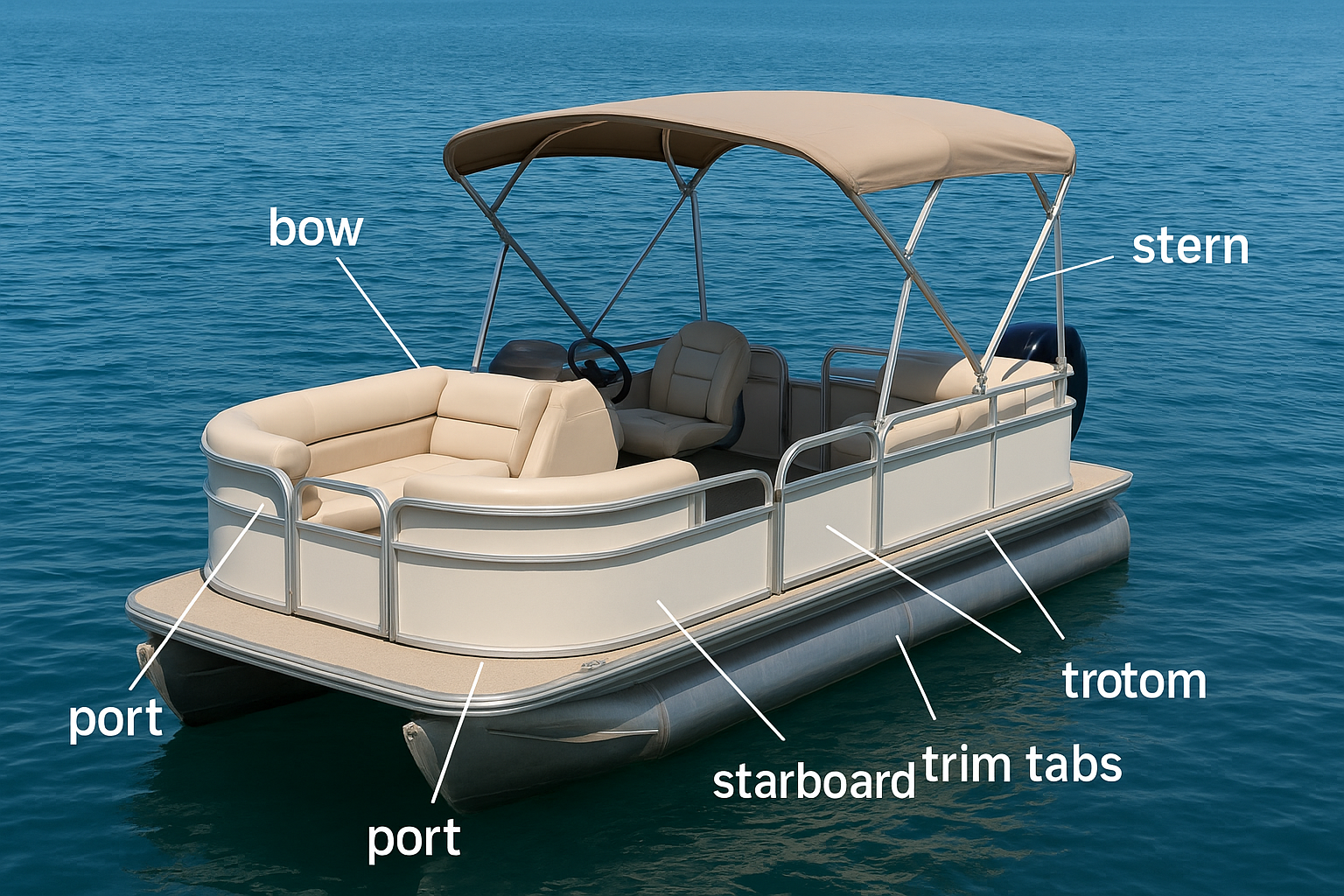
The helm is your driving station where the steering wheel and controls sit. Your throttle controls engine speed and sits near the wheel, usually as a push-forward lever. The trim tabs or engine trim adjust your boat’s angle in the water for optimal performance. Most pontoons feature outboard motors mounted at the stern, though some larger models use sterndrive or inboard engines.
Pre-departure visual checks
Walk around your pontoon before starting the engine. Look for any obvious damage to the tubes (the aluminum pontoons underneath), loose railings, or anything that seems out of place. Check that your battery is connected and the fuel tank shows adequate levels for your planned trip.
Make sure all loose items are secured and nothing will slide around once you’re moving. Verify that your anchor and line are properly stowed but accessible. Confirm that drain plugs are tight and you’re not taking on water. These quick visual checks take under five minutes but catch problems while you’re still safely tied to the dock:
- Inspect pontoon tubes for dents or damage
- Verify battery connections are tight
- Check fuel level and oil (if applicable)
- Ensure drain plugs are secure
- Confirm anchor is aboard and line is coiled
- Check that steering wheel turns freely
- Look for any loose equipment or trash
Step 1. Start the boat and run quick checks
Now that you understand the basics, it’s time to bring your pontoon to life. Starting the engine is the first physical step in learning how to drive a pontoon boat step by step, and the process follows a simple sequence that you’ll repeat every time you go out. You need to start the blower motor first (if your boat has one), verify all systems respond correctly, and confirm that your engine fires up without issues before you untie a single line.
Starting the engine properly
Locate your ignition key at the helm and check that the throttle sits in neutral. Most pontoons feature a clear neutral position marked on the control panel. Before turning the key, you must run the blower motor for at least four minutes if your boat has an enclosed engine compartment or uses an inboard motor. This ventilates any fuel vapors that could ignite when you start the engine.
Turn the key to the "on" position and watch your gauge cluster light up. You should see readings for fuel level, battery voltage, and engine hours. Now turn the key fully to engage the starter. Your outboard motor should fire up within a few seconds and settle into a steady idle around 600-800 RPM. If the engine doesn’t start immediately, wait 10 seconds before trying again to avoid flooding it.
Always run your blower for the full required time before starting the engine to prevent explosive fuel vapor buildup.
Verify all systems work
Once your engine runs smoothly, check that your steering responds by turning the wheel fully left and right. You should feel resistance but smooth movement throughout the entire range. Test your horn or sound device to confirm it works. Glance at your gauges again and verify that oil pressure (if equipped) reads normal and your battery shows adequate charge.
Check your navigation lights if you plan to be out near dusk, and verify that your bilge pump activates when you flip its switch. These quick functional checks take under 30 seconds but catch electrical problems before you leave the safety of the dock.
Step 2. Pull away from the dock and idle out

Getting away from the dock is where your practical boat handling truly begins. This step in learning how to drive a pontoon boat step by step requires coordination between your hands and your spatial awareness. You need to understand how your boat responds to throttle input and steering while moving at slow speeds, and you must clear the dock area without hitting other vessels, pilings, or the dock itself. Your pontoon handles differently than a car, so expect a learning curve as you get used to the way it drifts and turns.
Untie lines and push off correctly
Have your passengers remain seated while you prepare to depart. Untie the stern line first, then move to the bow and release that line. If wind or current pushes your boat against the dock, you may need someone to physically push the bow away from the dock as you step aboard. Never try to use your engine’s power to pull away while still tied up, as this strains your cleats and could damage both boat and dock.
Once all lines are free and coiled on deck, use your hands or a boat hook to push off gently from the dock. Create at least two feet of clearance between your boat and any fixed objects before you touch the throttle. If other boats sit close by, take extra time to ensure you have room to maneuver without contact.
Engage forward gear and idle out slowly
Place your hand on the throttle lever and push it forward gently until you feel it click into forward gear. Your engine will engage with a subtle clunk, and the boat will begin moving ahead slowly. Keep your throttle at idle speed (the lowest forward position) as you navigate away from the dock area.
Your pontoon turns wide, so start steering early if you need to avoid obstacles. Point your bow toward open water and maintain idle speed until you clear all no-wake zones, docks, and moored boats. Watch behind you occasionally to ensure your stern clears everything as you turn:
- Push throttle forward one click into gear
- Keep RPMs under 1000 in congested areas
- Steer gradually and anticipate wide turns
- Watch both bow and stern clearance
- Maintain idle until you reach open water
Always idle out slowly through congested dock areas and no-wake zones to maintain full control and avoid creating damaging wakes.
Step 3. Drive safely in open water and follow rules
Once you clear the no-wake zone, you can accelerate and truly experience what makes how to drive a pontoon boat step by step such an accessible skill. Open water driving requires you to balance speed with awareness, maintain proper lookout, and follow basic navigation rules that prevent collisions. Your pontoon handles predictably at cruising speeds, but you need to understand how wind, waves, and current affect your course. You also must respect other boaters by following established right-of-way rules and maintaining safe distances.
Understanding throttle and steering control
Push your throttle forward gradually to increase speed. Your pontoon accelerates smoothly, and most models cruise comfortably between 15 and 25 miles per hour. Avoid jamming the throttle to full power immediately, as this creates unnecessary strain on your engine and wastes fuel. Find a comfortable cruising speed where your boat planes efficiently and feels stable.
Steering requires a gentle touch at speed. Your pontoon responds more quickly than when idling, so make small steering corrections rather than large wheel movements. If you need to turn sharply, reduce your speed first to prevent passengers from sliding across the deck. When crossing wakes from other boats, slow down and approach them at a 45-degree angle to minimize the impact.
Navigation rules and right-of-way
Boats approaching head-on must both turn to starboard (right) to pass port-to-port, just like cars passing on a two-lane road. When two boats approach at an angle, the vessel on your starboard side has right-of-way, meaning you must slow down or alter course to pass behind them. Sailboats, kayaks, and paddleboards always have right-of-way over powerboats.
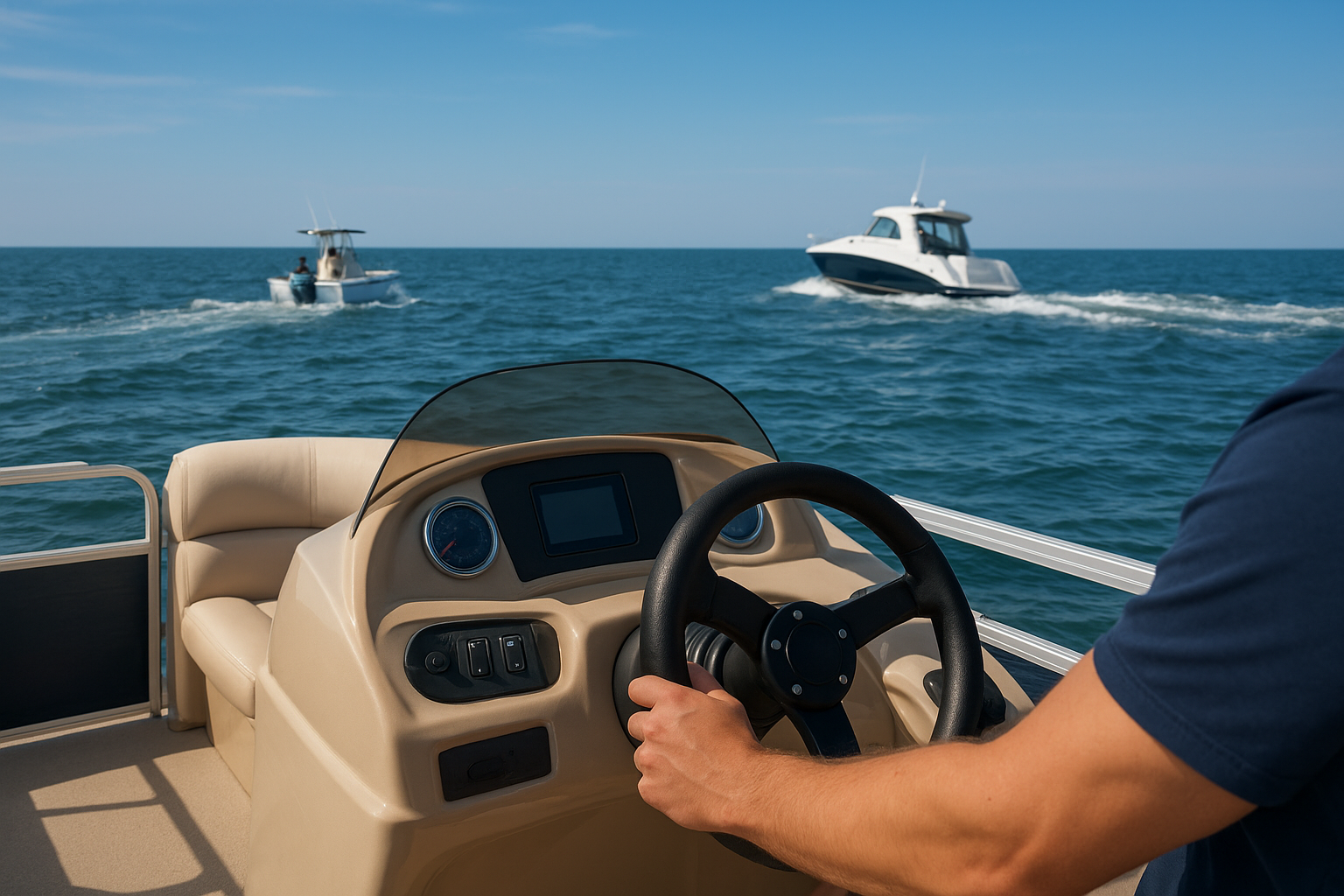
Always give sailboats, human-powered vessels, and boats restricted in their ability to maneuver the right-of-way, regardless of your position.
Maintain a safe distance from other boats, swimmers, and fixed objects. Keep at least 100 feet from divers-down flags and stay clear of fishing lines. Watch constantly for hazards like floating debris, shallow water markers, and sudden weather changes.
Step 4. Return, dock, tie up, and shut down
Returning to the dock completes your journey and tests your ability to control your boat at slow speeds in tight spaces. This final step in learning how to drive a pontoon boat step by step requires patience and precision, as you reverse the departure process while accounting for wind and current. Your goal is to bring your boat alongside the dock smoothly without bumping or scraping, secure it properly with dock lines, and shut down all systems safely. Rushing this step causes most docking accidents, so take your time and don’t let onlookers pressure you into moving faster than feels comfortable.
Approach the dock at idle speed
Slow to idle speed well before you reach the dock area. Position your boat to approach at a 30 to 45-degree angle to the dock, aiming your bow toward where you want to end up. Watch how wind and current push your boat and compensate by steering slightly into them. When you get within 10 feet of the dock, shift into neutral and let your momentum carry you the rest of the way.
If you come in too fast, shift into reverse briefly to slow yourself down. Your stern will swing wide when you reverse, so account for this. Have a passenger ready with fenders positioned between your boat and the dock to prevent scratches. Once alongside, shift immediately to neutral and let someone step off to hold the boat steady.
Approach every dock at idle speed with neutral gear ready, as momentum carries your heavy pontoon further than you expect.
Secure dock lines and shut down
Tie your bow line first by looping it around a dock cleat in a figure-eight pattern and securing it with a half hitch. Then secure your stern line the same way. Your lines should hold the boat snug against the dock without being overtight, allowing for minor water level changes. Cross your lines if possible for added stability:
- Loop line around cleat base in figure-eight
- Pull tight to remove slack
- Finish with half hitch over the top
- Check that knot holds firm
Turn your ignition key to the off position and remove it. Switch off all electronics, lights, and accessories to preserve battery power. Raise your outboard motor if in shallow water or if instructed by dock staff. Check that you’ve removed all trash and personal items before leaving.
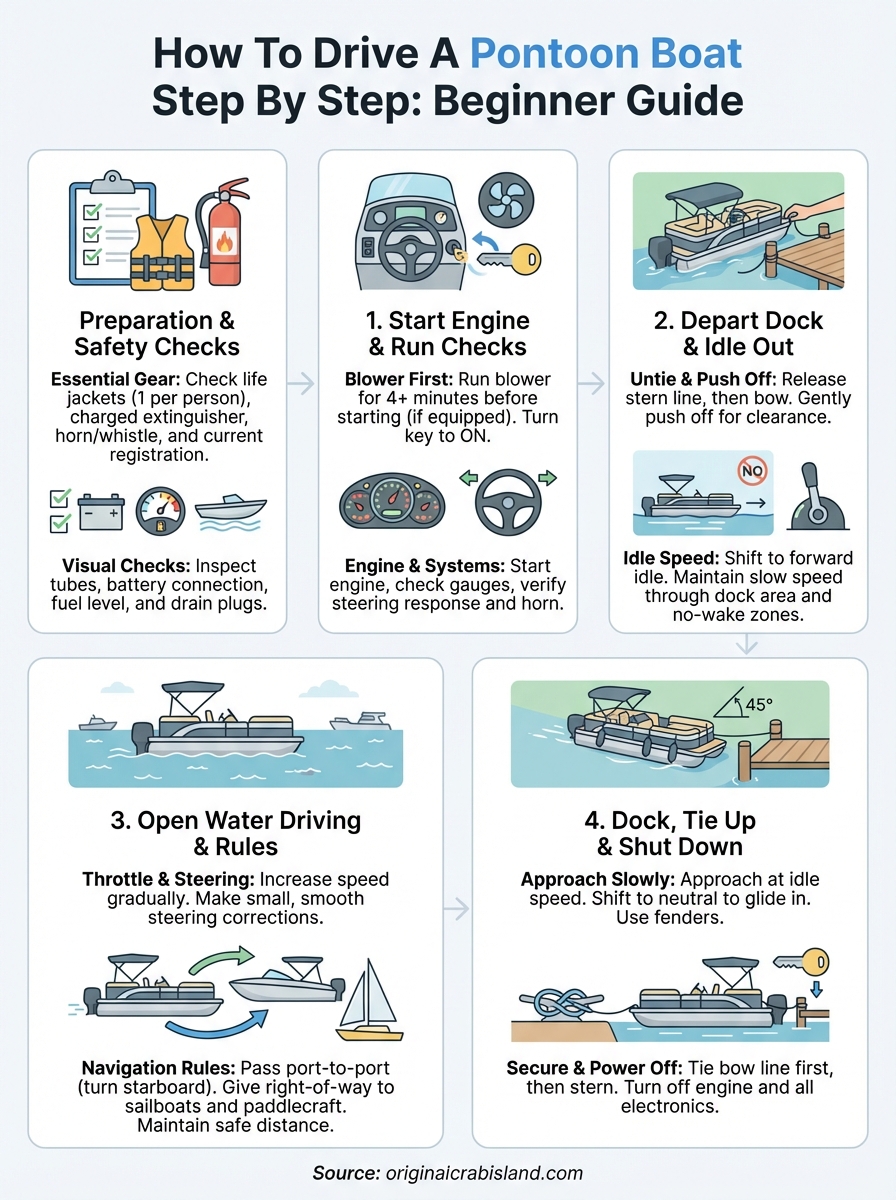
Quick recap before you go
You now understand how to drive a pontoon boat step by step, from starting your engine and checking safety equipment to navigating open water and docking confidently. The process becomes second nature after just one or two trips, and pontoons remain the most forgiving boats for beginners to learn on. Remember to always run your blower before starting, idle through no-wake zones, maintain proper lookout in open water, and approach docks slowly with neutral gear ready.
Your first solo drive might feel nerve-wracking, but trust the process you’ve learned here. Focus on smooth, gradual movements rather than sudden throttle changes, and you’ll handle your boat like you’ve been doing it for years. Ready to put these skills to work? Experience Crab Island with Original Crab Island on one of our well-maintained pontoon rentals, where you’ll get hands-on support from our team before heading out to explore Destin’s most famous sandbar.